
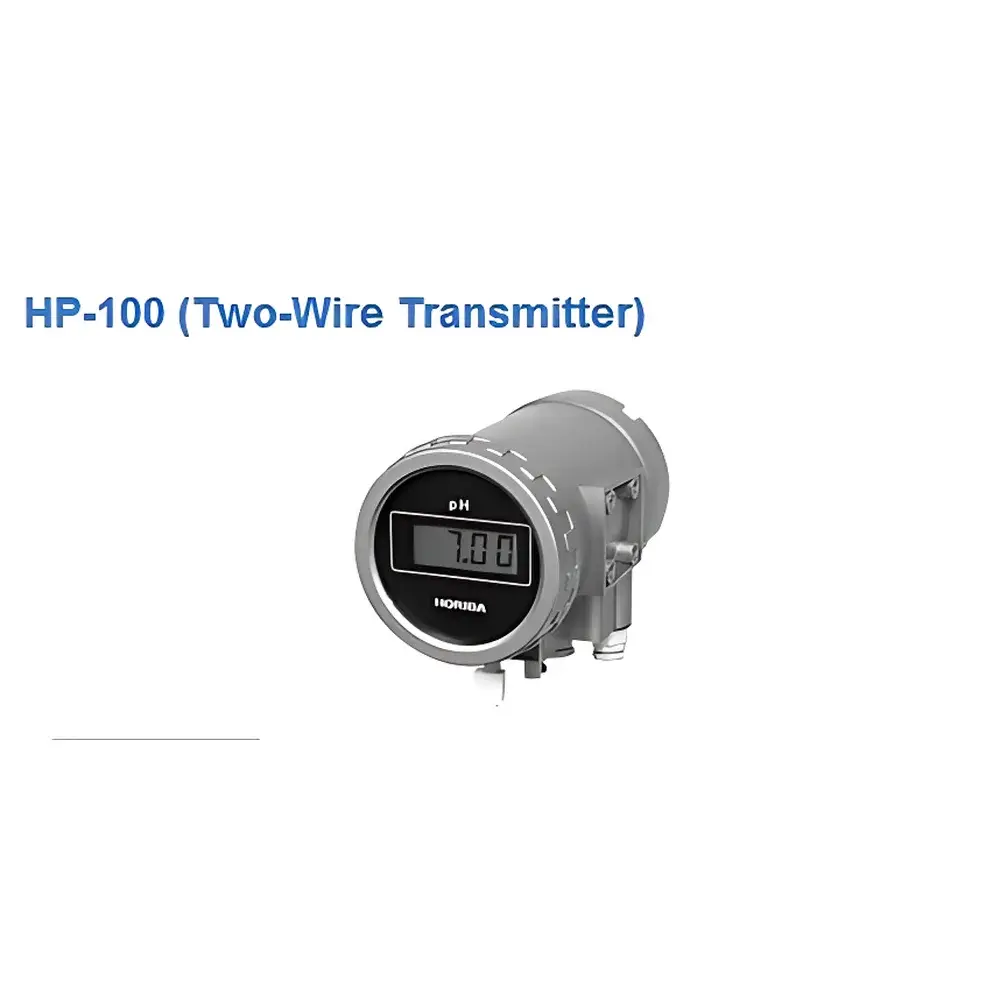
HORIBA HP-100 Industrial Online pH Meter
| Brand | HORIBA |
|---|---|
| Origin | Japan |
| Model | HP-100 |
| Measurement Principle | Glass Electrode Method |
| pH Range | 0–14 |
| pH Repeatability | ±0.05 pH (max) |
| Output Signal | 4–20 mA DC (max load resistance: 500 Ω) |
| Power Supply | 22.5–30 V DC (nominal 24 V DC) |
| Power Consumption | ~0.48 W |
| Temperature Compensation Range | 0–100 °C |
| Ambient Operating Temperature | −10 to +50 °C |
| Temperature Sensor | Pt1000 (at 0 °C) |
| Enclosure Rating | IP65 |
| Compliance | CE, FCC, RoHS, WEEE |
Overview
The HORIBA HP-100 Industrial Online pH Meter is a rugged, field-deployable process analyzer engineered for continuous, high-stability pH monitoring in demanding industrial and environmental water quality applications. Based on the potentiometric glass electrode principle—where pH is determined by measuring the electromotive force (EMF) generated across a hydrated pH-sensitive glass membrane relative to a stable reference electrode—the HP-100 delivers reliable, traceable measurements under variable flow, temperature, and chemical exposure conditions. Designed specifically for permanent outdoor installation in wastewater treatment plants, chemical process lines, cooling water systems, and effluent discharge points, it operates without requiring frequent recalibration or manual intervention. Its architecture adheres to fundamental electrochemical measurement standards, ensuring compliance with ISO 10523 (water quality — determination of pH), ASTM D1293 (standard test method for pH of water), and supports alignment with regulatory frameworks governing continuous emission and discharge monitoring (e.g., EPA 40 CFR Part 136, EU WFD monitoring requirements).
Key Features
- Robust aluminum alloy housing rated IP65 for dust-tight and water-jet resistant operation—validated for long-term deployment in unsheltered outdoor environments.
- Integrated dual-display interface showing real-time pH value and automatic temperature compensation (ATC) reading simultaneously, enhancing operational transparency and troubleshooting efficiency.
- Self-diagnostic functionality continuously monitors electrode impedance, reference junction status, and signal integrity—logging fault codes to support predictive maintenance and GLP-compliant recordkeeping.
- Screw-type terminal blocks designed to prevent loosening under vibration, ensuring stable electrical connections in industrial settings with mechanical stress.
- Non-volatile memory stores up to 10 calibration events—including date, time, buffer values, slope, and offset—enabling audit-ready traceability per ISO/IEC 17025 and FDA 21 CFR Part 11 data integrity expectations when paired with compliant SCADA or DCS systems.
- Compliant with electromagnetic compatibility directives (CE, FCC) and environmental stewardship regulations (RoHS, WEEE), reflecting HORIBA’s commitment to globally harmonized product safety and sustainability standards.
Sample Compatibility & Compliance
The HP-100 is compatible with standard combination pH electrodes (e.g., HORIBA’s 9210-10D or equivalent NIST-traceable sensors) and supports both aqueous and mildly aggressive industrial streams—including municipal wastewater, boiler feedwater, plating rinse baths, and food processing effluents. It is not intended for highly viscous, suspended-solid-laden, or strongly oxidizing media without appropriate pre-filtration or flow-cell integration. The instrument meets CE marking requirements under the Low Voltage Directive (2014/35/EU) and EMC Directive (2014/30/EU); FCC Part 15 Class A certification confirms suitability for industrial zones. All materials conform to RoHS Annex II substance restrictions, and end-of-life handling follows WEEE Directive 2012/19/EU guidelines.
Software & Data Management
While the HP-100 operates as a standalone analog transmitter (4–20 mA output), its output signal is fully compatible with industry-standard PLCs, DCS platforms (e.g., Siemens SIMATIC, Emerson DeltaV), and SCADA systems. When integrated into a validated data acquisition infrastructure, the device supports electronic record retention, alarm threshold configuration, and trend logging aligned with 21 CFR Part 11 controls—including user authentication, audit trails, and electronic signatures—provided the host system implements these features. Calibration history and diagnostic logs are accessible via front-panel navigation and may be exported manually for QA/QC review or internal audit preparation.
Applications
- Continuous pH monitoring in primary and secondary wastewater treatment stages (influent, aeration basins, final effluent).
- Process control in chemical manufacturing—neutralization reactors, acid/alkali dosing loops, and scrubber liquor management.
- Regulatory compliance reporting for NPDES or IED permit conditions requiring real-time discharge parameter verification.
- Monitoring of cooling tower water chemistry to prevent scaling, corrosion, and microbiological growth.
- Integration into multi-parameter water quality stations (e.g., alongside DO, conductivity, turbidity modules) within HORIBA’s H-1 series platform for unified environmental surveillance.
FAQ
Does the HP-100 include an integrated pH sensor?
No—the HP-100 is a dedicated pH transmitter; it requires connection to a compatible combination pH electrode (sold separately) with BNC or DIN connector interface.
Is temperature compensation automatic or manual?
Automatic temperature compensation (ATC) is enabled by default using the built-in Pt1000 sensor; no user adjustment is required during operation.
Can the 4–20 mA output be configured for different measurement ranges?
The output is fixed to represent the full 0–14 pH span; range reconfiguration is not supported in firmware.
What is the recommended calibration frequency?
Calibration interval depends on application severity; HORIBA recommends at least bi-weekly verification in critical processes and monthly calibration in stable ambient conditions, per ISO 5725-2 guidance on trueness and precision.
Is the HP-100 suitable for drinking water distribution networks?
Yes—when installed with food-grade wetted materials and certified electrodes, it complies with WHO Guidelines for Drinking-water Quality and supports utilities’ adherence to local regulatory pH specifications (e.g., US EPA 816-F-09-004).
Related Products







