
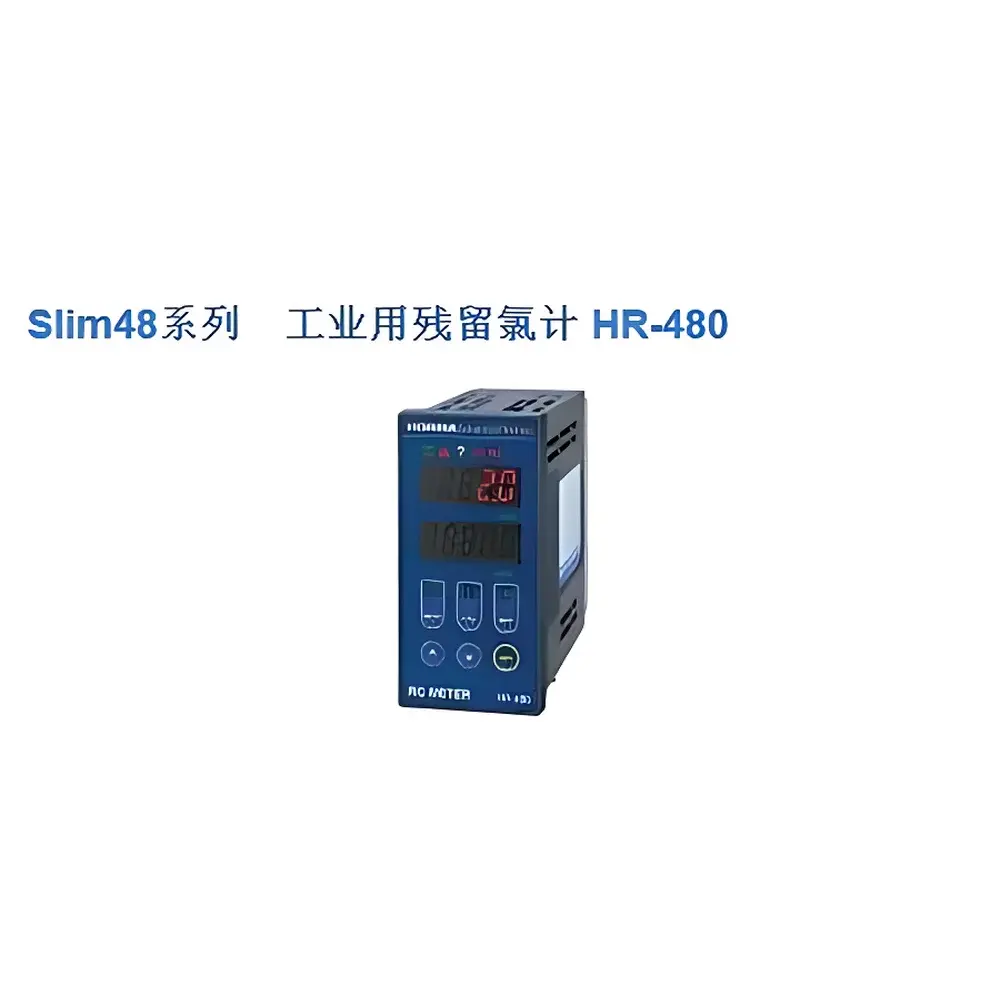
HORIBA HR-480 Industrial Online Free Chlorine Analyzer
| Brand | HORIBA |
|---|---|
| Origin | Japan |
| Model | HR-480 |
| Measurement Principle | Galvanic Cell (Electrochemical) |
| Measurand | Free Residual Chlorine |
| Range | 0–2 mg/L |
| Resolution | 0.01 mg/L |
| Repeatability | ±0.05 mg/L (max) |
| Linearity | ±0.05 mg/L (max) |
| Output | Isolated 4–20 mA DC (max load: 900 Ω) |
| Relay Outputs | 2 × SPDT (240 V AC / 30 V DC, 3 A) |
| Enclosure Rating | IP65 |
| Certifications | CE, FCC, RoHS, WEEE |
| Operating Temperature | −5 to +45 °C |
| Power Supply | 90–264 V AC, 50/60 Hz, ≤10 W |
| Compatible Sensor | HORIBA RS-1 Free Chlorine Electrode |
| Calibration | Zero calibration (using zero solution), Span calibration (against DPD colorimetric reference) |
Overview
The HORIBA HR-480 is an industrial-grade, wall- or pole-mounted online free chlorine analyzer engineered for continuous, real-time monitoring of free residual chlorine in water distribution systems, wastewater effluent streams, cooling towers, and process water loops. It operates on the galvanic cell principle—utilizing a self-polarizing, membrane-separated electrochemical sensor (compatible exclusively with the HORIBA RS-1 chlorine electrode)—to deliver stable, drift-resistant measurements without external polarization voltage. Unlike amperometric sensors requiring frequent maintenance and electrolyte refills, the galvanic design ensures low operational overhead and high long-term reproducibility under variable flow and temperature conditions. The HR-480 is purpose-built for outdoor deployment: its die-cast aluminum housing meets IP65 ingress protection, and its wide operating temperature range (−5 to +45 °C) supports year-round operation in unconditioned environments. As part of HORIBA’s H-1 series of multi-parameter analyzers, the HR-480 integrates seamlessly into centralized SCADA or DCS architectures via standardized analog output and relay control logic.
Key Features
- Galvanic electrochemical sensing technology—no external power required at the sensor; inherently stable zero point and minimal calibration drift.
- Large-format, high-contrast LCD display with dual-line readout: simultaneous real-time measurement value and temperature compensation status.
- Comprehensive self-diagnostic system: detects and logs calibration failures (zero offset error, sensitivity deviation), sensor disconnection, and internal analyzer faults.
- Two programmable SPDT relays support configurable alarm and control functions—including upper/lower limit triggering, maintenance alerts, and fault shutdown signals—fully compliant with IEC 61508 functional safety prerequisites for basic process control.
- Isolated 4–20 mA analog output with user-defined span mapping within the full 0–2 mg/L measurement range; supports HART-compatible signal conditioning when interfaced with smart I/O modules.
- Zero and span calibration protocols aligned with standard water quality practice: zero calibration using chlorine-free buffer (e.g., sodium thiosulfate-treated sample); span verification against certified DPD colorimetric reference values per APHA Standard Methods 4500-Cl G.
Sample Compatibility & Compliance
The HR-480 is validated for use with potable water, secondary treated wastewater, chlorinated cooling water, and low-turbidity process streams (≤100 NTU). It is not intended for seawater, highly oxidizing chemical feeds (e.g., ozone or chlorine dioxide), or samples containing >50 mg/L total suspended solids without upstream filtration. The analyzer complies with EU directives for electromagnetic compatibility (2014/30/EU), low-voltage safety (2014/35/EU), RoHS (2011/65/EU), and WEEE (2012/19/EU). Its CE marking confirms conformity with essential health and safety requirements under the Machinery Directive framework. While not intrinsically safe, the unit may be deployed in Zone 2 classified areas when installed per IEC 60079-14 guidelines and paired with appropriate barrier systems.
Software & Data Management
The HR-480 operates as a standalone field instrument with embedded firmware—no proprietary PC software is required for routine operation. All configuration, calibration history, and diagnostic logs are stored internally and accessible via front-panel navigation. Calibration events—including date/time stamp, operator ID (manually entered), zero and span reference values, and post-calibration deviation—are retained for ≥1,000 entries, satisfying GLP audit trail requirements. When integrated into supervisory systems, the 4–20 mA output enables time-synchronized data acquisition compatible with FDA 21 CFR Part 11-compliant historian platforms (e.g., OSIsoft PI, Inductive Automation Ignition) when paired with validated analog input modules and electronic signature workflows.
Applications
- Drinking water disinfection control at clearwell outlets and distribution network entry points.
- Effluent compliance monitoring for municipal and industrial wastewater treatment plants subject to NPDES permit limits.
- Chlorine residual management in pharmaceutical facility purified water (PW) and water-for-injection (WFI) loop sanitization cycles.
- Real-time dosing feedback for sodium hypochlorite feed systems in HVAC cooling tower applications.
- Process validation support during commissioning and routine requalification of water treatment skids per ISO 9001 and ISO 13485 quality management frameworks.
FAQ
What chlorine species does the HR-480 measure?
The HR-480 measures free residual chlorine (hypochlorous acid HOCl and hypochlorite ion OCl⁻) selectively, excluding combined chlorine (chloramines) and total chlorine. Its galvanic sensor exhibits negligible cross-sensitivity to bromine or iodine at typical municipal concentrations.
Can the HR-480 be used with existing piping configurations?
Yes—the RS-1 sensor is designed for insertion-type or flow-cell mounting (e.g., HORIBA FC-100 flow cell); no bypass stream or sample pump is required for inline operation at flow velocities ≥0.3 m/s.
Is remote calibration supported?
No—calibration must be performed locally using the front-panel interface and physical reference standards; however, relay and analog output states can be monitored remotely via PLC or DCS.
How often is calibration recommended?
Daily zero check is advised for critical applications; full zero-and-span calibration every 7–14 days depending on matrix fouling risk and regulatory requirements (e.g., US EPA Method 334.0 recommends weekly verification for compliance reporting).
Does the analyzer support MODBUS or other digital protocols?
No—the HR-480 provides only analog (4–20 mA) and relay outputs. For digital integration, a third-party analog-to-MODBUS converter or gateway is required.
Related Products







