
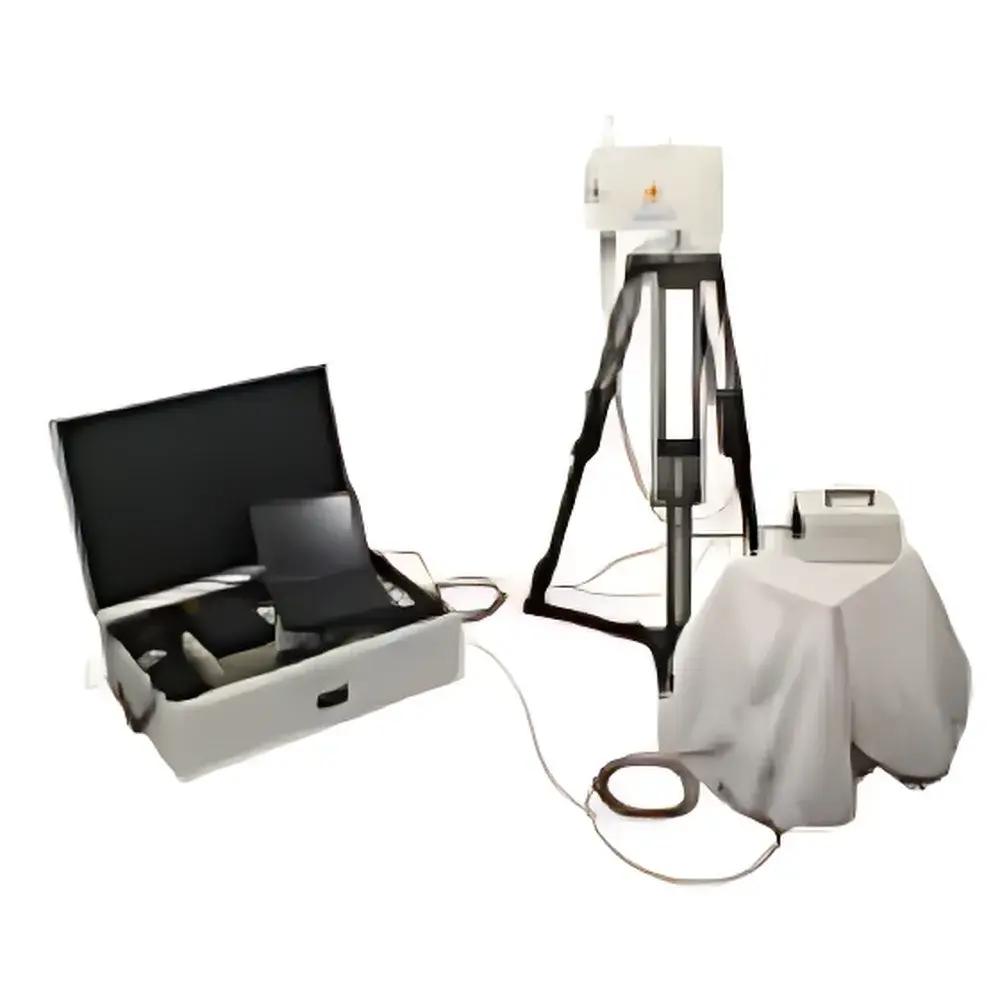
HORIBA JY HE Portable Raman Spectrometer
| Brand | HORIBA |
|---|---|
| Origin | France |
| Model | HE |
| Instrument Type | Portable / Handheld Raman Spectrometer |
| Spectral Range | 200–3200 cm⁻¹ |
| Spectral Resolution | < 5 cm⁻¹ (typical, dependent on grating and slit configuration) |
| Spatial Resolution | Diffraction-limited, down to ~1 µm (with 50× long-working-distance objective and confocal option) |
| Minimum Wavenumber | 200 cm⁻¹ |
| Spectral Reproducibility | < ±0.2 cm⁻¹ (over 8-hour operation, temperature-stabilized optics) |
| Detector | 1024 × 256 pixel CCD, MPP mode |
| Cooling | Peltier-cooled to −70 °C (air-cooled, no water required) |
| Read Noise | < 8 e⁻/pixel |
| Dark Current | < 0.01 e⁻/pixel/s |
| Laser Wavelength Options | 532 nm, 633 nm, 785 nm |
| Laser Power Range | 80–300+ mW (adjustable per application) |
| Fiber Probe Support | Up to 4 simultaneous SuperHead™ probes |
| Software | LabSpec 6 (Windows-compatible, FDA 21 CFR Part 11–ready audit trail & user access control) |
Overview
The HORIBA JY HE Portable Raman Spectrometer is an industrial-grade, benchtop-to-field deployable Raman analyzer engineered for robust, real-time molecular fingerprinting in demanding process environments. Based on confocal or non-confocal laser-induced Raman scattering, the HE system captures inelastic photon scattering signatures from vibrational modes of chemical bonds—enabling label-free, non-destructive identification and quantification of solids, liquids, gels, and powders. Its monolithic optical architecture features no moving parts, eliminating alignment drift and ensuring long-term stability under thermal cycling, vibration, or dust exposure. Designed for continuous 24/7 operation in pharmaceutical manufacturing suites, petrochemical refineries, battery material production lines, and hazardous-area facilities, the HE integrates seamlessly into existing DCS/SCADA infrastructures via Ethernet or OPC UA protocols.
Key Features
- Patented holographic concave grating delivering broad spectral coverage (200–3200 cm⁻¹) with high throughput and minimal stray light—optimized for signal-to-noise ratio in low-light industrial conditions.
- Modular SuperHead™ fiber-optic probe platform supporting visual sample targeting, adjustable working distance (40 mm standard), and interchangeable objectives (10×, 50× long-working-distance, immersion-type) for flexible spatial resolution and depth profiling.
- Multi-probe capability: Single HE unit synchronously interfaces up to four fiber probes—enabling parallel monitoring of multiple process streams, reactor zones, or packaging lines without hardware duplication.
- Air-cooled Peltier detector stage maintains stable −70 °C operation without external chillers or water lines—critical for cleanroom compliance and explosion-proof zone deployment (ATEX/IECEx-ready enclosures available).
- Laser wavelength flexibility: Selectable 532 nm (high sensitivity for inorganic/fluorescent samples), 633 nm (balanced fluorescence suppression and SNR), or 785 nm (optimal for organic, biological, and highly fluorescent matrices).
- Industrial-grade mechanical housing rated IP54; shock-mounted optics; wide operating temperature range (10–40 °C ambient); and EMC-compliant power supply (220 V, 15 A).
Sample Compatibility & Compliance
The HE spectrometer accommodates diverse sample geometries and states—including bulk solids in stainless-steel hoppers, liquid-filled glass vials, coated electrodes in battery dry rooms, and polymer films on roll-to-roll lines—via standardized fiber-coupled probing. Optional immersion probes enable direct in-situ measurement in agitated reactors or pipelines. All configurations support Good Manufacturing Practice (GMP) and Good Laboratory Practice (GLP) workflows: LabSpec 6 software provides full 21 CFR Part 11 compliance—including electronic signatures, role-based permissions, immutable audit trails, and data integrity validation reports. Instrument qualification packages (IQ/OQ/PQ) are available per ASTM E1783-22 and ISO/IEC 17025 requirements. Calibration traceability is maintained to NIST-traceable polystyrene and silicon standards.
Software & Data Management
LabSpec 6 Professional software serves as the unified interface for instrument control, spectral acquisition, chemometric modeling, and real-time trending. It supports multivariate analysis (PCA, PLS, SIMCA), spectral library matching (built-in >2,500 compound database), and automated peak detection with wavenumber calibration lock. Raw and processed spectra are stored in HDF5 format with embedded metadata (timestamp, laser power, integration time, probe ID, operator ID). Data export complies with ASTM E1394 and ISA-88/ISA-95 standards for MES/ERP integration. Remote diagnostics, firmware updates, and spectral cloud backup are enabled via secure TLS 1.3–encrypted connections—fully auditable and firewall-compatible.
Applications
- Pharmaceutical Manufacturing: Real-time API polymorph verification during crystallization, blend uniformity assessment in powder mixers, and coating thickness monitoring on tablet cores.
- Chemical Process Monitoring: In-line reaction endpoint detection (e.g., epoxidation, esterification), catalyst deactivation tracking, and impurity profiling in continuous flow reactors.
- Battery Materials QA: Phase identification of cathode precursors (NMC, LFP), SEI layer composition analysis on cycled electrodes, and electrolyte decomposition product screening.
- Petrochemical Refining: Hydrocarbon speciation in distillate streams, sulfur compound quantification (e.g., thiophenes), and coke formation monitoring in FCC units.
- Forensics & Hazardous Material ID: Rapid field identification of unknown white powders, explosives residues, illicit drugs, and toxic industrial chemicals—without sample preparation.
FAQ
Is the HE spectrometer suitable for Class I Div 1 hazardous locations?
Yes—when configured with optional ATEX-certified explosion-proof enclosures (II 2G Ex db IIB T4 Gb) and intrinsically safe fiber probes, the HE meets IEC 60079-0 and -11 requirements for flammable gas environments.
Can LabSpec 6 generate GMP-compliant reports for regulatory submissions?
Yes—reports include full electronic signatures, revision-controlled templates, raw-data embedding, and audit-trail exports compliant with FDA, EMA, and PMDA expectations for analytical instrument qualification.
What is the typical measurement time for a quantitative assay?
With 100–500 ms integration and 5–20 co-adds, most routine assays (e.g., concentration determination in liquid phase) complete in < 2 seconds—enabling sub-second sampling rates when synchronized with PLC triggers.
Does HORIBA provide application-specific chemometric model development?
Yes—HORIBA’s Application Support Center offers method development services including PLS regression training, outlier detection logic, and validation per ICH Q2(R2), with transferable models delivered as encrypted .mod files.
How is wavelength calibration stability maintained over extended operation?
The HE employs an internal neon-argon reference lamp with automated daily self-calibration routines; spectral drift is continuously monitored and corrected in real time using peak position locking algorithms.




