
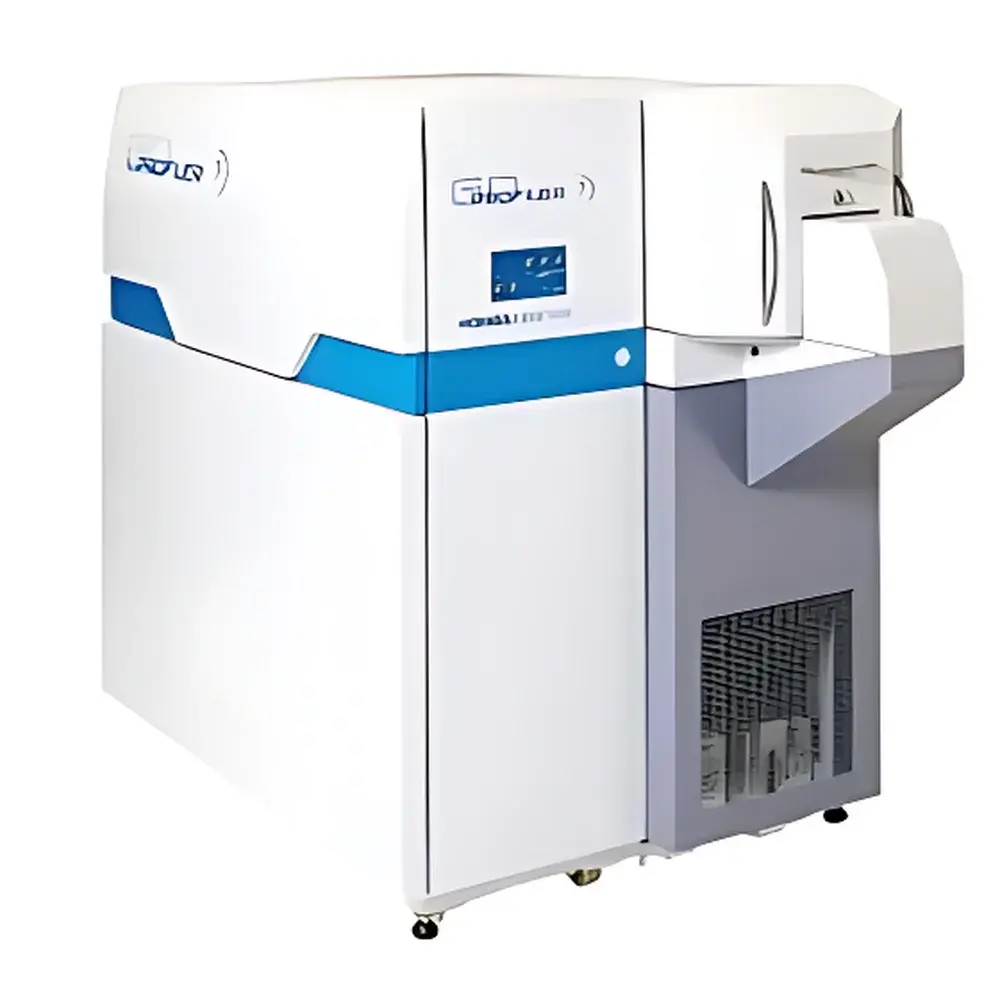
HORIBA JY Profiler 2 Radio-Frequency Glow Discharge Optical Emission Spectrometer
| Brand | HORIBA |
|---|---|
| Origin | France |
| Model | Profiler 2 |
| Excitation Source | Pulsed RF Glow Discharge |
| Depth Range | 1 nm – 200 µm |
| Depth Resolution | < 1 nm |
| Elemental Coverage | ≥70 elements including C, H, O, N, Cl |
| Spectral Range | 110–800 nm |
| Spectral Resolution (Polyscan) | 18–25 pm |
| Detector | High Dynamic Detector (HDD), dynamic range 5×10¹⁰ |
| Compliance | ISO 14707, ISO 16962 |
| Software | Quantum v5.x with GLP/GMP audit trail support |
| Optional Configuration | Monochromator for n+1 flexible channel selection |
Overview
The HORIBA JY Profiler 2 is a high-performance radio-frequency glow discharge optical emission spectrometer (RF-GD-OES) engineered for quantitative depth profiling of conductive and non-conductive thin films, coatings, and layered materials. Operating on the principle of pulsed RF sputtering coupled with optical emission spectroscopy, the Profiler 2 enables controlled, atomically resolved erosion of sample surfaces while simultaneously detecting elemental emission lines across the vacuum ultraviolet to near-visible spectrum (110–800 nm). Unlike DC-GD systems, its RF excitation mode eliminates the need for conductive matrixes or backing layers, permitting direct analysis of insulating substrates such as glass, ceramics, polymers, and oxide-coated semiconductors without metallization. The instrument delivers sub-nanometer depth resolution (<1 nm), calibrated against certified reference materials traceable to NIST and BAM standards, making it suitable for metrology-grade applications in R&D, process development, and quality assurance laboratories.
Key Features
- Pulsed RF glow discharge source with ultra-stable plasma ignition (<10 ms stabilization time) and uniform sputter crater morphology — critical for artifact-free surface and interface characterization.
- Polyscan multi-channel spectrometer with full spectral coverage (110–800 nm), enabling simultaneous detection of light elements (C, H, O, N, Cl) and metals at ppm-level sensitivity.
- High Dynamic Detector (HDD) with 5×10¹⁰ linear dynamic range, supporting quantification from major constituents down to trace impurities without detector saturation or gain switching artifacts.
- Holographic ion-etched gratings optimized for maximum photon throughput and signal-to-noise ratio, especially in the VUV region where conventional optics suffer absorption losses.
- Large-volume sample chamber accommodating specimens up to Ø100 mm × 50 mm height, compatible with irregular geometries via adjustable sample stage and optional motorized XYZ positioning.
- Integrated RF generator compliant with IEC 61000-3-2 harmonic emission limits and CE/UL safety certification; designed for continuous operation under ISO/IEC 17025-accredited laboratory conditions.
Sample Compatibility & Compliance
The Profiler 2 supports direct analysis of both conductive (e.g., Zn-coated steel, Cu interconnects) and non-conductive materials (e.g., SiO₂-on-Si wafers, Al₂O₃-coated battery separators, PET-based barrier films). Its RF coupling mechanism ensures stable plasma formation on dielectrics with thermal conductivity as low as 0.1 W/m·K — eliminating cracking, delamination, or carbonization often observed in thermally sensitive organic layers. The system meets the measurement requirements of ISO 14707 (metallic coatings on steel) and ISO 16962 (depth profiling of thin films by GD-OES), and all calibration protocols are fully documented for GLP and GMP environments. Audit trail functionality in Quantum software complies with FDA 21 CFR Part 11 requirements for electronic records and signatures.
Software & Data Management
Quantum software v5.x provides a modular, scriptable platform for method development, real-time spectrum visualization, depth-scale calibration (using SRM 2135a, BAM 113a, and user-defined standards), and automated report generation in PDF, CSV, and XML formats. Batch processing supports multi-sample alignment, layer-thickness calculation (via integrated step-height algorithms), and statistical comparison across runs. All raw spectra, parameter logs, and operator actions are timestamped and stored with immutable hash verification. Optional database integration (ODBC-compliant) enables seamless linkage with LIMS and ERP systems for enterprise-wide data governance.
Applications
- Zinc and aluminum alloy coatings on automotive steels — thickness, composition gradient, and interdiffusion zone quantification.
- Functional barrier layers on flexible OLED substrates — oxygen permeation inhibition layer integrity and pinhole detection.
- Anode/cathode coatings in lithium-ion batteries — Li distribution mapping, SEI layer stoichiometry, and transition metal dissolution profiling.
- Hard disk drive media stacks — CoCrPt-based magnetic layer homogeneity and Cr-underlayer oxidation state evolution.
- Optical interference filters and AR coatings on precision optics — stoichiometric control of TiO₂/SiO₂ multilayers.
- Surface-modified biomedical implants — Ca-P coating crystallinity, dopant incorporation (e.g., Sr, Mg), and bioactive interface stability.
FAQ
Can the Profiler 2 analyze hydrogen in polymer coatings?
Yes — using the VUV spectral window (110–135 nm), the instrument detects the H I 121.57 nm Lyman-α line with detection limits below 100 ppm (mass), validated per ASTM E2792-12.
Is depth calibration traceable to international standards?
All depth scale calibrations are referenced to NIST SRM 2135a (Zn/Fe bilayer) and BAM RM 113a (Al/Si), with uncertainty budgets reported per ISO/IEC Guide 98-3 (GUM).
Does the system support automated multi-point analysis?
Yes — via motorized XY stage and pattern-based sampling routines, enabling wafer-scale uniformity mapping with positional repeatability ±2 µm.
What maintenance intervals are recommended for the RF generator and detector?
RF generator requires annual power calibration; HDD detector undergoes biannual dark-current and linearity verification using internal LED references.
Can Quantitative results be exported to third-party statistical packages?
Yes — ASCII-formatted depth profiles and concentration matrices are directly importable into MATLAB, Python (pandas), JMP, and Minitab for advanced multivariate analysis.
Related Products




