
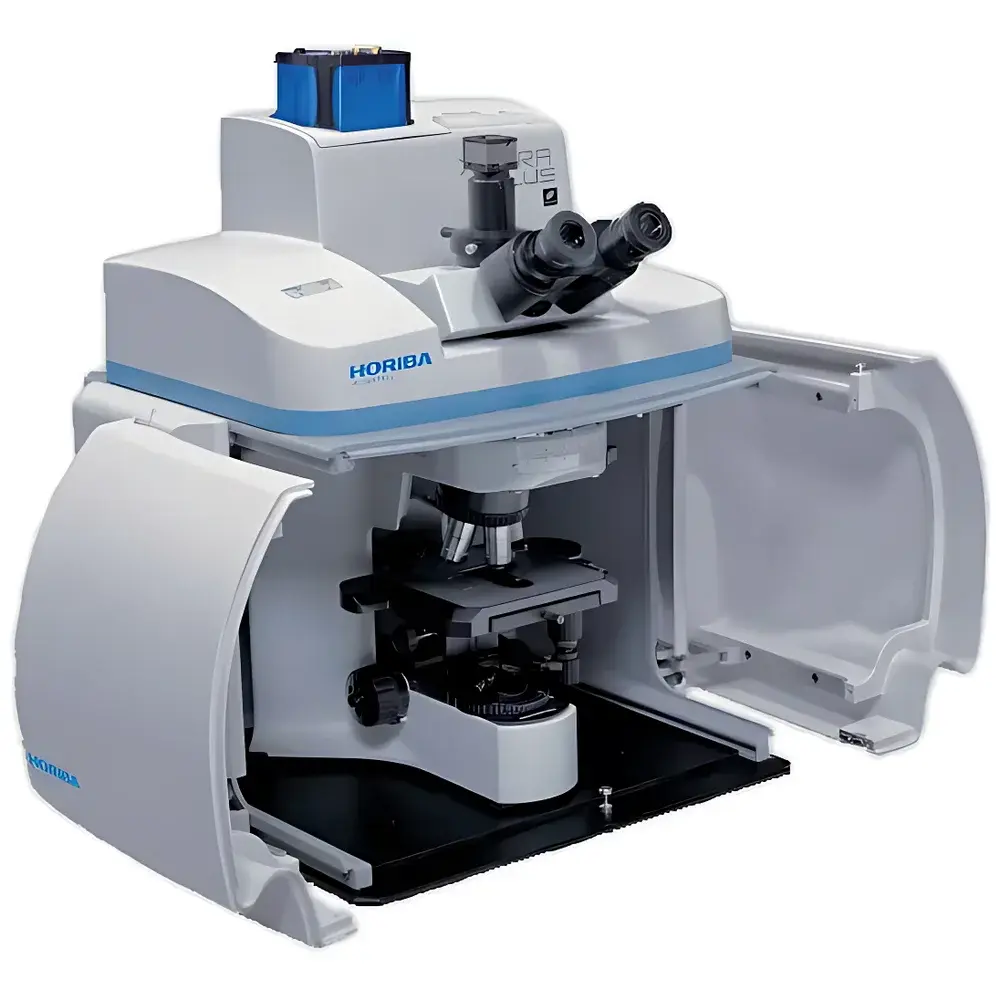
HORIBA LabRAM XploRA PLUS XS Ultra-Fast Imaging Raman Spectrometer
| Brand | HORIBA |
|---|---|
| Origin | France |
| Model | LabRAM XploRA PLUS XS |
| Instrument Type | Confocal Micro-Raman Spectrometer |
| Spectral Range | 50–9000 cm⁻¹ |
| Spectral Resolution | <1 cm⁻¹ |
| Spatial Resolution | Lateral 0.4 µm, Axial 1.5 µm |
| Minimum Wavenumber | 50 cm⁻¹ |
| Spectral Reproducibility | ≤ ±0.03 cm⁻¹ |
| Maximum Acquisition Speed | 1600 spectra/s |
| Pixel Dwell Time | <1 ms/pixel |
| Automated Laser Selection | Up to 3 Integrated Lasers (532 nm, 638 nm, 785 nm) |
| Grating Options | 4 Motorized Gratings |
| Detection | EMCCD and XS Fast-Imaging Detector |
Overview
The HORIBA LabRAM XploRA PLUS XS is a high-performance confocal micro-Raman spectrometer engineered for ultra-fast spectral imaging, quantitative chemical mapping, and nanoscale structural characterization. Based on the well-established LabRAM platform, the XS variant integrates advanced optomechanical design with real-time acquisition architecture to deliver up to 1600 full Raman spectra per second—enabling sub-millisecond pixel dwell times and high-fidelity 2D/3D hyperspectral datasets. Its core optical path employs a Czerny–Turner spectrograph with flat-field corrected output, optimized for large-format EMCCD detectors and multi-window spectral acquisition modes. The system operates on the fundamental principle of inelastic light scattering (Raman effect), where monochromatic excitation induces vibrational transitions in molecular bonds; the resulting Stokes/anti-Stokes shifts are resolved with sub-wavenumber accuracy across a broad 50–9000 cm⁻¹ range. Designed for rigorous laboratory environments—including R&D, QC/QA, forensic analysis, and GLP-compliant material evaluation—the XploRA PLUS XS features a rigid, monolithic optical bench with all components kinematically mounted to minimize thermal drift and mechanical misalignment.
Key Features
- Confocal microscopy architecture with diffraction-limited lateral resolution of 0.4 µm and axial resolution of 1.5 µm, enabling depth-resolved chemical profiling.
- Automated laser selection and power attenuation: three integrated solid-state lasers (532 nm, 638 nm, 785 nm) with motorized neutral density filters for precise irradiance control—critical for photolabile or fluorescent samples.
- Four motorized holographic gratings for seamless switching between spectral resolution and throughput configurations; supports both high-resolution (<1 cm⁻¹) and wide-range acquisition.
- Real-time Z-axis cruise scanning with auto-focus feedback loop, allowing continuous focal plane tracking during large-area or topographically variable sample mapping.
- XS fast-imaging engine synchronized with EMCCD detection, supporting single-pixel dwell times under 1 ms and full-frame acquisition at >100 fps in binned mode.
- Integrated polarization control module for anisotropy studies, stress/strain mapping, and symmetry-sensitive vibrational mode identification.
- Modular compatibility with AFM, SEM, and optical contrast techniques (DIC, phase contrast, darkfield) via standardized optical coupling interfaces.
Sample Compatibility & Compliance
The XploRA PLUS XS accommodates diverse sample geometries and physical states—including bulk solids, thin films, powders, liquids, gels, biological tissues, and embedded forensic evidence—via interchangeable stages and accessories (e.g., cryo/heat stages, liquid cells, large-sample holders, fiber-optic probes). Its confocal pinhole ensures rejection of out-of-focus signal, enhancing specificity for layered or heterogeneous specimens. The system meets essential regulatory expectations for analytical instrumentation used in quality-controlled environments: spectral reproducibility (≤±0.03 cm⁻¹) and wavelength calibration stability comply with ISO 17025 traceability requirements when operated with NIST-traceable polystyrene or silicon standards. Optional 21 CFR Part 11–compliant audit trail and electronic signature modules are available through Labspec 6 software configuration for pharmaceutical and clinical applications governed by GMP/GLP frameworks.
Software & Data Management
Labspec 6 serves as the unified control and analysis environment, featuring wizard-driven workflows for instrument setup, calibration, mapping, and multivariate analysis (PCA, cluster analysis, spectral unmixing). All experimental parameters—including laser wavelength, grating position, integration time, pinhole size, and stage coordinates—are saved as reusable templates, ensuring method consistency across users and sessions. Raw hyperspectral cubes (.hdf5 or .spc format) support batch processing, spectral library matching (with customizable reference databases), and export to third-party platforms (MATLAB, Python via SciPy/HDF5 libraries). Data integrity safeguards include automatic timestamping, user authentication logs, and version-controlled project files. Optional add-ons enable automated particle classification based on morphological descriptors (size, aspect ratio, convexity) correlated with Raman-derived chemical composition.
Applications
This system supports domain-specific analytical workflows across multiple sectors: In materials science, it enables grain-boundary chemistry mapping in battery cathodes, stress distribution analysis in semiconductor heterostructures, and polymorph identification in pharmaceutical co-crystals. In geosciences and archaeology, non-destructive mineral phase discrimination and degradation product detection (e.g., corrosion layers on artifacts) are achieved without vacuum or conductive coating. Forensic laboratories utilize its rapid spectral acquisition for fiber dye analysis, explosive residue screening, and ink differentiation on questioned documents. Nanotechnology researchers apply it for plasmon-enhanced Raman (SERS) quantification and defect-mode characterization in 2D materials such as graphene and transition metal dichalcogenides. Food safety labs deploy automated particle classification algorithms to detect adulterants (e.g., melamine in milk powder) or authenticate origin markers in botanical extracts.
FAQ
What is the difference between the XploRA PLUS and the XS configuration?
The XS variant adds the high-speed imaging engine, EMCCD detector, and sub-millisecond acquisition firmware—enabling >1600 spectra/s and real-time spectral mapping not available in the standard PLUS model.
Can the system perform correlative AFM-Raman measurements?
Yes—via optional hardware synchronization modules and shared coordinate referencing, enabling simultaneous topographical and chemical mapping with spatial registration accuracy better than 100 nm.
Is spectral calibration traceable to international standards?
Yes—using certified reference materials (e.g., silicon at 520.7 cm⁻¹, polystyrene peaks), and calibration procedures documented per ISO/IEC 17025 guidelines.
Does Labspec 6 support automated particle analysis?
Yes—integrated morphological segmentation tools classify particles by size, shape, and Raman signature, exporting statistical reports compliant with ASTM E2917 and ISO 13322-2.
What environmental conditions are recommended for optimal performance?
Stable ambient temperature (20–25°C ±0.5°C), low vibration (optical table recommended), and humidity control (30–60% RH non-condensing) ensure long-term spectral stability and mechanical repeatability.
Related Products






