
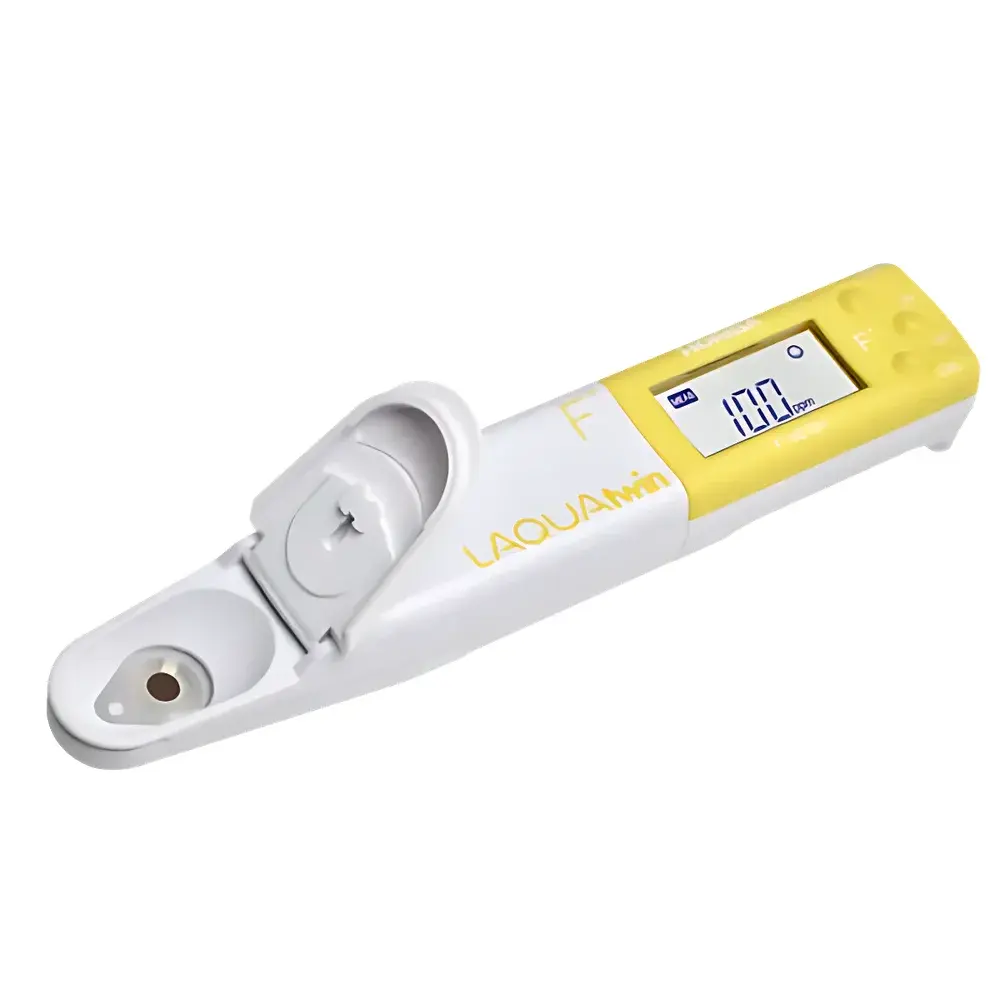
HORIBA LAQUAtwin F-11 Portable Fluoride Ion Meter
| Brand | HORIBA |
|---|---|
| Origin | Japan |
| Model | F-11 |
| Instrument Type | Portable |
| Measurement Range | 0.1 to 990 ppm (mg/L) |
| Accuracy | ±2% of actual value |
| Temperature Range | 0.0 to 50.0 °C |
| Minimum Sample Volume | 0.3 mL (0.01 mL with Sampling Sheet B) |
| Resolution | 0.1 ppm (0.1–9.9 ppm), 1 ppm (10–99 ppm), 10 ppm (100–990 ppm) |
| Calibration Points | 2 (auto-recognized 1 ppm and 10 ppm standards) |
| IP Rating | IP67 |
| Temperature Compensation | Yes |
| Auto-Hold / Auto-Stability Mode | Yes |
| Power Management | Auto-off after 30 min |
| Display | Monochrome backlit LCD |
Overview
The HORIBA LAQUAtwin F-11 is a compact, handheld fluoride ion meter engineered for rapid, field-deployable quantification of aqueous fluoride concentrations in environmental, industrial, and regulatory compliance settings. It operates on the potentiometric principle using a solid-state lanthanum trifluoride (LaF₃) crystal-based ion-selective electrode (ISE), which generates a Nernstian response proportional to the logarithm of free fluoride ion activity in solution. This electrochemical transduction mechanism ensures high selectivity against common interferents—including hydroxide, chloride, and nitrate—when operated within recommended pH (5.0–8.0) and ionic strength conditions. Designed for on-site water quality verification, the F-11 delivers laboratory-grade reliability without requiring benchtop infrastructure, making it suitable for routine monitoring of drinking water, wastewater effluents, groundwater, and industrial process streams where fluoride regulation aligns with WHO guidelines (1.5 mg/L), EPA Maximum Contaminant Level (4.0 mg/L), or local statutory limits.
Key Features
- Ultra-low sample consumption: Measures accurately with as little as 0.3 mL of sample; further reduced to 0.01 mL when used with optional Sampling Sheet B—ideal for limited-volume or precious samples.
- Pre-calibrated dual-point auto-recognition: Automatically detects and applies calibration using supplied 1 ppm and 10 ppm fluoride standard solutions; supports user-defined two-point calibration with any decade-difference standards (e.g., 0.5 ppm / 5 ppm).
- Multiplicative dilution compensation: Enables direct entry of dilution factor (0.01–9.90×) to report corrected concentration without manual calculation—critical for compliance reporting and QA/QC traceability.
- Intelligent measurement modes: Auto-Stability mode monitors signal drift and displays a “smiley face” icon upon achieving <±0.1 ppm stability for ≥3 seconds; Auto-Hold freezes the stabilized reading for documentation.
- Ruggedized field design: IP67-rated enclosure withstands immersion in 1 m of water for 30 minutes and full dust ingress protection—validated for outdoor, humid, or splash-prone environments.
- Integrated temperature sensing and compensation: Built-in thermistor provides real-time temperature readout (0.0–50.0 °C, resolution 0.1 °C) and applies automatic Nernst slope correction per ISE theory, ensuring accuracy across seasonal or thermal gradients.
- Long-term sensor maintainability: Field-replaceable LaF₃ sensor cartridge extends instrument service life and avoids full-unit replacement—reducing total cost of ownership and downtime.
Sample Compatibility & Compliance
The F-11 is validated for use with clarified, low-turbidity aqueous matrices including tap water, bottled water, surface water, treated wastewater, and fluoride-containing rinse solutions. For optimal performance, samples must be buffered to pH 5.0–8.0 using TISAB II (Total Ionic Strength Adjustment Buffer) to minimize hydroxide interference and stabilize ionic activity. The instrument meets general requirements for portable field instrumentation under ISO 5667-3 (water sampling) and ASTM D1129 (standard terminology relating to water), and its calibration traceability supports GLP-aligned data integrity when paired with documented standard preparation and handling procedures. While not inherently 21 CFR Part 11 compliant (as it lacks electronic audit trail functionality), its stable analog-to-digital conversion, non-volatile calibration memory, and physical recordability of readings enable integration into auditable paper-based or hybrid QC workflows.
Software & Data Management
The LAQUAtwin F-11 operates as a standalone, embedded-system device with no proprietary software dependency or USB connectivity. All calibration parameters, date/time stamp (manual entry), and measurement history are retained in non-volatile memory for up to 500 readings. Data export requires manual transcription or optical capture; however, its consistent output format (ppm, °C, timestamp placeholder) facilitates structured entry into LIMS or Excel-based tracking templates. The monochrome backlit LCD ensures legibility under low-light field conditions while minimizing power draw—supporting >10,000 measurements per set of AAA batteries. Auto-power-off (30-minute timeout) and low-battery indicator enhance operational continuity during extended surveys.
Applications
- Drinking water safety verification at distribution points, wells, or household taps per national regulatory thresholds.
- Monitoring fluoride dosing efficacy in municipal water fluoridation plants and post-treatment validation.
- Environmental site assessment of groundwater plumes near aluminum smelters, phosphate fertilizer facilities, or volcanic regions.
- Quality control of fluoride-containing dental products, pharmaceutical excipients, and semiconductor etchants.
- Educational laboratory instruction on ion-selective electrode theory, Nernst equation application, and field analytical method validation.
FAQ
What sample volume is required for accurate measurement?
The F-11 requires a minimum of 0.3 mL for standard operation; with Sampling Sheet B, this is reduced to 0.01 mL—enabling analysis of micro-volume environmental or biological samples.
Can the instrument measure fluoride in seawater or high-salinity samples?
Direct measurement is not recommended due to ionic strength effects and potential chloride interference; use of TISAB II buffer and appropriate dilution is mandatory, followed by multiplicative compensation.
How often should calibration be performed?
Calibration is advised before each measurement session, after electrode replacement, or when ambient temperature changes exceed ±5 °C—consistent with ISO/IEC 17025 metrological best practices.
Is the sensor compatible with other LAQUAtwin models?
No—the F-11 uses a dedicated LaF₃ sensor cartridge designed specifically for fluoride detection and is not interchangeable with pH, conductivity, or nitrate modules.
Does the device support GLP-compliant recordkeeping?
While lacking digital audit trails, its stable calibration memory, visible timestamp capability, and repeatable manual logging workflow support paper-based GLP adherence when combined with controlled documentation protocols.
Related Products







