
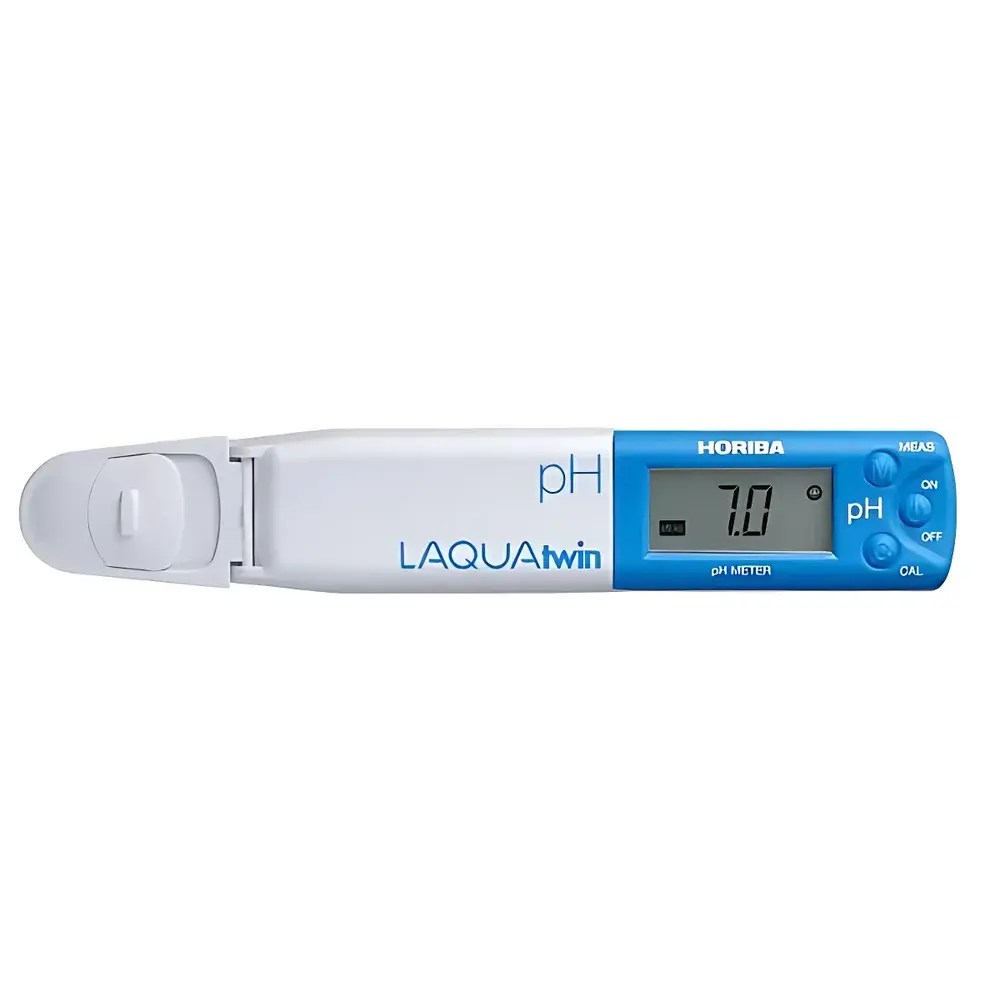
HORIBA LAQUAtwin B-712 Portable pH Meter
| Brand | HORIBA |
|---|---|
| Origin | Japan |
| Model | B-712 |
| Measurement Principle | Glass Electrode Method |
| Sample Volume | ≥0.05 mL (with sampling film B) |
| pH Range | 2.0–12.0 |
| Calibration | One-point or Two-point (user-selectable) |
| Accuracy | ±0.1 pH (after calibration, repeatability in standard buffer) |
| Temperature Compensation | Automatic (ATC) |
| Auto-Hold | Yes |
| Ingress Protection | IP67 (1 m submersion for 30 min |
| Operating Environment | 5–40 °C, ≤85% RH (non-condensing) |
| Power | Two CR2032 batteries |
| Dimensions (L×W×H) | 164 × 29 × 20 mm (excl. protrusions) |
| Weight | ~50 g (instrument only, excl. batteries) |
Overview
The HORIBA LAQUAtwin B-712 is a compact, handheld pH meter engineered for rapid, reliable field and laboratory measurements of aqueous solutions. Utilizing a robust flat-surface glass electrode architecture refined through decades of HORIBA sensor development, the B-712 operates on the potentiometric principle—measuring the voltage difference between a pH-sensitive glass membrane and a stable reference electrode to determine hydrogen ion activity. Designed specifically for environmental monitoring, wastewater screening, aquaculture, hydroponics, and educational use, the instrument delivers laboratory-grade accuracy in a pen-form factor. Its ultra-low sample requirement—just 0.05 mL when used with optional sampling film B—minimizes waste and enables analysis of limited or precious samples, such as droplets from leaf surfaces, microcosm effluents, or small-volume process streams. The B-712 represents the second-generation evolution of the LAQUAtwin platform, succeeding the B-212 with enhanced electrode stability, improved moisture sealing, and intuitive user feedback via visual indicators.
Key Features
- Flat-surface glass pH electrode optimized for fast response (<5 seconds typical stabilization) and high reproducibility across repeated measurements
- User-selectable calibration mode: one-point (e.g., pH 7.00) or two-point (e.g., pH 4.01/7.00 or 7.00/10.01), supporting NIST-traceable buffer standards
- Integrated automatic temperature compensation (ATC) using a built-in thermistor, eliminating manual correction and reducing thermal drift error
- Auto-hold function freezes the stabilized reading on-screen, ensuring consistent data capture without timing pressure
- IP67-rated enclosure—fully dust-tight and protected against immersion in 1 m of water for up to 30 minutes—suitable for humid field environments, rain exposure, or accidental splashes (not intended for submerged operation)
- High-contrast LCD with smiley-face confirmation icon upon successful calibration or measurement completion, enhancing operational clarity for non-specialist users
- Ergonomic pen-style design (164 × 29 × 20 mm, ~50 g) with tactile button interface and low-power CR2032 battery system enabling >1,000 measurements per set
Sample Compatibility & Compliance
The B-712 is validated for use with clear, low-turbidity aqueous samples within pH 2.0–12.0. For particulate-laden or viscous media (e.g., slurry filtrates, pond scum extracts), filtration through optional 0.45 µm membrane filters is recommended prior to measurement. When paired with sampling film B, the instrument achieves reliable readings from volumes as low as 0.05 mL—ideal for spot-checking soil leachates, plant xylem sap, or micro-batch reactor outputs. While not certified to ISO/IEC 17025 or FDA 21 CFR Part 11 out-of-the-box, its calibration traceability, documented repeatability (±0.1 pH), and stable electrode performance support GLP-aligned documentation workflows. It complies with IEC 60529 for IP67 rating and meets RoHS Directive 2011/65/EU for hazardous substance restrictions.
Software & Data Management
The B-712 operates as a standalone instrument with no embedded Bluetooth, USB, or PC connectivity. All data are displayed and retained visually on the LCD only during active use; no internal memory or export capability is provided. This design prioritizes simplicity, durability, and regulatory neutrality—avoiding software validation burdens common in GMP environments. Users maintain full control over record-keeping: manual transcription into lab notebooks, LIMS, or electronic spreadsheets remains the standard practice. Calibration logs, measurement timestamps, and environmental conditions must be documented externally per institutional SOPs. Optional accessories—including protective carrying cases, calibration buffer kits (pH 4.01, 7.00, 10.01), and replacement electrodes (LAQUAtwin pH Sensor Cartridge)—are supplied with batch-specific CoA documentation.
Applications
- Field-based water quality screening in rivers, lakes, and coastal zones per EPA Method 150.1 and ISO 10523
- Routine pH verification in municipal wastewater treatment plants (influent, aeration basins, effluent)
- Aquaculture health monitoring—tracking diurnal pH shifts in recirculating aquaculture systems (RAS)
- Hydroponic nutrient solution management in controlled-environment agriculture
- Soil saturation extract analysis following ASTM D4972 for acid sulfate soil assessment
- Classroom experiments and undergraduate analytical chemistry labs requiring rugged, intuitive instrumentation
- Quick verification of buffer integrity prior to spectrophotometric or titrimetric assays
FAQ
Can the B-712 measure pH in non-aqueous or high-alcohol-content samples?
No. The flat glass electrode is calibrated and optimized exclusively for aqueous electrolyte solutions. Non-aqueous solvents, glycerol-rich media, or ethanol concentrations >10% v/v will cause unpredictable drift and inaccurate readings.
Is electrode replacement possible, and what is the expected service life?
Yes—the pH sensor is a field-replaceable cartridge (HORIBA Part No. 9531-10D). Under normal use (≤5 measurements/day, proper storage in KCl storage solution), typical electrode lifespan is 6–12 months. Performance degradation manifests as slow response (>15 s), unstable readings, or failure to calibrate within tolerance.
Does the IP67 rating permit cleaning with disinfectants or alcohol wipes?
Yes—surface cleaning with 70% isopropyl alcohol or mild detergent is permissible. Avoid abrasive pads or chlorinated cleaners, which may degrade the silicone O-rings and compromise long-term ingress protection.
How does temperature affect measurement accuracy outside the 5–40 °C operating range?
Below 5 °C, response time increases significantly and ATC compensation becomes less effective; above 40 °C, reference junction potential drift rises, risking >±0.2 pH deviation. Measurements outside this range are not supported by HORIBA’s specifications or warranty.
Can the B-712 be used for ISO 5725-compliant precision testing?
It is suitable for intermediate precision (within-lab repeatability) verification under controlled conditions but lacks the documented uncertainty budget, interlaboratory validation data, or digital audit trail required for full ISO 5725 conformance. It serves best as a screening tool preceding definitive analysis on benchtop meters.
Related Products







