
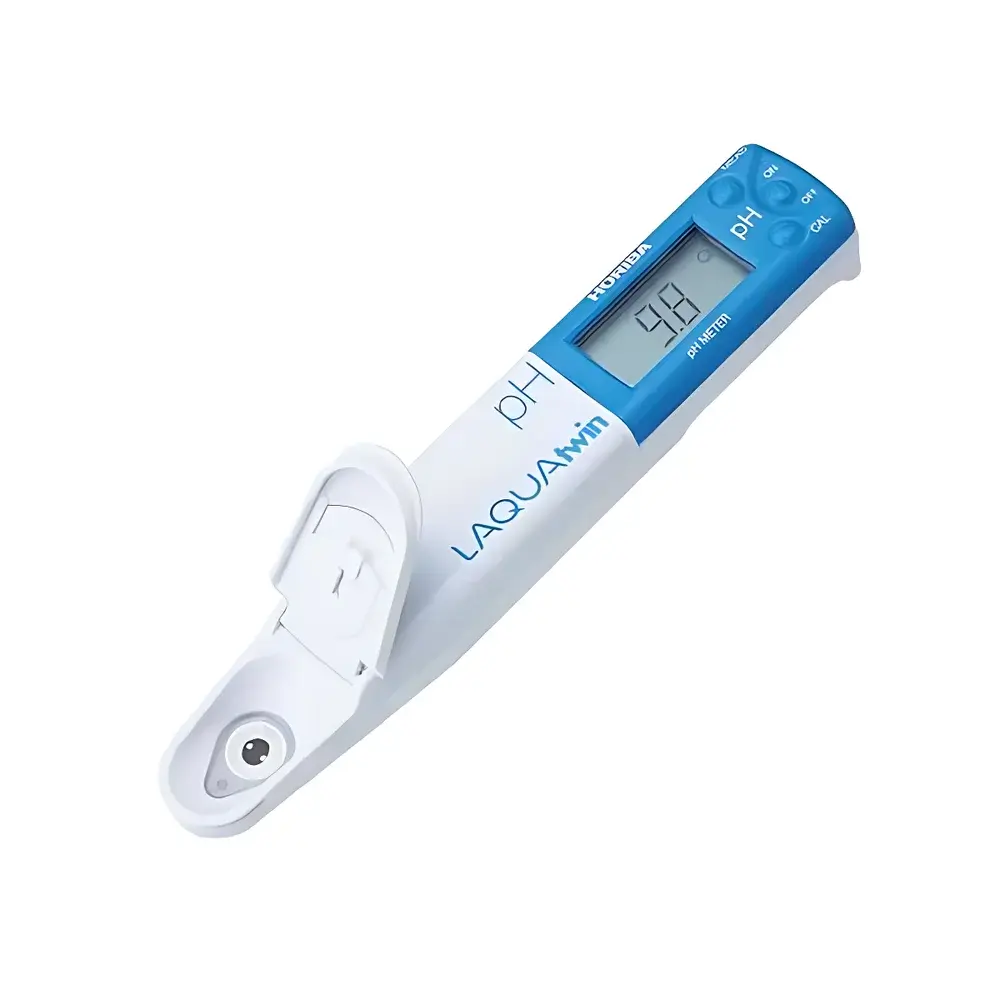
Horiba LAQUAtwin pH22 Pocket-Sized pH Meter
| Brand | HORIBA |
|---|---|
| Origin | Japan |
| Model | pH22 |
| Instrument Type | Pen-Style pH Meter |
| Parameter Type | Single-Parameter (pH/mV) |
| Measurement Accuracy | ±0.01 pH |
| Measurement Range | 0–14 pH / ±650 mV |
| Resolution | 0.01 pH |
| Calibration Standards | NIST-traceable and USA-standard buffer solutions |
| IP Rating | IP67 |
| Temperature Compensation | Automatic (ATC) |
| Display | Monochrome LCD with Auto-Hold & Auto-Stabilization |
| Power | 2 × CR2032 batteries (≈400 hours operational life) |
| Dimensions | 164 × 29 × 20 mm (L×W×H, excluding protrusions) |
| Weight | ≈45 g (instrument only, without batteries) |
Overview
The HORIBA LAQUAtwin pH22 is a precision-engineered, pocket-sized pH meter designed for rapid, reliable, and laboratory-grade electrochemical measurements in field, industrial, and educational environments. Unlike conventional pen-style meters relying on simplified electrode architectures, the pH22 employs a miniaturized flat-sensor chip integrating a glass pH sensing membrane and reference junction—directly derived from HORIBA’s benchtop laboratory electrode technology. This architecture enables true potentiometric measurement based on the Nernst equation, delivering high reproducibility and minimal liquid junction potential error. The device operates within the full aqueous pH range of 0–14 and concurrently measures redox potential (±650 mV), supporting both routine quality control and method development where mV-mode verification is required. Its compact form factor, combined with IP67-rated ingress protection, ensures robust performance under demanding conditions—including accidental submersion, dust exposure, and intermittent splashing during calibration or sample handling.
Key Features
- Miniaturized flat-sensor chip incorporating a glass pH membrane and integrated Ag/AgCl reference system—enabling laboratory-level accuracy in a pen-format device.
- True automatic temperature compensation (ATC) via built-in thermistor, eliminating manual correction errors across 5–40°C operating range.
- IP67-certified housing: fully dust-tight and submersible up to 1 m for 30 minutes—validated per IEC 60529 standards.
- Intelligent measurement algorithm with Auto-Stabilization and Auto-Hold functions; result confirmation signaled by a smiley-face icon on the monochrome LCD.
- Multi-mode sampling compatibility: drop, dip, scoop, wipe, solid, powder, and film-based measurement protocols—all supported without accessory modification.
- NIST- and USA-standard buffer-compatible calibration (2-point standard); supports traceable calibration verification per ISO/IEC 17025 requirements.
- Low-power design with dual CR2032 cells providing ~400 hours of continuous operation; auto-shutdown after 30 minutes of inactivity.
Sample Compatibility & Compliance
The LAQUAtwin pH22 accommodates diverse sample matrices while maintaining metrological integrity. It is validated for aqueous solutions (≥0.05 mL using Sampling Sheet B), semi-solids (e.g., food surfaces, gels), powders (with controlled addition of deionized water), and thin-film substrates (e.g., filter paper, textiles) when hydrated prior to contact. All measurements comply with fundamental electrochemical principles defined in ASTM D1293 (Standard Test Method for pH of Water) and ISO 10523 (Water Quality — Determination of pH). The device meets GLP documentation requirements through unambiguous calibration timestamping and stable endpoint detection. While not FDA 21 CFR Part 11-compliant as a standalone instrument, its calibration logs and measurement consistency support audit readiness in regulated QC/QA workflows where manual recordkeeping is permitted.
Software & Data Management
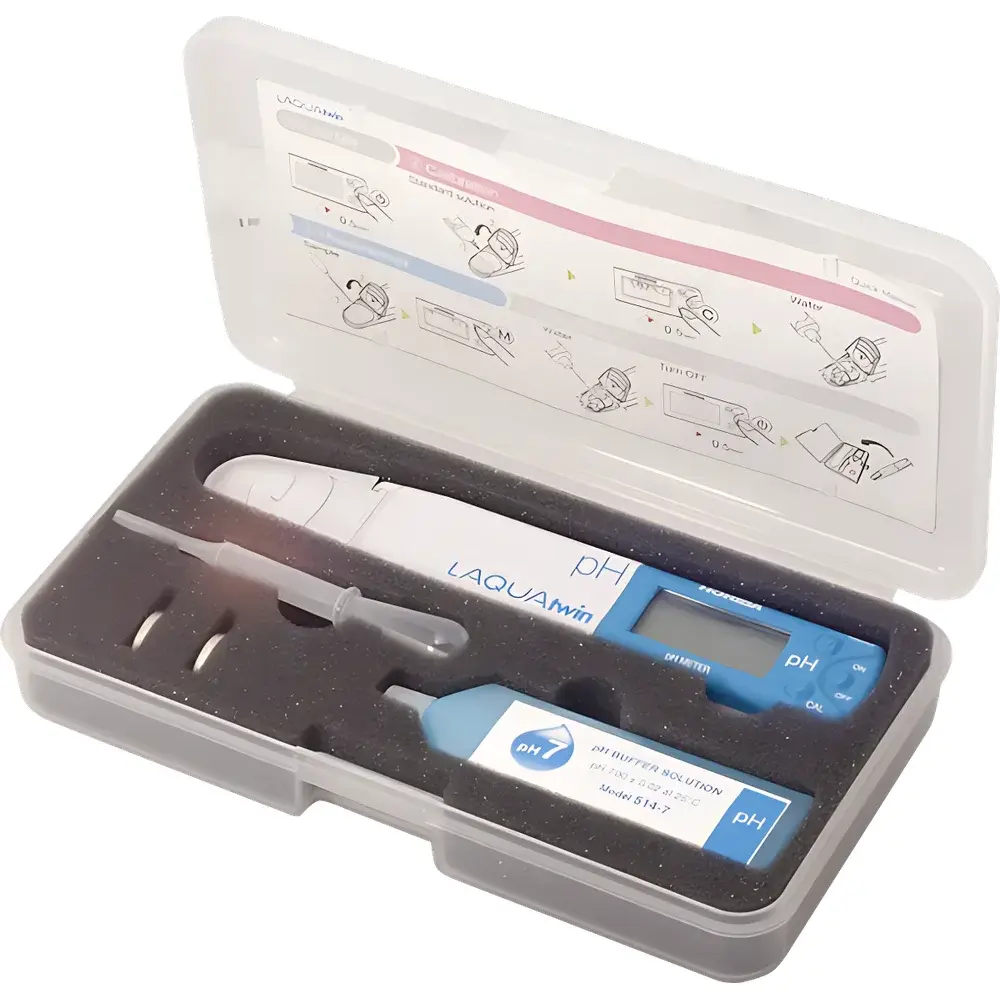
The pH22 operates as a self-contained, embedded-system instrument with no onboard data logging or Bluetooth connectivity. All measurement data are displayed in real time and retained only visually on the LCD until the next reading. For traceability, users are expected to manually document results alongside calibration records—including date/time, buffer lot numbers, electrode condition notes, and environmental parameters (temperature, humidity). This design aligns with ISO/IEC 17025 Clause 7.7 (Ensuring Validity of Results) and supports paper-based or LIMS-integrated workflows where operator-entered metadata is sufficient for compliance. Optional accessories—including standardized storage cases with pre-filled 14 mL NIST-traceable pH 4.01 and pH 7.00 buffers—facilitate consistent inter-laboratory calibration practices.
Applications
- Field-based water quality screening (surface water, wastewater effluent, aquaculture ponds).
- In-process monitoring of food and beverage production lines (e.g., dairy, brewing, fruit processing).
- Educational laboratories requiring rugged, intuitive tools for teaching electrochemical fundamentals.
- Pharmaceutical excipient testing where small-volume pH verification is needed prior to dissolution studies.
- Environmental remediation site assessments involving soil leachates and sediment pore water.
- Hydroponic and greenhouse nutrient solution management.
- Calibration verification of larger benchtop systems using portable cross-check methodology.
FAQ
What calibration standards are supported?
The pH22 is factory-configured for USA/NIST-traceable pH 4.01 and pH 7.00 buffers. Users may perform 2-point calibration using these certified standards; deviation from recommended buffers may affect accuracy and void traceability claims.
Can the sensor be cleaned or regenerated?
Yes—the flat sensor chip is chemically resistant to mild detergent washes and deionized water rinses. For protein or lipid fouling, a 0.1 M HCl soak (≤2 min) followed by thorough DI water rinse is recommended. Mechanical abrasion must be avoided.
Is temperature compensation mandatory?
Automatic temperature compensation is enabled by default and cannot be disabled. The internal thermistor continuously monitors sample temperature to apply real-time Nernst slope correction, ensuring accurate pH values across the specified 5–40°C range.
How is measurement stability determined?
The instrument applies a dynamic convergence algorithm: it monitors potential drift over successive 0.5-second intervals and locks the reading only when change remains ≤±0.005 pH for three consecutive cycles—meeting ISO 10523 stability criteria.
Does the device meet any international regulatory standards?
While not certified to specific regulatory frameworks (e.g., FDA 21 CFR Part 11), the pH22 conforms to ISO 10523, ASTM D1293, and IEC 60529 (IP67) for measurement principle, methodology, and environmental resilience—providing foundational metrological credibility for non-GxP and GxP-adjacent applications.




