
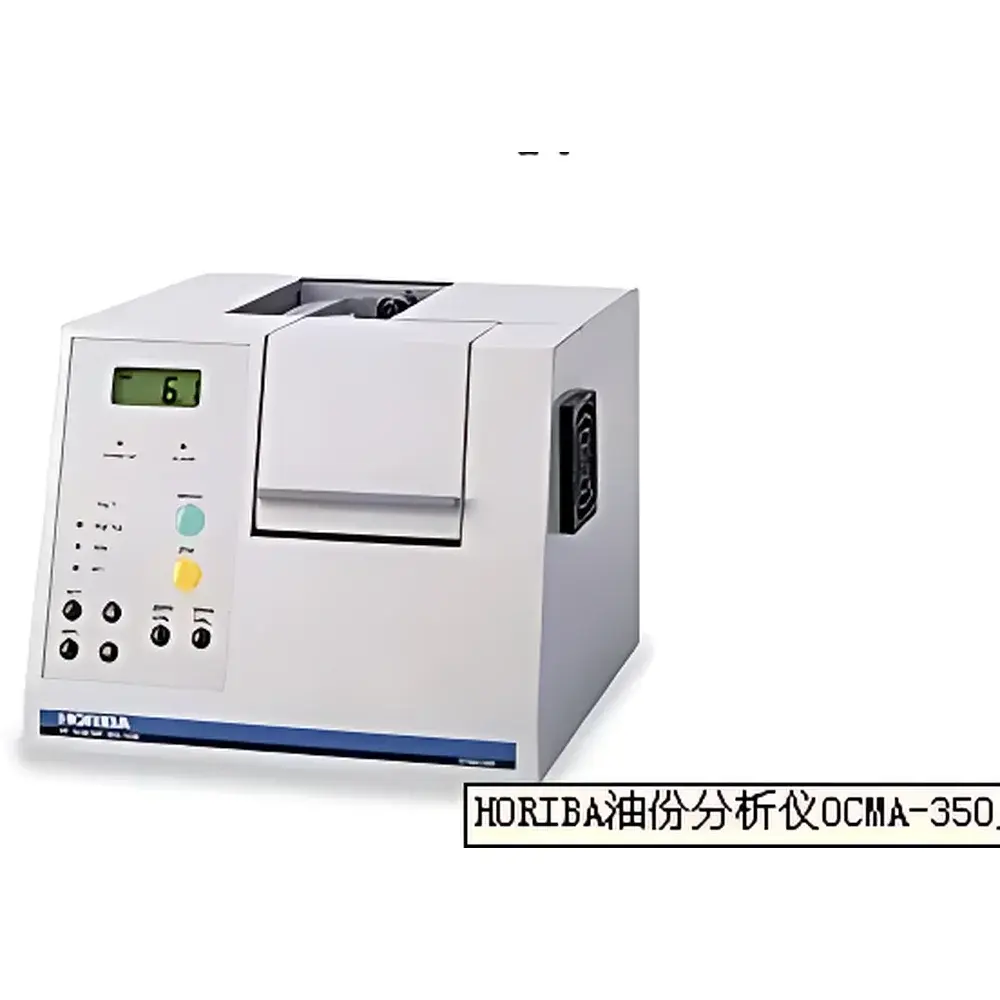
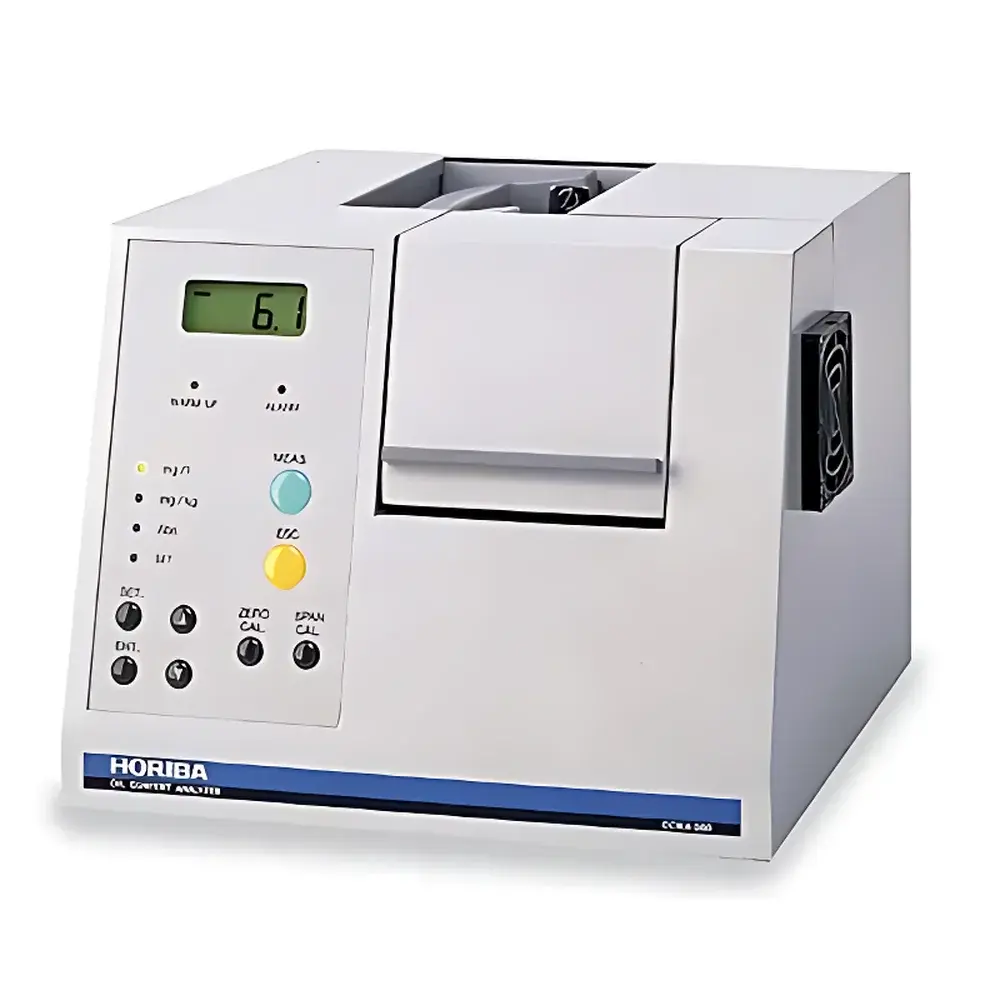
HORIBA OCMA-350/355 Oil Content Analyzer
| Brand | HORIBA |
|---|---|
| Origin | Japan |
| Model | OCMA-350/355 |
| Detection Method | Non-dispersive Infrared (NDIR) Absorption |
| Extraction Solvent | OCMA-350 — S-316 |
| Measurement Range | 0–200 mg/L (water), 0–1000 mg/kg (soil), 0–1 Abs |
| Repeatability | ±0.4 mg/L ±1 digit (0–9.9 mg/L), ±2.0 mg/L ±1 digit (10.0–99.9 mg/L), ±4 mg/L ±1 digit (100–200 mg/L), ±1% F.S. (0–1 Abs) |
| Sensitivity | 1% of full-scale lower limit |
| Detector | Thermoelectric sensor |
| Display | Backlit LCD with timestamping |
| Interface | RS-232C port, parallel printer port |
| Power Supply | 230 V AC, 50 Hz |
| Dimensions | 250 mm (W) × 200 mm (H) × 285 mm (D) |
| Sample Cell | 200 mm pathlength quartz cuvette |
| Minimum Detection Limit | 0.1 ppm (as oil) |
Overview
The HORIBA OCMA-350 and OCMA-355 are laboratory-grade, non-dispersive infrared (NDIR) oil content analyzers engineered for precise quantification of hydrocarbon contaminants in aqueous, solid, and surface-bound matrices. Based on the fundamental principle of infrared absorption at the characteristic C–H stretching band near 3.4 µm, these instruments deliver trace-level sensitivity (down to 0.1 ppm) without spectral interference—enabled by the selective transparency of extraction solvents S-316 (OCMA-350) or H-997 (OCMA-355) in this spectral region. Unlike broad-spectrum UV-Vis methods, NDIR detection ensures high specificity for aliphatic and aromatic hydrocarbons commonly found in petroleum-based oils, lubricants, cutting fluids, and industrial residues. The system is designed for post-extraction analysis: samples are first subjected to solvent extraction under standardized conditions (e.g., EPA Method 1664 or ISO 9377-2), followed by direct measurement of the extract in a 200 mm pathlength quartz cell. This configuration maximizes optical path length for enhanced signal-to-noise ratio, critical for low-concentration compliance monitoring.
Key Features
- Triple-unit display capability: simultaneous selection between mg/L (for water extracts), mg/kg (for soil/sediment extracts), and absorbance (Abs) for method validation and calibration traceability.
- Thermoelectric infrared detector with stable thermal baseline—no moving parts or wavelength-scanning mechanisms, ensuring long-term measurement reproducibility.
- Integrated timestamping and data logging directly to internal memory, supporting GLP-compliant record retention without external software dependency.
- RS-232C serial interface and parallel printer port for seamless integration into LIMS environments and automated reporting workflows.
- Auto-zero and auto-calibration sequence initiated after standard initialization, reducing operator-induced drift and minimizing daily setup time.
- Compact benchtop footprint (250 × 200 × 285 mm) with robust aluminum housing, rated for continuous operation in QC laboratories and field-deployable mobile labs.
Sample Compatibility & Compliance
The OCMA-350/355 accommodates a wide range of sample types following appropriate pretreatment: wastewater effluents, groundwater leachates, soil/sediment extracts, swabbed metal or semiconductor wafer surfaces, and rinse waters from precision cleaning lines. It supports regulatory frameworks including EPA 1664A/B (oil and grease), ISO 9377-2 (petroleum hydrocarbons in water), ASTM D7066 (infrared determination of oil in water), and JIS K 0102 (Japanese Industrial Standard for oil content). When operated with documented extraction protocols and certified reference materials (e.g., B-grade heavy oil supplied with unit), results meet data integrity requirements for ISO/IEC 17025-accredited testing laboratories. The instrument’s repeatability specifications align with USP analytical instrument qualification (AIQ) criteria for Category C instruments used in quantitative analysis.
Software & Data Management
While the OCMA-350/355 operates as a standalone instrument with embedded firmware, its RS-232C interface enables bidirectional communication with third-party data acquisition systems. Raw absorbance values, concentration outputs, timestamps, and unit selections are transmitted in ASCII format using configurable baud rates (up to 19200 bps). No proprietary drivers or closed-source software are required—standard terminal emulators or custom Python/Excel VBA scripts can parse and archive output. For regulated environments, the device supports 21 CFR Part 11-compliant audit trails when paired with validated host software that captures operator ID, measurement event logs, and calibration history. Optional solvent recovery units (SR-305) integrate seamlessly via mechanical interlock signaling, allowing solvent reuse while maintaining extract purity per ASTM D7066 Annex A3.
Applications
- Industrial wastewater monitoring: real-time verification of oil removal efficiency in API separators, coalescers, and membrane filtration systems.
- Hazardous waste site characterization: quantification of total petroleum hydrocarbons (TPH) in soil extracts prior to remediation and post-treatment verification.
- Semiconductor manufacturing: assessment of residual hydrocarbon contamination on silicon wafers and photomasks after solvent-based cleaning steps.
- Metalworking fluid management: tracking carryover oil in coolant sumps and evaluating skimmer performance in machining centers.
- Environmental compliance reporting: generation of auditable data packages for discharge permits (e.g., NPDES), landfill leachate monitoring, and brownfield redevelopment studies.
FAQ
What extraction solvents are compatible with the OCMA-350 and OCMA-355?
The OCMA-350 requires S-316 (1,1,2-trichloro-1,2,2-trifluoroethane), while the OCMA-355 uses H-997 (a proprietary chlorinated hydrocarbon blend). Both solvents exhibit negligible IR absorption at 3.4 µm, enabling selective oil quantification.
Can the instrument measure emulsified or dissolved oil without extraction?
No. The OCMA-350/355 is designed exclusively for solvent-extracted samples. Emulsified or dissolved fractions must be isolated via acidification, salting-out, or centrifugation prior to extraction per EPA 1664.
Is the 200 mm quartz cuvette included with the system?
Yes—a matched pair of stoppered quartz cells with 200 mm optical path length is supplied as standard equipment, calibrated for NDIR transmission at 3.4 µm.
How often does the instrument require recalibration?
Initial calibration is performed using the supplied B-grade heavy oil standard. Routine verification is recommended before each analytical batch; full recalibration is required if absorbance drift exceeds ±1% F.S. over 24 hours.
Does HORIBA provide IQ/OQ documentation for GMP environments?
Yes—validated installation qualification (IQ) and operational qualification (OQ) protocols are available upon request, aligned with ASTM E2500 and EU Annex 15 guidelines for analytical instrumentation.
Related Products







