
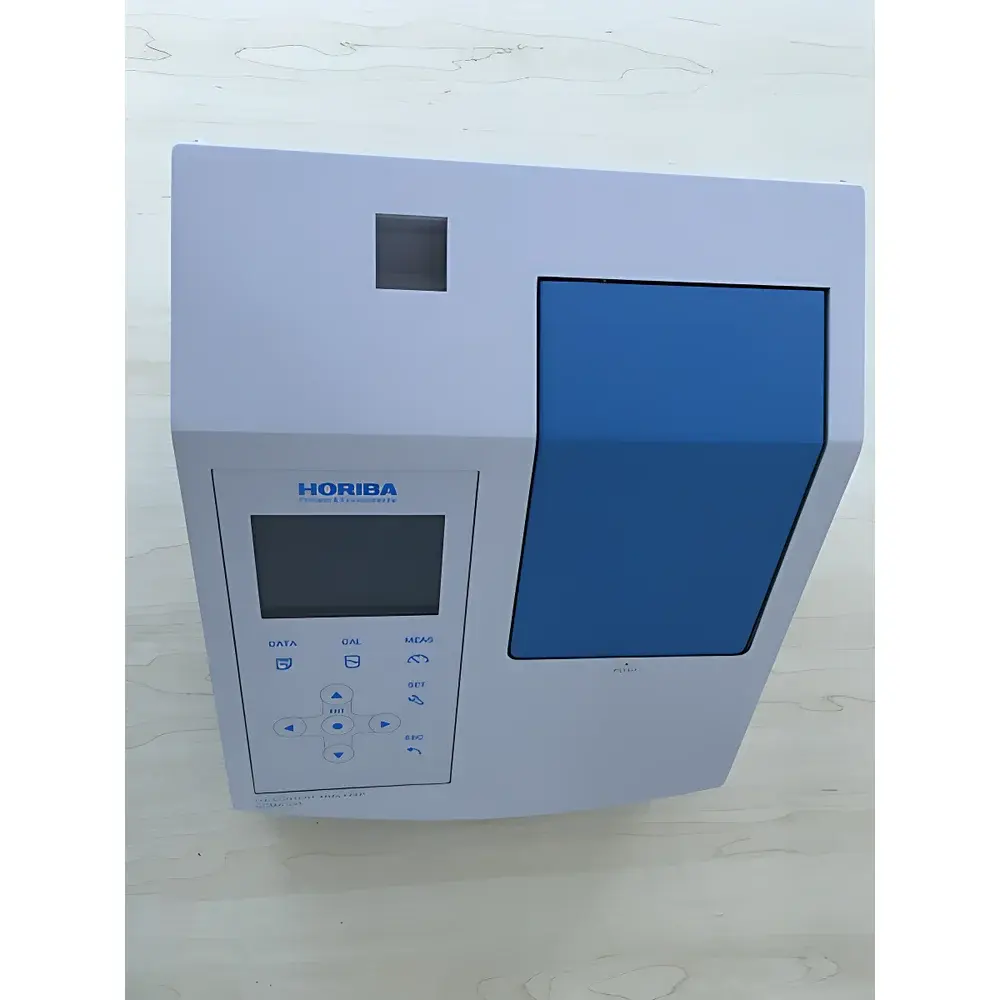
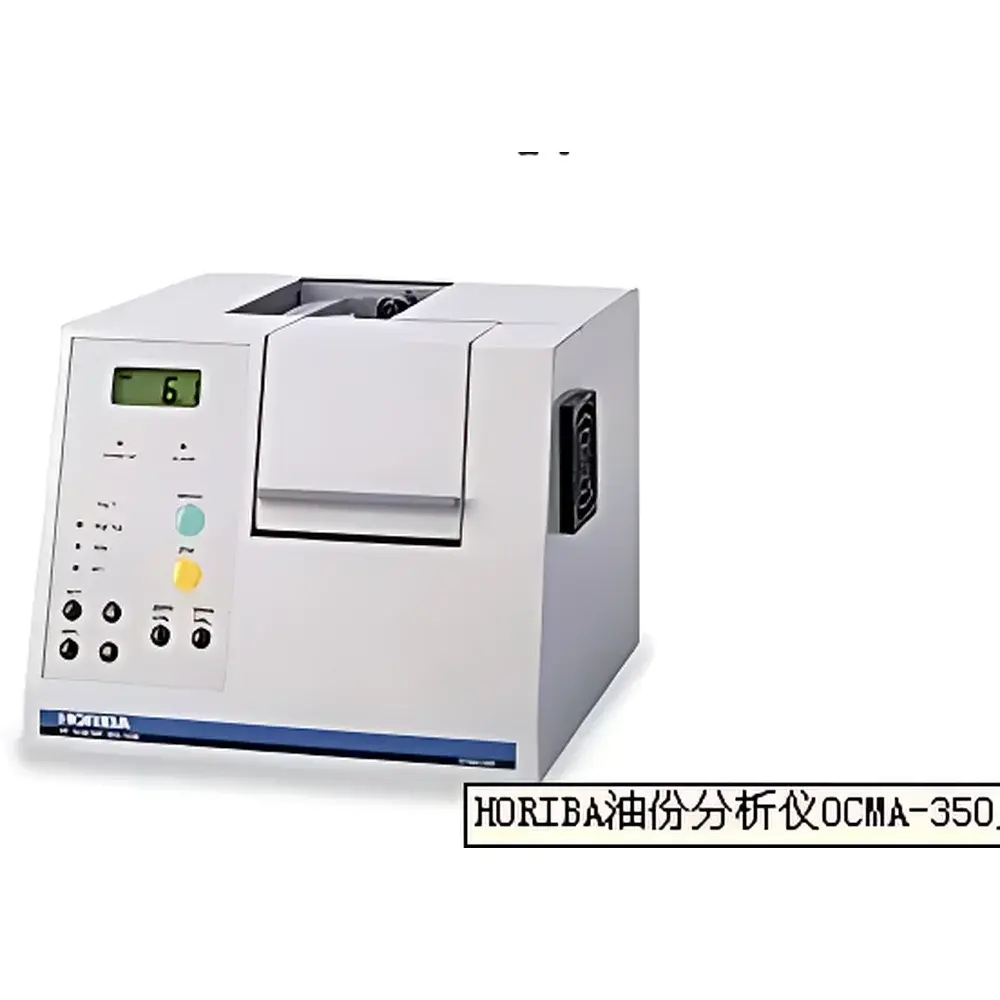
HORIBA OCMA-550/555 Oil Content Analyzer
| Brand | HORIBA |
|---|---|
| Origin | Japan |
| Model | OCMA-550 / OCMA-555 |
| Instrument Type | Portable |
| Measurement Principle | Non-Dispersive Infrared (NDIR) Absorption Spectrophotometry |
| Extraction Solvent | OCMA-550 — S-316 |
| Measurement Range | 0–200 mg/L (water), 0–1000 mg/kg (soil), 0–1 Abs |
| Repeatability | ±0.4 mg/L (0–9.9 mg/L), ±2.0 mg/L (10.0–99.9 mg/L), ±4 mg/L (100–200 mg/L), ±1% F.S. (0–1 Abs) |
| Detector | Thermoelectric Sensor |
| Display | Backlit LCD with timestamping |
| Interface | RS-232C, Parallel Printer Port |
| Power Supply | 230 V AC, 50 Hz |
| Dimensions | 250 × 200 × 285 mm (W × H × D) |
| Sample Cell | 200-mm Pathlength Quartz Cuvette |
| Standard Accessories | Covered quartz cuvette, power cord, heavy oil standard (B-grade), 2 A fuse, 10 mL and 25 µL syringes |
Overview
The HORIBA OCMA-550 and OCMA-555 Oil Content Analyzers are portable, field-deployable instruments engineered for precise quantification of hydrocarbon contamination in aqueous and solid-phase environmental matrices. Both models operate on the principle of non-dispersive infrared (NDIR) absorption spectroscopy—specifically targeting the C–H stretching vibration band near 3.4 µm—where petroleum-based oils exhibit strong, characteristic absorbance. Unlike fluorescence or UV-Vis methods, NDIR ensures high selectivity for aliphatic and aromatic hydrocarbons while minimizing interference from humic substances, chlorophyll, or suspended solids. The OCMA-550 utilizes S-316 (1,1,2-trichloro-1,2,2-trifluoroethane) as its extraction solvent, whereas the OCMA-555 employs H-997 (a proprietary, low-toxicity alternative). Both solvents are spectrally transparent at the measurement wavelength, enabling direct, solvent-compensated quantitation of extracted oil mass. The instrument’s optical path employs a thermoelectrically stabilized detector and a fixed 200-mm quartz cuvette, delivering robust signal-to-noise performance across the full 0–200 mg/L (aqueous) or 0–1000 mg/kg (soil) dynamic range.
Key Features
- Triple-unit display capability: switch seamlessly between concentration units—mg/L (for water samples), mg/kg (for soil/sediment extracts), and absorbance (Abs)—without recalibration.
- Integrated timestamping and data logging: all measurements are automatically annotated with date/time stamps and stored in internal memory for traceability.
- Single-button operation: after solvent extraction, sample introduction into the quartz cell requires no manual alignment or optical adjustment—measurement initiates with one press.
- Auto-zero and reference compensation: built-in baseline correction eliminates drift from solvent batch variation or ambient thermal fluctuation.
- RS-232C serial interface and parallel printer port: enables direct export to LIMS, laboratory PCs, or thermal printers under GLP-compliant audit trail protocols.
- Compact, rugged housing (250 × 200 × 285 mm) with IP20-rated enclosure: suitable for deployment in wastewater treatment plants, remediation sites, and manufacturing cleanrooms.
Sample Compatibility & Compliance
The OCMA-550/555 is validated for use with a broad spectrum of environmental and industrial samples—including surface water, groundwater, effluent streams, oily sludge, contaminated soils, metalworking fluid residues, and precision-cleaned semiconductor wafers. Its extraction protocol aligns with ASTM D7066-22 (Standard Test Method for Determination of Oil and Grease in Water by Infrared Spectrophotometry) and ISO 9377-2:2000 (Water quality — Determination of hydrocarbon oil index — Part 2: Infrared spectrometric method). When operated with documented SOPs—including solvent blank verification, calibration curve validation (minimum 5-point linear regression, r² ≥ 0.999), and periodic system suitability checks—the instrument supports data integrity requirements under FDA 21 CFR Part 11 and EU Annex 11 for regulated environmental monitoring. Optional SR-305 solvent regeneration unit extends S-316/H-997 reuse cycles, reducing hazardous waste generation and operational cost per analysis.
Software & Data Management
No proprietary PC software is required for basic operation; however, HORIBA provides ASCII-compatible communication protocols for integration with third-party data acquisition systems. Each measurement output includes: sample ID (user-definable), timestamp (YYYY-MM-DD HH:MM:SS), selected unit (mg/L/mg/kg/Abs), raw absorbance value, calculated concentration, and instrument status flag (e.g., “CAL OK”, “BLANK ERROR”). For laboratories implementing electronic records, the RS-232C interface supports configurable baud rates (up to 19200 bps) and optional checksum-enabled transmission to ensure data fidelity. Audit trails—comprising operator ID, calibration history, and maintenance logs—can be exported manually via printer or programmatically via serial handshake commands, satisfying GLP/GMP documentation mandates.
Applications
- Regulatory compliance monitoring of NPDES discharge permits and EPA Method 1664B equivalents.
- In-process verification of degreasing efficiency in aerospace component cleaning lines.
- Leachate analysis at landfill containment facilities per SW-846 Method 9071B.
- Residual oil quantification on silicon wafers and MEMS substrates prior to thin-film deposition.
- Rapid field screening of diesel/kerosene contamination in soil cores during Phase II ESAs.
- Quality control of emulsified cutting fluids in CNC machining centers.
FAQ
What extraction solvents are compatible with the OCMA-550 and OCMA-555?
The OCMA-550 is designed exclusively for S-316; the OCMA-555 uses H-997. Substitution between solvents is not supported due to spectral differences and hardware-specific calibration.
Does the instrument require annual factory recalibration?
No—users perform routine verification using certified reference standards (e.g., B-grade heavy oil). Factory recalibration is recommended only after physical impact, detector replacement, or failure of system suitability tests.
Can the OCMA-550/555 measure polycyclic aromatic hydrocarbons (PAHs) selectively?
It quantifies total extractable petroleum hydrocarbons (TEPH) as a class. PAH-species resolution requires GC-MS or HPLC separation prior to analysis.
Is the quartz cuvette autoclavable?
No—quartz cells must be cleaned with solvent-rinsed lint-free wipes; thermal or chemical sterilization may induce stress birefringence affecting pathlength accuracy.
How is measurement uncertainty reported in compliance reports?
Repeatability data per ISO/IEC 17025 Annex A.2 is provided in the technical manual; combined uncertainty (k=2) can be calculated incorporating calibration standard uncertainty, repeatability, and solvent blank variability.
Related Products







