
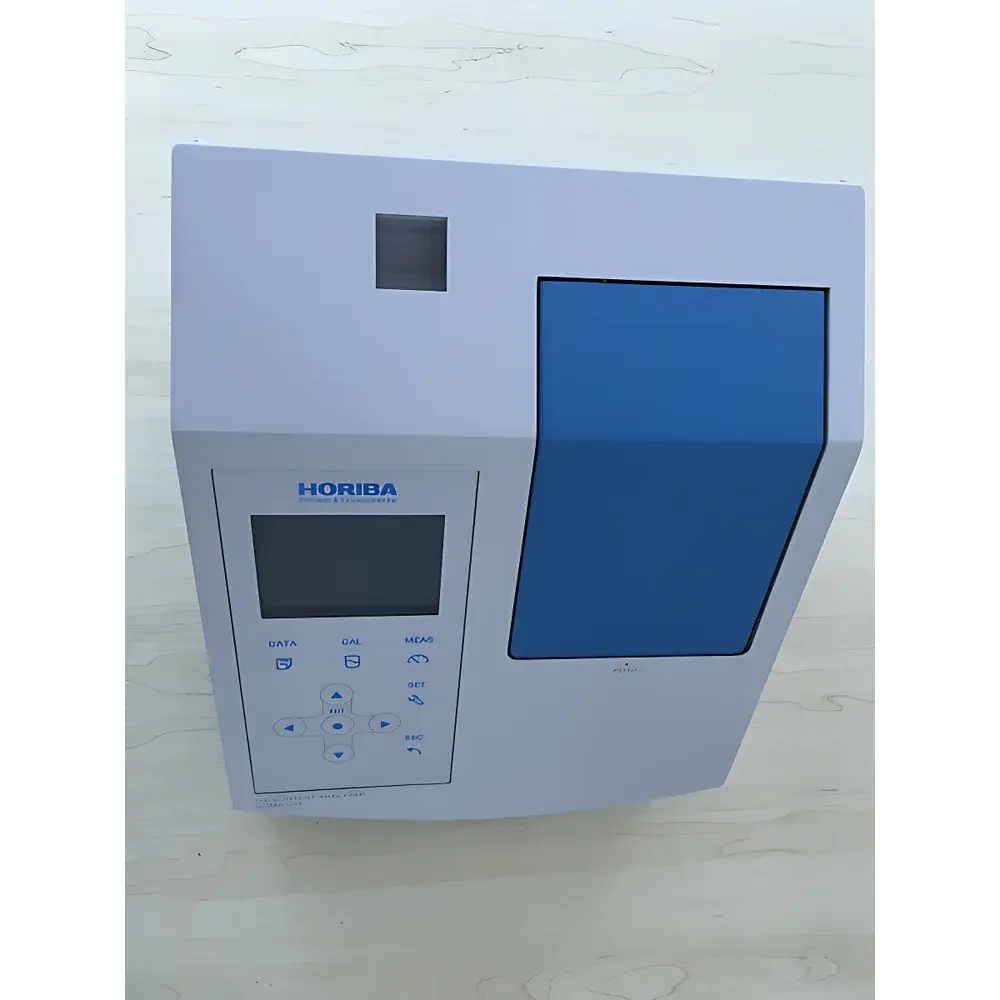
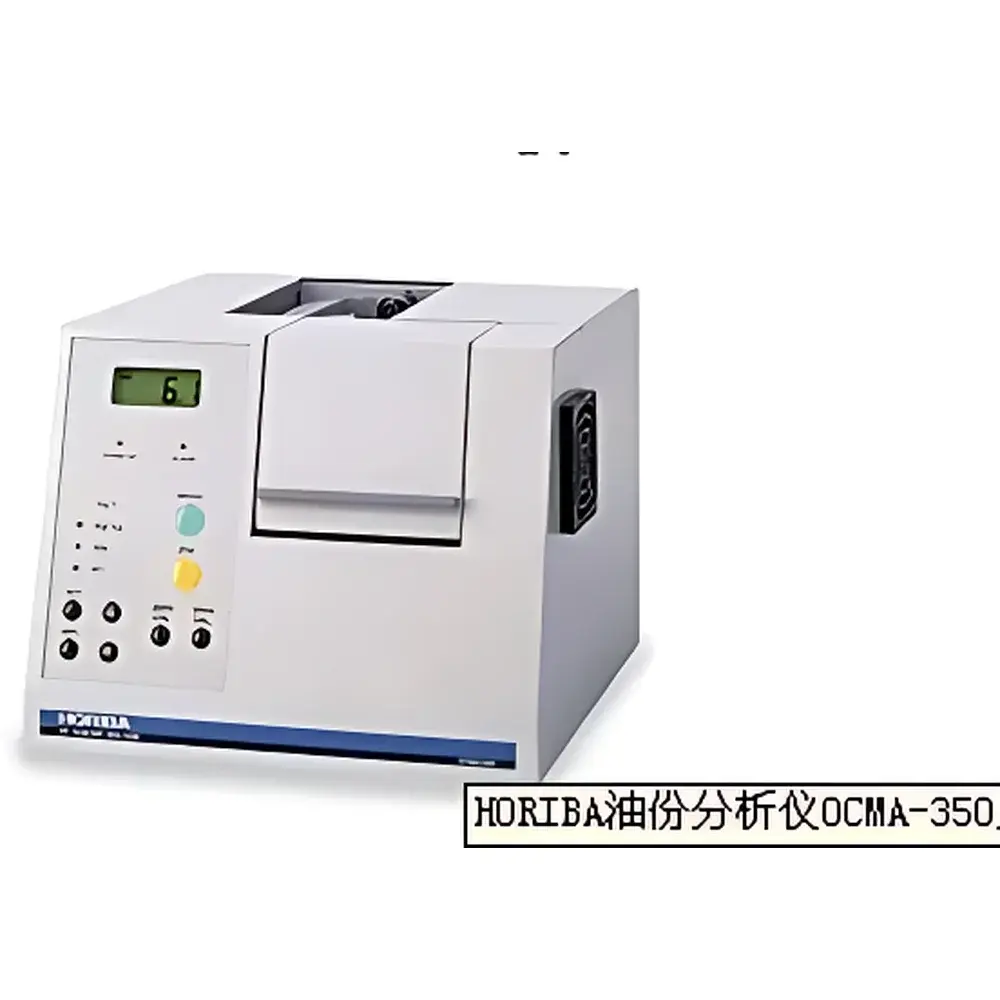
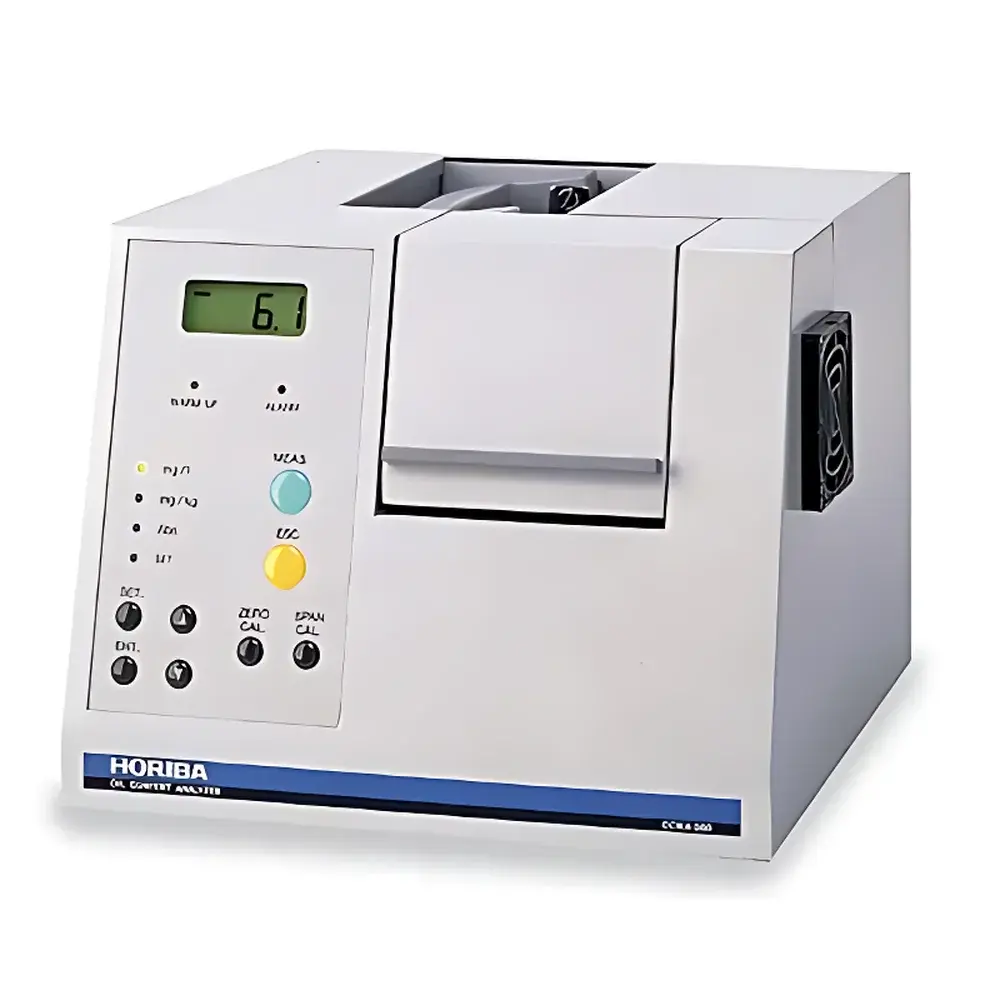
HORIBA OCMA-550 Portable Oil Content Analyzer
| Brand | HORIBA |
|---|---|
| Origin | Japan |
| Model | OCMA-550 |
| Instrument Type | Portable |
| Measurement Principle | Non-Dispersive Infrared (NDIR) Absorption with S-316 Solvent Extraction |
| Measurement Range | 0–200 mg/L (water), 0–1000 mg/kg (soil), 0–1 Abs |
| Detection Limit | 0.1 ppm |
| Repeatability | ±0.4 mg/L (0–9.9 mg/L), ±2.0 mg/L (10.0–99.9 mg/L), ±4 mg/L (100–200 mg/L), ±1% F.S. (0–1 Abs) |
| Optical Path | Quartz Cuvette (200 mm path length) |
| Detector | Thermoelectric Sensor |
| Display | Backlit LCD with Timestamp |
| Interface | RS-232C, Parallel Printer Port |
| Power Supply | 230 V AC, 50 Hz |
| Dimensions | 250 × 200 × 285 mm (W × H × D) |
| Standard Accessories | Covered quartz cuvette, power cord, heavy oil standard (B-grade), 2 A fuse, 10 mL and 25 µL syringes |
Overview
The HORIBA OCMA-550 is a portable, laboratory-grade oil content analyzer engineered for precise quantification of hydrocarbon contamination in aqueous and solid-phase environmental samples. It operates on the principle of non-dispersive infrared (NDIR) absorption spectroscopy at the characteristic C–H stretching band near 3.4 µm — a spectral region where hydrocarbons exhibit strong, selective absorbance while the extraction solvent S-316 remains optically transparent. This enables highly specific detection of total petroleum hydrocarbons (TPH) without interference from water, particulates, or common solvents. Unlike fluorescence-based methods, NDIR provides superior linearity, stability, and resistance to matrix-induced quenching or photobleaching — critical for regulatory compliance in wastewater discharge monitoring, hazardous waste site assessment, and industrial effluent verification. The instrument is calibrated using certified heavy oil reference standards traceable to NIST-maintained hydrocarbon matrices, ensuring metrological integrity across field and fixed-lab deployments.
Key Features
- Triple-unit display capability: switch seamlessly between concentration units — mg/L (for water extracts), mg/kg (for soil/sediment extracts), and absorbance (Abs) — directly on the backlit LCD interface with embedded timestamping.
- Integrated solvent compatibility: optimized for S-316 (1,1,2-trichloro-1,2,2-trifluoroethane), a non-toxic, non-flammable, low-volatility solvent approved under EPA Method 1664B for TPH extraction; its IR-inertness at 3.4 µm eliminates baseline drift.
- High-fidelity optical architecture: utilizes a 200 mm path-length quartz cuvette to maximize sensitivity and signal-to-noise ratio, enabling reliable detection down to 0.1 ppm (µg/L) in aqueous phase.
- Onboard auto-calibration: initiates reference zeroing upon startup using internal dark-current compensation and factory-set gain coefficients stored in non-volatile memory.
- Robust data handling: supports real-time output via RS-232C serial interface or parallel printer port; compatible with LIMS integration and GLP-compliant audit trails when paired with external logging software.
- Compact, field-deployable design: weighs <4.5 kg and fits within ISO-standard transport cases; operates continuously on standard 230 V AC / 50 Hz mains without external cooling or purge gas requirements.
Sample Compatibility & Compliance
The OCMA-550 is validated for use with water, wastewater, leachate, soil slurries, and solid matrices (e.g., metal parts, textiles, machining residues) following standardized solvent extraction protocols. It complies with key international regulatory frameworks including EPA Method 1664B (Revision B), ASTM D7066-04 (Standard Test Method for Determination of Oil and Grease and Selected Petroleum Hydrocarbons in Water and Wastewater by Infrared Spectrophotometry), and ISO 9377-2:2000 (Water quality — Determination of hydrocarbon oil index — Part 2: Infrared spectrometric method). Its measurement uncertainty profile meets QA/QC requirements for Class II and III discharge monitoring under EU Directive 2000/60/EC (Water Framework Directive) and supports documentation for ISO/IEC 17025:2017 accredited laboratories. All calibration standards are supplied with certificate of analysis referencing NIST SRM 2721 (Mineral Oil in Water).
Software & Data Management
While the OCMA-550 operates as a standalone instrument with embedded firmware, its RS-232C interface enables bidirectional communication with PC-based acquisition software (e.g., HORIBA’s optional OCMA DataLink v3.2). This software supports automated batch reporting, statistical process control (SPC) charting, calibration curve validation per ICH Q2(R2), and 21 CFR Part 11-compliant electronic signatures when deployed with validated IT infrastructure. Raw absorbance spectra are not stored onboard, but peak-area integrals at 3.4 µm, integrated time stamps, operator IDs, and calibration history are retained in volatile memory and exportable as CSV or XML. Audit logs record all parameter changes, zero calibrations, and unit switches — essential for GLP/GMP audits and environmental agency inspections.
Applications
- Industrial wastewater compliance: real-time verification of oil-water separator efficiency and post-treatment discharge concentrations prior to release into municipal sewers or surface waters.
- Hazardous waste characterization: quantification of TPH in soil cores, drummed sludges, and remediation site leachates per RCRA SW-846 Method 9071B.
- Manufacturing process control: validation of degreasing efficacy in semiconductor wafer cleaning lines, precision machining coolant carryover, and textile scouring residue limits.
- Environmental forensics: differentiation of crude oil vs. refined product contamination using spectral fingerprint consistency checks (when coupled with reference library matching).
- Regulatory reporting: generation of auditable datasets required for NPDES permits, SPCC plans, and ISO 14001 environmental management system documentation.
FAQ
What extraction solvent is required for the OCMA-550, and why is S-316 specified?
S-316 (1,1,2-trichloro-1,2,2-trifluoroethane) is mandated because it exhibits negligible IR absorbance at 3.4 µm, ensuring that only hydrocarbon signals contribute to the measured absorbance. Its low volatility and high extraction efficiency for aliphatic and aromatic hydrocarbons align with EPA 1664B performance criteria.
Can the OCMA-550 measure dissolved vs. emulsified oil separately?
No — it reports total extractable petroleum hydrocarbons (TEPH) after solvent partitioning. Phase separation must be performed upstream (e.g., centrifugation or filtration) if speciation is required.
Is the instrument suitable for seawater analysis?
Yes, provided salinity correction is applied during calibration; high chloride content does not interfere with the 3.4 µm band, but matrix-matched standards are recommended for accuracy below 5 mg/L.
Does the OCMA-550 support multi-point calibration?
Yes — up to five-point linear or quadratic calibration curves can be programmed via PC interface; factory default uses two-point (zero and span) for field simplicity.
What maintenance is required for long-term accuracy?
Annual verification of detector responsivity and cuvette transmission using NIST-traceable neutral density filters; quarterly cleaning of optical windows with spectroscopic-grade methanol; biannual replacement of desiccant in the sample chamber housing.







