
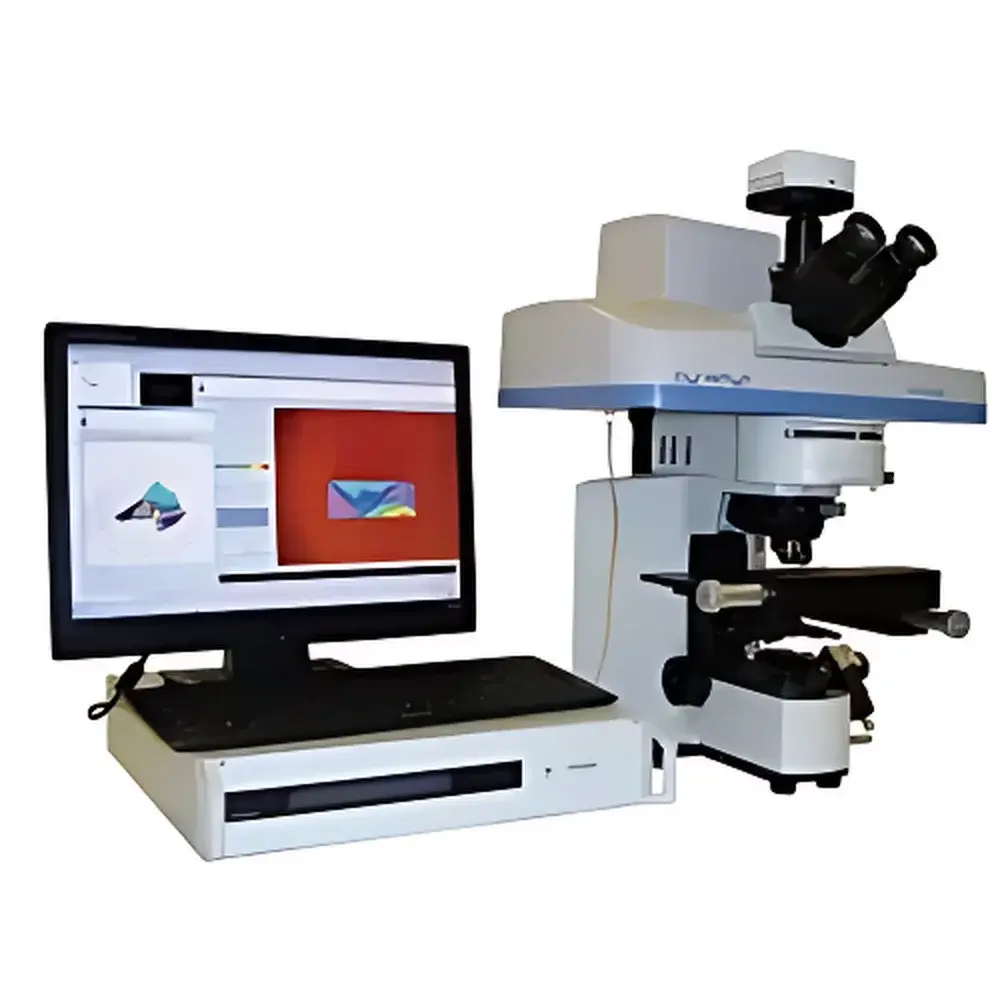
HORIBA Scientific DynaMyc Time-Resolved Fluorescence Lifetime Imaging Microscope
| Brand | HORIBA |
|---|---|
| Origin | USA |
| Model | DynaMyc |
| Detection Principle | Time-Correlated Single Photon Counting (TCSPC) |
| Lifetime Range | 100 ps – 10 µs |
| Spectral Detection Range | 185–650 nm / 300–850 nm (with TBX fast detector) |
| Spatial Resolution | 0.5 µm |
| Scan Stage Travel | 75 × 50 mm |
| Laser Source Options | Pulsed diode lasers (370–980 nm), DeltaDiode series, repetition rate up to 100 MHz, CW/pulsed mode selectable |
| Excitation Filtering | Motorized filter wheel with dichroic mirrors and pinholes (100–1000 µm) |
| Data Acquisition Modes | Single-point, multi-point, FLIM mapping |
| Software | DataStation (instrument control), DAS6 (lifetime decay analysis & deconvolution) |
| Compliance | Designed for GLP/GMP-aligned workflows |
Overview
The HORIBA Scientific DynaMyc is a fully automated, filter-based confocal fluorescence lifetime imaging microscope engineered for quantitative spatiotemporal analysis of molecular dynamics at cellular and subcellular scales. It implements time-correlated single photon counting (TCSPC) — a gold-standard technique in time-resolved fluorescence spectroscopy — to measure fluorescence lifetimes with picosecond temporal resolution (100 ps – 10 µs). Unlike intensity-based fluorescence imaging, lifetime measurements report intrinsic photophysical properties of fluorophores, rendering them insensitive to concentration gradients, photobleaching, excitation intensity fluctuations, and scattering artifacts. This enables robust, quantitative mapping of microenvironmental parameters such as pH, ion concentration, molecular binding states, conformational changes, and Förster resonance energy transfer (FRET) efficiency. Integrated with an Olympus BX51 upright microscope platform and motorized XYZ scanning stage, the DynaMyc delivers micron-level spatial resolution (0.5 µm) while maintaining optical sectioning capability through hardware-confined pinhole selection (100–1000 µm). Its modular architecture supports seamless coupling of multiple pulsed laser diodes (370–980 nm), spectral detection modules, and high-sensitivity detectors — making it suitable for both fundamental biophysics research and applied assay development.
Key Features
- TCSPC-based lifetime acquisition with 100 ps minimum temporal resolution and configurable upper limit up to 10 µs
- Motorized optical module enabling automatic switching of excitation filters, dichroic mirrors, and confocal pinholes
- Fiber-coupled pulsed laser diode sources (DeltaDiode series), supporting wavelengths from 370 nm to 980 nm and repetition rates up to 100 MHz — with optional continuous-wave (CW) output mode
- Confocal head unit featuring programmable pinhole selection (100–1000 µm) for optimized optical sectioning across diverse sample thicknesses
- High-precision XYZ scanning stage with 75 × 50 mm travel range and sub-micron positioning repeatability
- Multi-mode acquisition: single-point decay recording, multi-region ROI analysis, and full-field fluorescence lifetime imaging (FLIM)
- Optional cryogenically cooled sCMOS camera for widefield fluorescence imaging with high dynamic range and low read noise
Sample Compatibility & Compliance
The DynaMyc accommodates a broad range of biological and material science specimens, including live and fixed mammalian cells, tissue sections, 3D organoids, thin-film polymer systems, quantum dot suspensions, and dye-doped nanoparticles. Its open optical design permits integration with environmental chambers (temperature, CO₂, humidity control) and electrophysiology rigs. All hardware and software components are engineered to support regulatory-compliant workflows: DataStation includes user-access logging, electronic signature support, and optional audit trail configuration aligned with FDA 21 CFR Part 11 requirements. Lifetime decay datasets are stored in vendor-neutral formats (e.g., SPC, ASCII) compatible with third-party analysis tools. The system meets ISO/IEC 17025 general requirements for competence of testing and calibration laboratories when operated under documented SOPs.
Software & Data Management
Instrument operation and data acquisition are managed via HORIBA’s DataStation software — a Windows-based platform offering intuitive GUI-driven control of all hardware subsystems (lasers, filters, stages, detectors). Real-time preview, region-of-interest definition, and acquisition parameter optimization are performed without interrupting measurement sequences. Post-acquisition, DAS6 software provides advanced lifetime analysis capabilities including multi-exponential decay fitting, χ² minimization, phasor plot generation, and global analysis across image stacks. Deconvolution algorithms account for instrument response function (IRF) and enable pixel-wise lifetime mapping, amplitude-weighted average lifetime (⟨τ⟩ₐ), intensity-weighted average lifetime (⟨τ⟩ᵢ), and fractional component visualization. Export options include TIFF, PNG, CSV, and HDF5 for integration into MATLAB, Python (NumPy, SciPy), or ImageJ/Fiji pipelines.
Applications
- Quantitative FRET analysis for protein–protein interaction kinetics and conformational transitions
- Monitoring intracellular Ca²⁺, pH, O₂, or redox state using environment-sensitive probes (e.g., SNARF, BCECF, Ru-complexes)
- Characterizing autofluorescence signatures in cancerous vs. healthy tissues for label-free diagnostics
- Studying aggregation kinetics of amyloidogenic proteins (e.g., α-synuclein, Aβ) via lifetime shifts
- Evaluating nanoparticle–biomembrane interactions and endosomal escape mechanisms
- Mapping excited-state dynamics in perovskite thin films and organic photovoltaic materials
FAQ
What is the minimum detectable fluorescence lifetime with the DynaMyc?
The system achieves a temporal resolution of 100 ps, limited primarily by the instrument response function (IRF) of the selected laser/detector combination.
Can the DynaMyc perform simultaneous spectral and lifetime measurements?
Yes — when equipped with a spectrograph-compatible TBX detector and appropriate grating, it supports time-resolved emission spectra (TRES) acquisition in point-scanning mode.
Is the system compatible with super-resolution techniques such as STED or STORM?
The DynaMyc is not inherently a super-resolution platform; however, its modular optical path allows retrofitting with STED-compatible depletion lasers and specialized objectives upon consultation with HORIBA Applications Engineering.
Does the software support batch processing of large FLIM datasets?
DAS6 includes scripting interfaces (VBScript, Python API) enabling automated batch fitting, parameter extraction, and report generation across hundreds of images.
What maintenance protocols are recommended for long-term TCSPC stability?
Annual IRF characterization, detector dark count monitoring, and laser pulse width verification are advised. HORIBA provides preventive maintenance kits and certified service contracts covering alignment validation and timing calibration.






