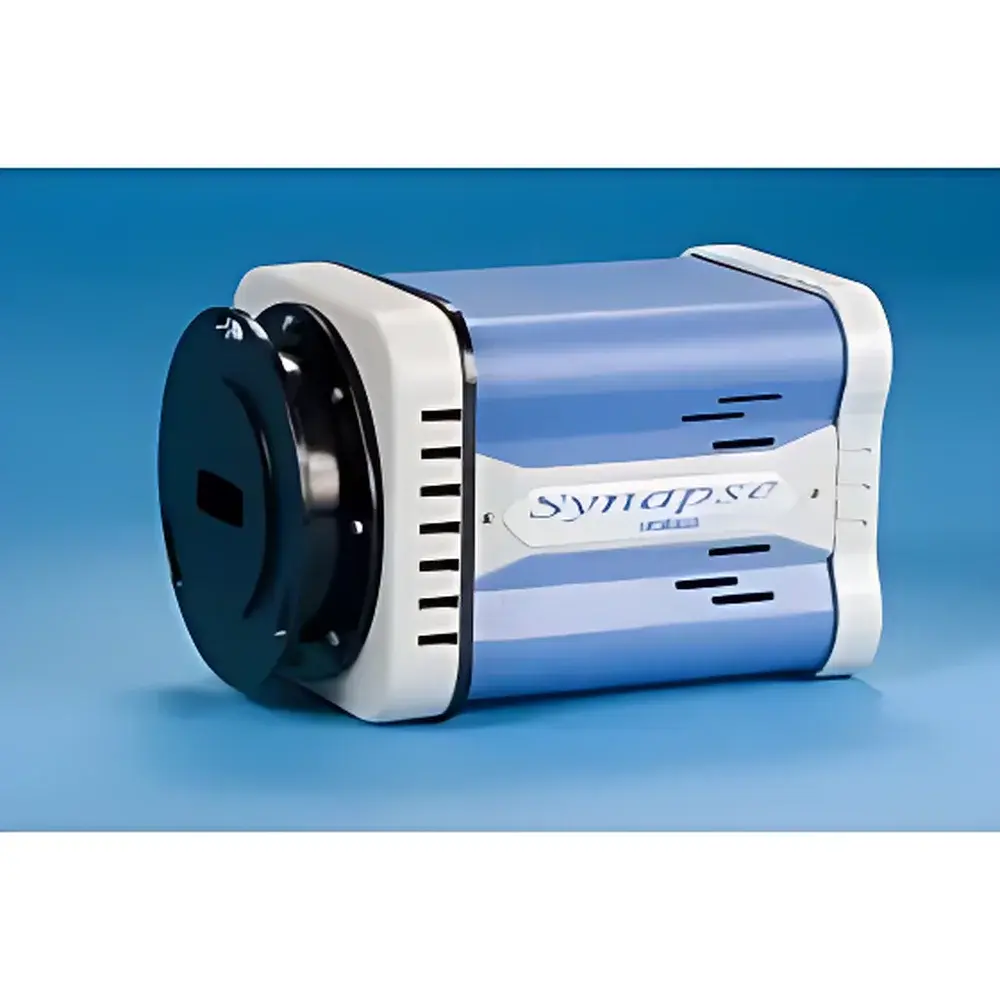
HORIBA Synapse CCD Detector
| Brand | HORIBA |
|---|---|
| Origin | USA |
| Model | Synapse CCD |
| Cooling | Thermoelectric (TE), down to −75 °C |
| Sensor Architecture | Front-Illuminated (FI) or Back-Illuminated (BI), with UV/Visible/NIR-optimized variants |
| Pixel Array Options | 1024×256, 2048×512, 512×512 |
| Readout Interface | USB 2.0 |
| Auxiliary Analog Input | Voltage or current channel for PMT/Si/InGaAs reference detection |
| Trigger Support | Programmable TTL edge-triggered input/output |
| Integrated Shutter Driver | Yes |
| Vacuum-Sealed Sensor Chamber | Yes |
| Linearity Certification | Per-unit factory-tested across full dynamic range |
| Software Compatibility | SynerJY® control suite, SDK, LabVIEW® VIs |
| Compliance | Designed for GLP/GMP-aligned spectral laboratories |
Overview
The HORIBA Synapse CCD Detector is a high-performance, thermoelectrically cooled scientific-grade charge-coupled device engineered for precision optical spectroscopy. Operating on the principle of photon-to-electron conversion in silicon-based photodiode arrays, the Synapse delivers exceptional quantum efficiency across ultraviolet (UV), visible (VIS), and near-infrared (NIR) spectral regions—depending on sensor architecture (front- or back-illuminated, UV-enhanced, deep-depletion, or visible-optimized). Its integrated vacuum-sealed chamber and on-chip low-noise amplification minimize dark current and readout noise, enabling reliable detection of weak spectral signals in demanding applications such as Raman scattering, photoluminescence, time-resolved fluorescence, and low-light absorption spectroscopy. Designed exclusively for seamless integration with HORIBA Jobin Yvon spectrometers—including modular systems like iHR, Triax, and LabRAM—the Synapse serves as a core detection engine in research, quality control, and regulatory-compliant analytical environments.
Key Features
- Thermoelectric cooling to −75 °C reduces dark current by >99% compared to ambient operation, eliminating reliance on liquid nitrogen while maintaining long-exposure stability.
- Dual-stage low-noise analog signal chain with on-die preamplifier placement ensures sub-electron read noise performance and high dynamic range (>16-bit effective).
- Factory-calibrated linearity verification across full well capacity (up to 100,000 e⁻ depending on variant), with individual unit certification for quantitative spectral intensity accuracy.
- Dedicated auxiliary analog input channel accepts voltage or current signals from external detectors (e.g., PMTs, Si photodiodes, InGaAs or Ge diodes), enabling real-time reference normalization or extended wavelength coverage beyond the primary CCD’s native range.
- Built-in TTL-compatible trigger interface supports synchronized multi-instrument timing—programmable input triggers initiate acquisition, while output triggers monitor exposure or readout events for system-level automation.
- Integrated shutter driver circuitry eliminates need for external controllers; enables precise background subtraction, dark-frame correction, and gated acquisition protocols directly from the detector firmware.
- USB 2.0 interface provides plug-and-play connectivity with deterministic latency and sustained 20 MB/s data throughput—sufficient for full-frame reads at up to 10 Hz (1024×256) without frame buffering bottlenecks.
Sample Compatibility & Compliance
The Synapse CCD supports diverse optical configurations through its broad array of sensor options: front-illuminated (FI) devices optimized for cost-sensitive VIS applications; back-illuminated (BI) variants delivering >90% peak QE in UV/VIS; and deep-depletion (DD) models extending sensitivity to 1100 nm. All configurations operate within sealed, single-window vacuum housings to preserve cooling integrity and eliminate maintenance requirements. The detector complies with electromagnetic compatibility (EMC) standards IEC 61326-1 and safety standard IEC 61010-1. When deployed with SynerJY® software under validated laboratory conditions, the system supports audit trails, electronic signatures, and data integrity controls aligned with FDA 21 CFR Part 11 and ISO/IEC 17025 requirements for accredited testing laboratories.
Software & Data Management
The Synapse is fully controlled via HORIBA’s SynerJY® software—a modular, cross-platform application supporting real-time spectrum visualization, multi-channel acquisition, kinetic series capture, and advanced post-processing (e.g., cosmic ray removal, spectral deconvolution, and intensity calibration). Raw data are stored in vendor-neutral HDF5 format with embedded metadata (exposure time, gain, temperature, calibration coefficients). For custom automation, HORIBA provides a comprehensive Software Development Kit (SDK) with C/C++, Python, and .NET bindings, alongside certified LabVIEW® Virtual Instruments (VIs) compliant with NI’s driver architecture. All software components support timestamped logging, user-access controls, and configurable export to CSV, ASCII, or SPC formats for third-party analysis tools.
Applications
- Raman spectroscopy: High-sensitivity detection of low-intensity Stokes/anti-Stokes bands with minimal thermal noise contribution.
- Photoluminescence (PL) and electroluminescence (EL): Quantitative decay kinetics and spectral mapping under pulsed excitation.
- UV-Vis-NIR absorbance and reflectance: Multi-wavelength quantification in pharmaceutical, polymer, and thin-film characterization.
- Time-resolved spectroscopy: Gated acquisition synchronized with laser pulses or chopper wheels for lifetime-resolved measurements.
- Process analytical technology (PAT): In-line spectral monitoring in bioreactors or chemical synthesis reactors using auxiliary reference channels for real-time drift correction.
- Astronomical spectroscopy: Low-background operation suitable for ground-based slit spectrographs requiring stable dark current over extended integrations.
FAQ
What cooling method does the Synapse CCD use, and what is its minimum operating temperature?
The Synapse employs single-stage thermoelectric (Peltier) cooling, achieving sensor temperatures as low as −75 °C without cryogenic fluids.
Does the Synapse require external hardware to drive a mechanical shutter?
No—it includes an integrated shutter driver circuit compatible with standard solenoid and rotary shutters, controllable via software commands.
Can the auxiliary input channel be used simultaneously with CCD acquisition?
Yes; the analog input operates independently and synchronously, allowing concurrent recording of reference signals during CCD exposure.
Which software platforms are officially supported for custom integration?
HORIBA provides native SDKs for C/C++, Python (via ctypes), .NET Framework, and LabVIEW® 2015–2023 with documented API calls and error-handling conventions.
Are linearity and noise specifications guaranteed per unit?
Each Synapse detector undergoes individual factory testing for full-well linearity, read noise, and dark current, with test reports supplied with shipment.