
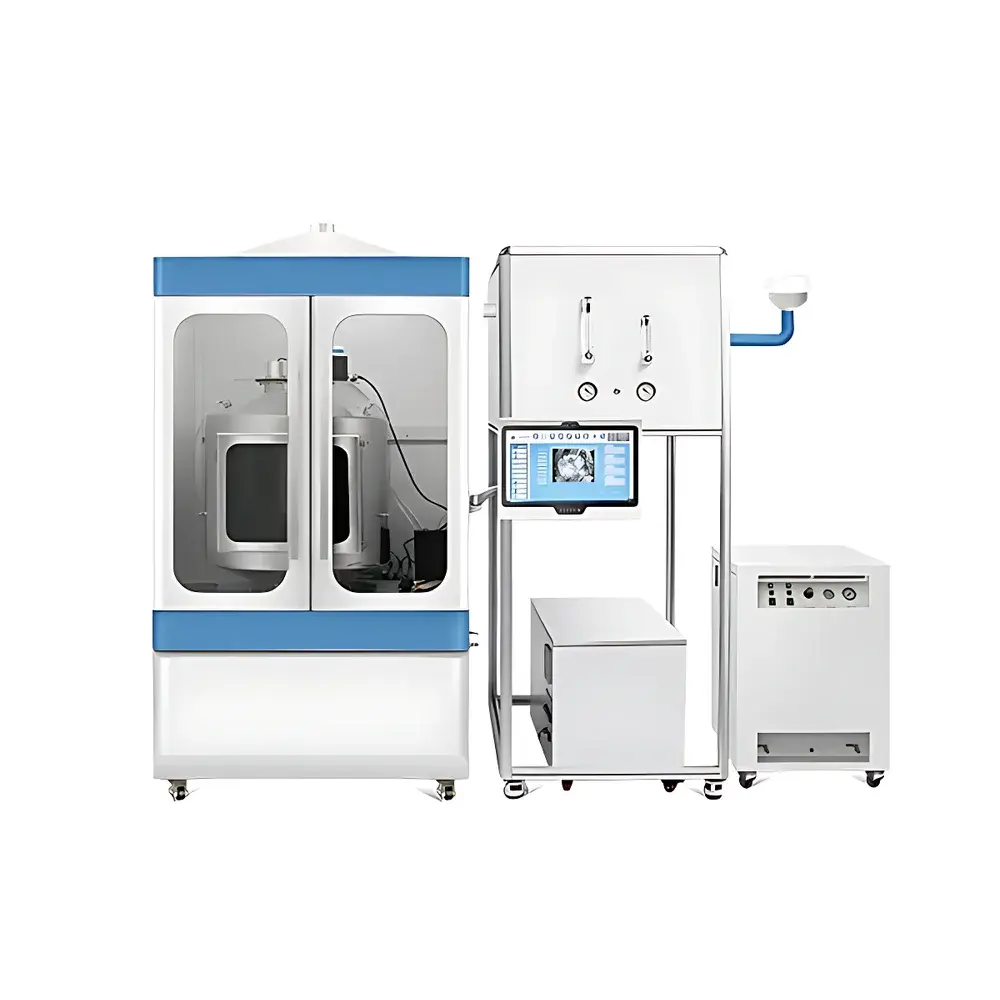
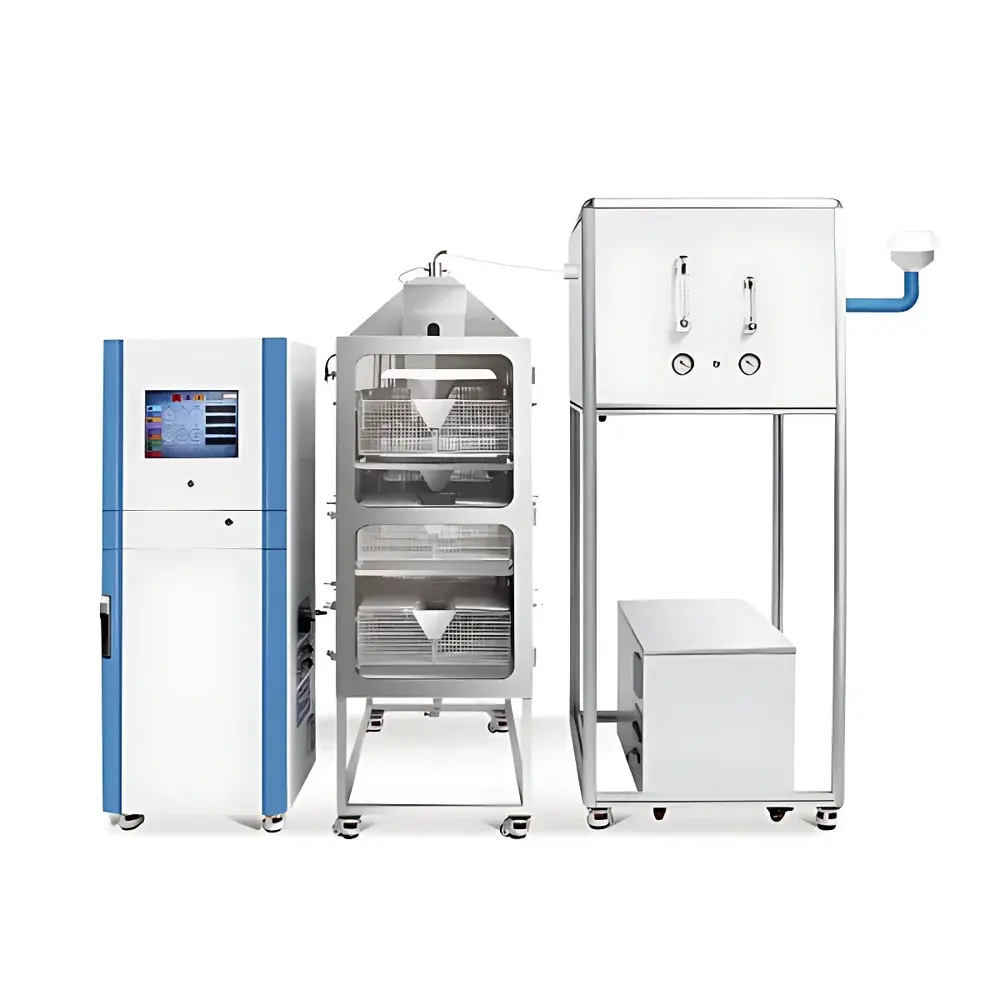
HRH-PM186 / HRH-PM286 Whole-Body Inhalation Exposure System with Online PM₂.₅ Enrichment
| Brand | Huironghe |
|---|---|
| Origin | Beijing, China |
| Model | HRH-PM186 (0.3 m³ chamber) / HRH-PM286 (1.0 m³ chamber) |
| PM₂.₅ enrichment factor | 6–10× |
| Output flow rate | 40–60 L/min |
| Chamber volume options | 0.3 m³ (up to 40 rats, single-animal per cage) / 1.0 m³ (up to 96 rats, single-animal per cage) |
Overview
The HRH-PM186 and HRH-PM286 Whole-Body Inhalation Exposure Systems are engineered for controlled, reproducible, and physiologically relevant delivery of ambient fine particulate matter (PM₂.₅) to laboratory animals under standardized exposure conditions. These systems integrate a slit-type inertial impactor-based online PM₂.₅ enrichment module with a stainless-steel whole-body exposure chamber, enabling real-time concentration of ambient PM₂.₅ by a factor of 6 to 10 without chemical alteration or particle agglomeration. Unlike nebulizer- or aerosol-generator-based systems, this design preserves the native size distribution, chemical composition, and hygroscopic properties of environmental PM₂.₅—critical for modeling human-relevant inhalation pathophysiology. The system supports chronic and subchronic exposure protocols aligned with OECD Test Guideline 412 (Subacute Inhalation Toxicity) and ASTM E1755–01 (Standard Guide for Inhalation Exposure of Laboratory Animals), facilitating regulatory-grade toxicological assessment.
Key Features
- Online PM₂.₅ enrichment via slit-jet inertial impaction: maintains particle integrity, avoids thermal degradation or solvent interference
- Dual-chamber configuration: HRH-PM186 (0.3 m³) accommodates up to 40 rats in individual cages; HRH-PM286 (1.0 m³) supports up to 96 rats under identical airflow homogeneity
- Stable output flow range of 40–60 L/min ensures uniform aerosol distribution and laminar flow profiles across the exposure zone
- PM₂.₅ sampling performance validated per HJ 93–2013: 50% cutoff aerodynamic diameter ≤ 2.5 µm ± 0.2 µm; sharpness (σg) ≤ 1.2
- Modular construction with electropolished 316L stainless-steel chambers, quick-disconnect fittings, and HEPA-filtered exhaust management
- Integrated real-time monitoring ports for concurrent gravimetric (TEOM), optical (OPC), and chemical (XRF/IC) analysis of delivered aerosol mass concentration and composition
Sample Compatibility & Compliance
The system is compatible with untreated ambient air, roadside, urban, or downwind industrial PM₂.₅ samples—no pre-conditioning or resuspension required. It supports exposure durations from acute (≤ 6 h) to subchronic (≥ 90 days), with temperature (18–26 °C) and relative humidity (30–70% RH) control optional via external HVAC integration. All exposure protocols adhere to GLP principles per OECD Series on Principles of Good Laboratory Practice, including audit-trail-capable exposure log generation, calibration traceability to NIST SRM 1648a (Urban Dust), and documentation of chamber leakage rate (< 5% vol/min at 250 Pa differential pressure). The PM₂.₅ enrichment module meets the mechanical and metrological requirements specified in HJ 93–2013 for reference method samplers used in China’s national ambient air quality monitoring network.
Software & Data Management
Exposure parameters—including total flow rate, enrichment ratio, chamber pressure differential, and cumulative exposure time—are logged at 1 Hz via an embedded industrial PLC (Siemens S7-1200) with Ethernet/IP interface. Data export is supported in CSV and HDF5 formats, compatible with MATLAB, Python (pandas/h5py), and commercial toxicokinetic platforms (e.g., GastroPlus®, Simcyp). Optional FDA 21 CFR Part 11-compliant software add-on provides electronic signatures, role-based access control, and immutable audit trails for regulatory submissions. Calibration certificates for mass flow controllers (Bronkhorst EL-FLOW Select) and pressure transducers (Setra 230) are supplied with NIST-traceable uncertainty statements.
Applications
- Establishment of etiologically relevant animal models of PM₂.₅-induced respiratory disease: asthma, COPD, pulmonary fibrosis, ARDS, and ALI
- Mechanistic studies of oxidative stress, NLRP3 inflammasome activation, alveolar macrophage polarization, and epithelial barrier dysfunction
- Preclinical evaluation of inhalable therapeutics, antioxidant interventions, and anti-fibrotic agents under environmentally realistic exposure scenarios
- Co-exposure studies with gaseous pollutants (O₃, NO₂, SO₂) using integrated gas dosing modules (optional)
- Translational biomarker discovery via bronchoalveolar lavage fluid (BALF), lung tissue RNA-seq, and serum cytokine profiling
FAQ
What is the maximum achievable PM₂.₅ mass concentration during enrichment?
Concentration depends on ambient input levels; with typical urban background PM₂.₅ of 20–80 µg/m³, the system delivers 120–800 µg/m³ at 10× enrichment—within the range observed in severe haze episodes.
Can the system be used for nose-only exposure?
No; it is configured exclusively for whole-body inhalation. Nose-only adaptation requires separate hardware (e.g., restraint tubes, tapered manifolds) not included in this platform.
Is the enrichment factor adjustable in real time?
Yes—via programmable control of impactor jet velocity and dilution air ratio, enabling stepwise or gradient exposure protocols.
Does the system include aerosol characterization instrumentation?
The base configuration includes ports for third-party analyzers; optional integrated TEOM microbalance and optical particle sizer (OPS) modules are available upon request.
What maintenance intervals are recommended for the impactor and chamber?
Impactor slits require ultrasonic cleaning every 72 h of cumulative operation; chamber interior must be wiped with 70% ethanol after each study and passivated quarterly per ISO 14644-1 Class 7 cleanroom protocols.
Related Products



