
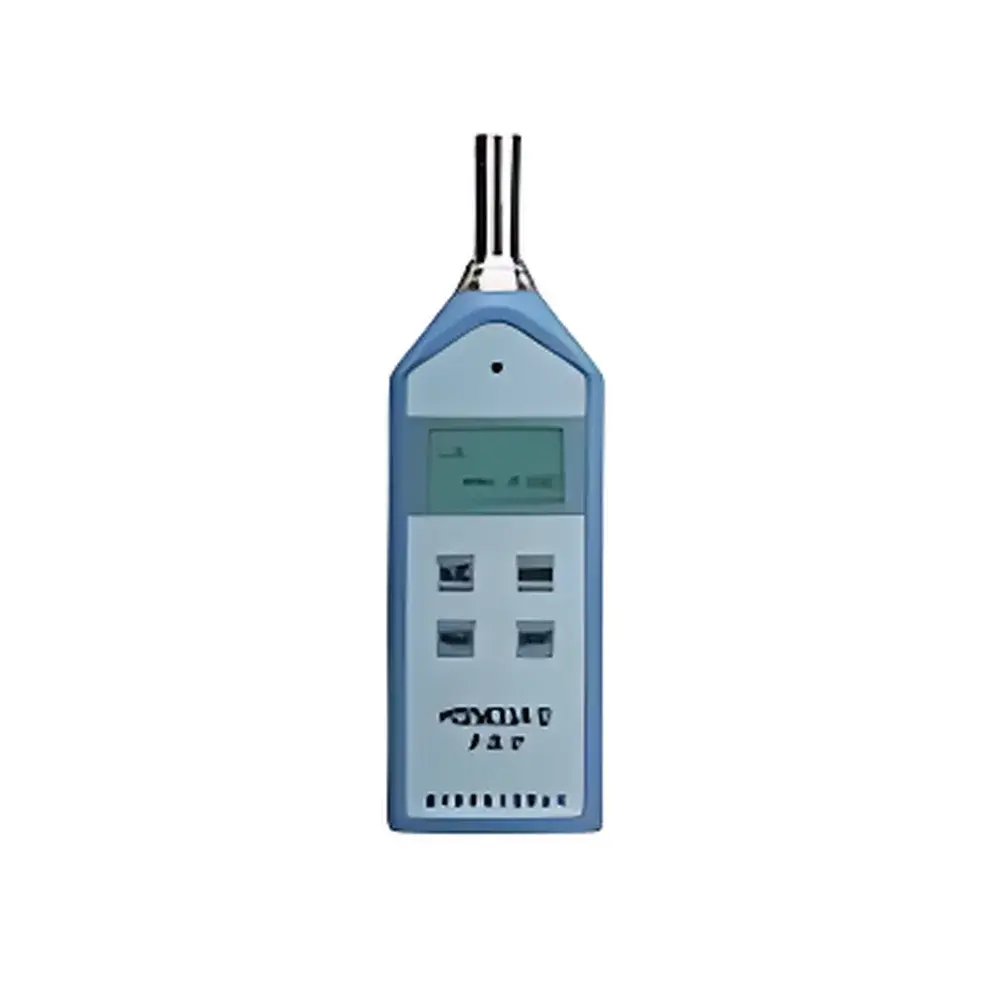
HS5633A Sound Level Meter by Yinhé Technology
| Origin | Jiangsu, China |
|---|---|
| Manufacturer Type | Authorized Distributor |
| Origin Category | Domestic (PRC) |
| Model | HS5633A |
| Pricing | Available Upon Request |
| Microphone | 1/2″ Electret Condenser, 30 mV/Pa |
| Frequency Range | 20 Hz – 10 kHz |
| Measurement Range | 35–120 dB (L: 35–90 dB |
| H | 60–120 dB) |
| Frequency Weighting | A, C |
| Time Weighting | Fast (F) |
| Detector | RMS + Peak (Peak Factor ≥3) |
| Display | 2×8 Character LCD, 0.1 dB Resolution, 1 Hz Update Rate |
| Compliance | IEC 61672-1:2013 Class 2, GB/T 3785.1–2010 Class 2 |
| Reference SPL | 94 dB @ 1 kHz |
| Reference Incidence | Axial |
| Power Supply | 1 × 9 V Alkaline (6F22), <15 mA |
| Dimensions | 170 × 52 × 24 mm |
Overview
The HS5633A Sound Level Meter is a compact, handheld acoustic measurement instrument engineered for field-deployable noise assessment in industrial, transportation, occupational, and environmental contexts. It operates on the principle of electroacoustic transduction using a precision 1/2″ electret condenser microphone, converting incident sound pressure fluctuations into proportional voltage signals. Signal conditioning—including analog filtering, RMS detection with peak-hold capability (peak factor ≥3), and digital conversion—is performed under embedded microcontroller control. The device conforms strictly to IEC 61672-1:2013 Class 2 and GB/T 3785.1–2010 Class 2 requirements for sound level meters, ensuring metrological traceability and inter-laboratory comparability in routine monitoring applications where high reproducibility—not laboratory-grade uncertainty—is the operational priority.
Key Features
- True Class 2 compliance per IEC 61672-1:2013 and GB/T 3785.1–2010, validated for use in regulatory screening, workplace noise surveys, and community noise mapping.
- Integrated 1/2″ electret condenser microphone with nominal sensitivity of 30 mV/Pa and flat frequency response from 20 Hz to 10 kHz—optimized for broadband noise evaluation across urban traffic, machinery emissions, and HVAC systems.
- Dual-range measurement architecture: Low-range mode (35–90 dB) enables sensitive detection of ambient and indoor noise; high-range mode (60–120 dB) supports industrial impact and machinery noise characterization without clipping.
- A- and C-frequency weightings implemented in analog hardware prior to RMS detection, ensuring real-time spectral correction aligned with human hearing perception and regulatory thresholds (e.g., OSHA, EU Directive 2003/10/EC).
- Fast (F) time weighting (125 ms integration time) provides dynamic response suitable for fluctuating noise sources such as passing vehicles or intermittent equipment operation.
- Backlit 2×8 character LCD with 0.1 dB resolution and 1 Hz display refresh rate ensures legibility in low-light conditions and stable numerical interpretation during extended field sessions.
- Ultra-portable form factor (170 × 52 × 24 mm) and single 9 V alkaline battery operation (<15 mA current draw) support multi-hour continuous use without external power infrastructure.
Sample Compatibility & Compliance
The HS5633A is designed for free-field sound pressure measurements under standard atmospheric conditions (23 °C ±5 °C, 65% RH max, 86–106 kPa). It accepts axial incidence only, per IEC 61672-1 Annex B. While not intended for impulse or ultrasound measurement, its 20 Hz–10 kHz bandwidth covers the full audible spectrum relevant to occupational exposure assessments (e.g., ISO 9612:2009) and environmental noise ordinances (e.g., WHO Guidelines on Community Noise). The instrument meets the minimum performance criteria for Class 2 devices—including amplitude linearity, temperature stability, and overload recovery—as verified during factory calibration against NIST-traceable reference sound sources. It is suitable for use in GLP-aligned field studies but does not provide audit trails or electronic signature functionality required for FDA 21 CFR Part 11–regulated environments.
Software & Data Management
The HS5633A operates as a standalone, firmware-embedded instrument with no onboard data logging or USB connectivity. All measurements are displayed in real time; no internal memory or export interface is provided. For documentation purposes, users must manually record readings or integrate the meter’s AC/DC output signal (available via rear-panel BNC connector) into external data acquisition systems compliant with IEEE 1057 or IEC 61000-4-30. Calibration verification should be performed before and after each measurement session using a Class 1 pistonphone (e.g., 94 dB @ 1 kHz) in accordance with ISO 7196:1995. No proprietary software suite is supplied or supported.
Applications
- Ongoing noise surveillance at construction sites, manufacturing facilities, and logistics hubs per ISO 14001 environmental management system requirements.
- Preliminary assessment of worker exposure levels in accordance with national occupational safety standards (e.g., China’s GBZ 2.2–2014, OSHA 29 CFR 1910.95).
- Community noise baseline studies supporting municipal planning, zoning decisions, and complaint investigations.
- Verification of acoustic performance for building envelope elements (e.g., windows, façades) under ISO 140-3 and ISO 717-1 test protocols.
- Educational demonstrations of sound propagation, frequency weighting, and decibel scaling in physics and environmental engineering curricula.
FAQ
Does the HS5633A support data logging or Bluetooth connectivity?
No. It is a real-time display-only instrument with no internal memory, SD card slot, or wireless interface.
Is periodic recalibration required—and if so, how often?
Yes. Annual calibration against an accredited acoustic standard (e.g., Class 1 pistonphone) is recommended per ISO/IEC 17025 guidance and manufacturer specifications.
Can it measure octave-band or 1/3-octave spectra?
No. The HS5633A provides only broadband A- and C-weighted Leq, Lmax, and Lpeak values—not frequency-analyzed outputs.
What is the maximum operating temperature range?
The specified operating range is −10 °C to +50 °C, with relative humidity ≤85% non-condensing.
Is the microphone replaceable in the field?
The electret microphone is factory-integrated and not user-serviceable; replacement requires return-to-factory service.
Related Products







