
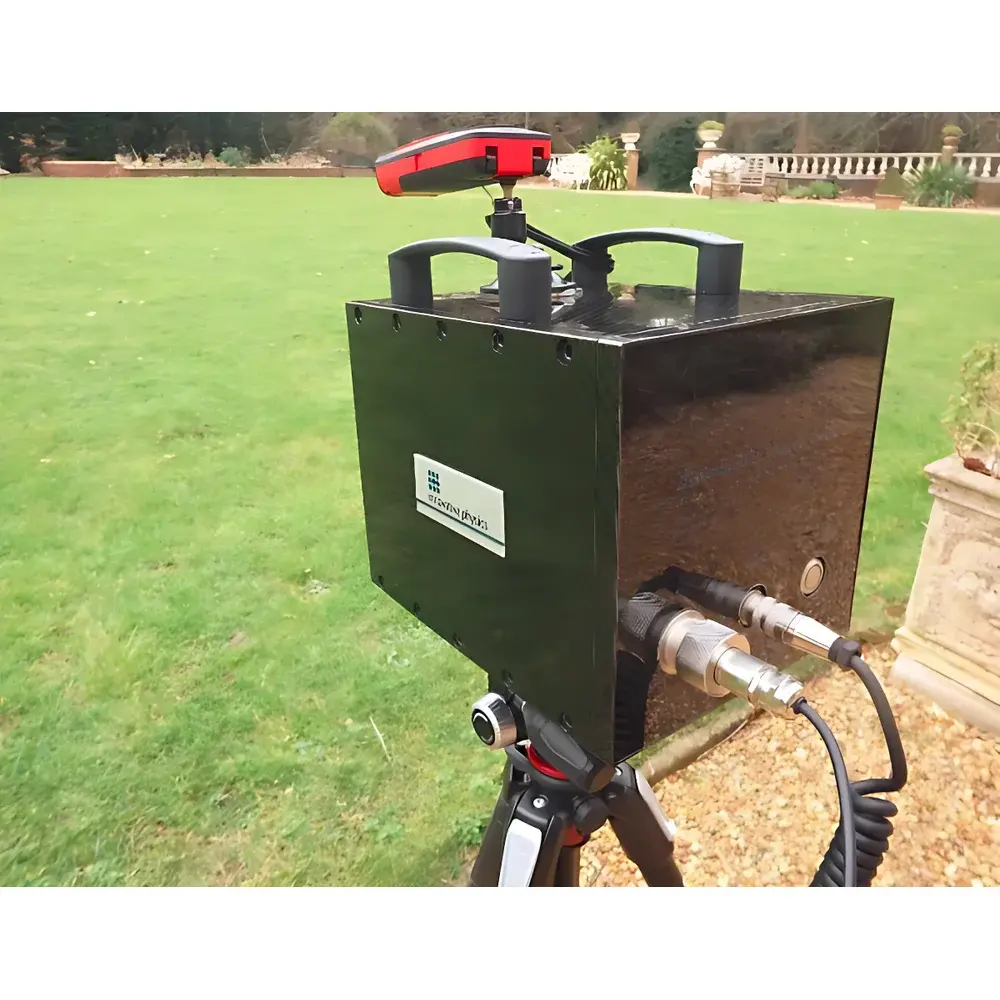
HSL Gamma Hotspot Imaging System
| Origin | UK |
|---|---|
| Manufacturer Type | Distributor |
| Origin Category | Imported |
| Model | HSL |
| Instrument Type | Activity Meter (Radiation Intensity Meter) |
| Detector Material | CsI(Tl), 8×8 Array |
| Collimator | Dynamic Coded Aperture |
| Energy Range | 50 keV – 1.5 MeV |
| Field of View | 60° |
| Optical Lens Resolution | 1024 × 768, Auto-Focus |
| Software Interface | Three-Button Operation (Start / Stop / Replay) |
| Weight | <10 kg (with shielding), <6.5 kg (without shielding) |
| Ingress Protection Rating | IP67 |
| Wireless Data Transmission | Yes |
Overview
The HSL Gamma Hotspot Imaging System is a portable, real-time gamma radiation imaging instrument engineered for rapid spatial localization and quantitative assessment of radioactive contamination. Unlike conventional survey meters or scintillation probes that provide only point-source intensity readings, the HSL employs coded aperture imaging—a well-established technique in nuclear instrumentation—based on geometric modulation of incident gamma photons through a dynamically reconfigurable mask. Coupled with a high-resolution CsI(Tl) scintillator array (8 × 8 elements) and advanced iterative reconstruction algorithms, the system converts statistically sparse photon arrival data into high-fidelity, georeferenced gamma intensity maps. This enables operators to visually identify “hotspots” with sub-degree angular resolution across a 60° field of view—critical during radiological emergency response, decommissioning surveys, or routine contamination screening. Designed in accordance with the ALARA (As Low As Reasonably Achievable) principle, the system supports remote operation via secure wireless telemetry, minimizing operator dose exposure without compromising measurement fidelity.
Key Features
- Real-time coded aperture gamma imaging with dynamic mask optimization for enhanced contrast and reduced artifacts
- High-sensitivity CsI(Tl) scintillation detector array delivering stable light yield and low afterglow across the 50 keV–1.5 MeV energy range
- Integrated 1024 × 768 optical camera with auto-focus and synchronized overlay of gamma intensity contours onto visible-light imagery
- Three-button operational interface (Start / Stop / Replay) enabling intuitive, glove-compatible use in PPE environments
- Ruggedized housing rated IP67 for dust-tight and immersion-resistant performance in harsh outdoor or industrial settings
- Lightweight architecture: <6.5 kg (unshielded), <10 kg (with integrated lead/tungsten collimation shielding)
Sample Compatibility & Compliance
The HSL system is compatible with heterogeneous radiation fields typical of environmental monitoring, nuclear facility maintenance, and post-incident reconnaissance—including mixed nuclide sources (e.g., 137Cs, 60Co, 241Am) and low-activity surface contamination scenarios. It does not require sample preparation or physical contact with contaminated surfaces. Regulatory alignment includes compliance with IEC 62327:2017 (hand-held instruments for photon emission detection), IEC 60846-2:2014 (radiation protection instrumentation—dose rate meters), and supports audit-ready documentation per ISO/IEC 17025:2017 requirements when integrated into accredited laboratory workflows. Its wireless transmission protocol adheres to IEEE 802.11n standards with TLS 1.2 encryption, ensuring secure data integrity during field-to-command-center transfer.
Software & Data Management
The embedded firmware and companion PC software support full traceability and regulatory readiness. Each acquired image includes embedded metadata: GPS coordinates (when GNSS module enabled), timestamp (NTP-synchronized), operator ID, instrument calibration certificate ID, and acquisition parameters (exposure duration, energy window, collimator state). Data export formats include DICOM-SR (Structured Reporting), GeoTIFF with embedded radiation intensity scaling, and CSV for spectral histogram analysis. Audit trail functionality logs all user actions—including parameter changes and replay events—with immutable timestamps, satisfying FDA 21 CFR Part 11 and EU Annex 11 requirements for electronic records in radiological safety management.
Applications
- Environmental remediation site characterization and hotspot prioritization prior to excavation
- Radiological emergency response—rapid mapping of dispersed contamination following transport incidents or facility breaches
- Nuclear power plant auxiliary building surveys, spent fuel pool perimeter monitoring, and steam generator tube inspection support
- Border security and counter-terrorism operations involving illicit radioactive material interdiction
- Metallurgical scrap yard screening for orphan sources in recycled metal streams
- Decommissioning planning and clearance verification under IAEA RS-G-1.7 and national regulatory frameworks
FAQ
What gamma-emitting isotopes can the HSL detect?
The system is optimized for medium-to-high-energy gamma emitters between 50 keV and 1.5 MeV, including but not limited to 137Cs (662 keV), 60Co (1.17 & 1.33 MeV), 241Am (59.5 keV), and 192Ir (295–468 keV). Detection sensitivity varies with source geometry, distance, and background conditions.
Does the HSL require annual recalibration?
Yes—calibration must be performed annually against traceable reference sources (e.g., NIST-traceable 137Cs or 60Co point sources) and documented per ISO/IEC 17025 requirements. Field verification checks using built-in test sources are recommended before each deployment.
Can the system operate in rain or dusty environments?
With its IP67-rated enclosure, the HSL withstands temporary immersion (up to 1 m for 30 min) and complete dust ingress protection—making it suitable for outdoor use in adverse weather or industrial zones with airborne particulates.
Is spectral identification supported?
No—the HSL is an imaging activity meter, not a spectrometer. It provides spatially resolved intensity mapping within the specified energy window but does not perform nuclide-specific identification. For isotopic analysis, complementary HPGe or NaI(Tl) spectroscopy systems are recommended.
How is wireless data security ensured during transmission?
All wireless communications use WPA2-Enterprise authentication and AES-256 encryption. Session keys are regenerated per connection, and no raw image data is stored on the device after transmission unless explicitly configured for local backup.







