
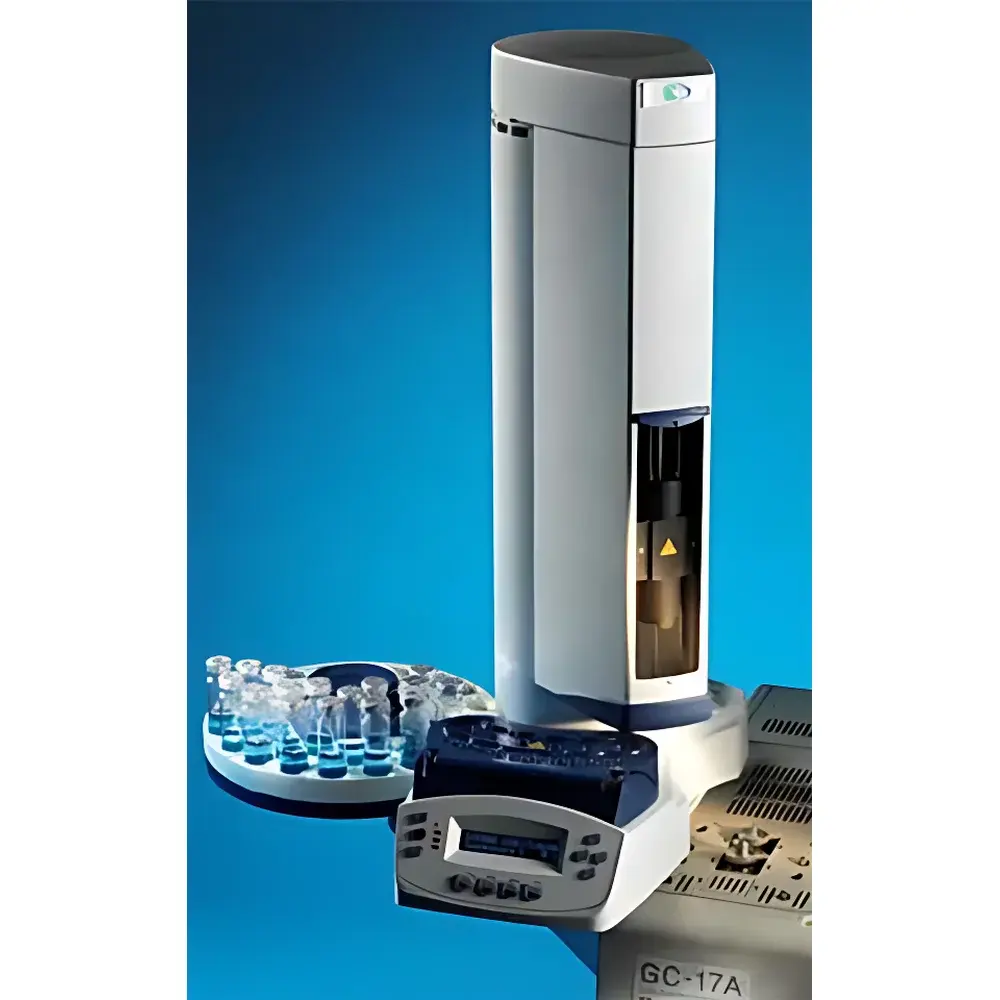
HT200H Headspace Autosampler by Shimadzu
| Brand | Shimadzu |
|---|---|
| Origin | Italy |
| Model | HT200H Headspace Autosampler |
| Sample Capacity | 40 positions (for 10 mL or 20 mL headspace vials) |
| Sample Heating Block | Simultaneous heating of up to 6 vials |
| Heating Temperature Range | 40–150 °C |
| Heating Time Range | 0–23 h 59 min |
| Agitation Duration | 0–99 min |
| Agitation Speed | Adjustable |
| Syringe Volume | Standard 2.5 mL, optional 5 mL |
| Minimum Injection Volume | 0.01 mL |
| Injection Flow Rate | 0.1–100 mL/min |
| Equilibration Delay | 0–60 s |
| Needle Temperature Control | 40–150 °C |
| Carrier/Purge Gas | Inert gas (N₂ or He) |
| Extraction Mode | Multiple Headspace Extraction (MHE), up to 15 cycles |
| Software Compatibility | HT-Comsoft-H and Clarity Chromatography Data Systems |
| Position Flexibility | Removable sample tray configurable for left- or right-side installation |
Overview
The HT200H Headspace Autosampler by Shimadzu is a precision-engineered, benchtop thermal desorption system designed for automated, reproducible headspace sampling in gas chromatography (GC) workflows. It operates on the principle of equilibrium headspace analysis—where volatile analytes partition between a liquid or solid sample matrix and the vapor phase above it at controlled temperature and agitation conditions. This method enables quantitative determination of trace-level volatiles without solvent interference or column contamination. The HT200H supports both static headspace and multiple headspace extraction (MHE), a technique widely adopted in regulated environments for enhanced accuracy in residual solvent analysis, environmental testing, and pharmaceutical stability studies. Its modular architecture, robust temperature control, and vendor-agnostic interface make it suitable for integration into diverse GC platforms—including those from Agilent, Thermo Fisher, PerkinElmer, Waters, and domestic manufacturers—without hardware modification.
Key Features
- High-capacity 40-position sample carousel compatible with standard 10 mL and 20 mL crimp-top headspace vials.
- Independent dual-zone thermal control: a programmable heating block capable of simultaneously conditioning up to six vials at temperatures from 40 °C to 150 °C with ±0.1 °C stability.
- Adjustable mechanical agitation with variable speed and duration (0–99 min), optimizing mass transfer kinetics for heterogeneous or viscous matrices.
- Precision syringe-driven injection system with selectable volumes (2.5 mL standard; 5 mL optional) and fine-tuned delivery rates (0.1–100 mL/min), enabling accurate sub-10 µL injections.
- Heated injection needle (40–150 °C) prevents condensation and carryover, critical for high-boiling-point analytes and low-concentration applications.
- MHE mode supports up to 15 sequential extractions per vial, facilitating statistical validation of equilibration completeness and improving detection reliability per ICH Q2(R2) guidelines.
- Configurable sample tray orientation—easily repositioned to left- or right-side mounting to accommodate varied GC inlet geometries and lab layout constraints.
Sample Compatibility & Compliance
The HT200H accommodates a broad range of sample types: aqueous solutions, polymers, pharmaceutical tablets, food matrices, soil slurries, and packaged consumer products. Its inert gas purge system (N₂ or He) ensures minimal oxidative degradation during equilibration. The system complies with fundamental requirements of ISO 17025 for method validation and aligns with USP , EP 2.4.24, and ICH Q3C for residual solvent analysis. When operated under validated protocols with audit-trail-enabled software (e.g., Clarity with 21 CFR Part 11 compliance modules), the HT200H supports GLP and GMP-regulated laboratories in maintaining data integrity, traceability, and electronic signature requirements.
Software & Data Management
Control and method development are performed via HT-Comsoft-H—a dedicated, Windows-based interface offering intuitive sequence building, real-time status monitoring, and error logging. For integrated chromatographic data handling, native drivers enable bidirectional communication with Clarity CDS, supporting synchronized method loading, run initiation, and post-run result correlation. All parameter changes, injection events, and system alerts are timestamped and stored locally, forming a complete electronic record. Optional upgrades include network deployment, remote diagnostics, and LIMS integration through standard OPC UA or ASCII export protocols.
Applications
- Residual solvent quantification in APIs and excipients per ICH Q3C Class 1–3 limits.
- Volatile organic compound (VOC) profiling in drinking water, wastewater, and ambient air samples (EPA Method 502.2, 624).
- Flavor and fragrance release kinetics in beverages and dairy products.
- Head-space oxygen and moisture permeation testing in pharmaceutical blister packaging.
- Decomposition product screening in accelerated stability studies (ICH Q1A).
- Quality control of ethanol content in hand sanitizers and disinfectants (USP ).
FAQ
Is the HT200H compatible with non-Shimadzu GC systems?
Yes—it features universal analog/digital I/O and RS-232/USB connectivity, allowing seamless integration with all major GC vendors via standard trigger and handshake protocols.
Can MHE data be exported for statistical evaluation?
Yes—raw peak area/time data from each extraction cycle is logged in CSV format and can be imported into statistical software for linearity assessment, RSD calculation, and equilibration modeling.
What maintenance intervals are recommended for long-term reliability?
Syringe calibration verification every 200 injections; septum replacement every 500 cycles; carrier gas filter inspection quarterly; full system performance qualification annually per laboratory SOP.
Does the system support unattended overnight operation?
Yes—full sequence autonomy with power-fail recovery, vial position tracking, and end-of-sequence alerting ensures uninterrupted multi-day runs.
Is method transfer documentation available?
Shimadzu provides application notes, IQ/OQ templates, and cross-platform validation checklists upon request to support regulatory submissions and internal audits.




