
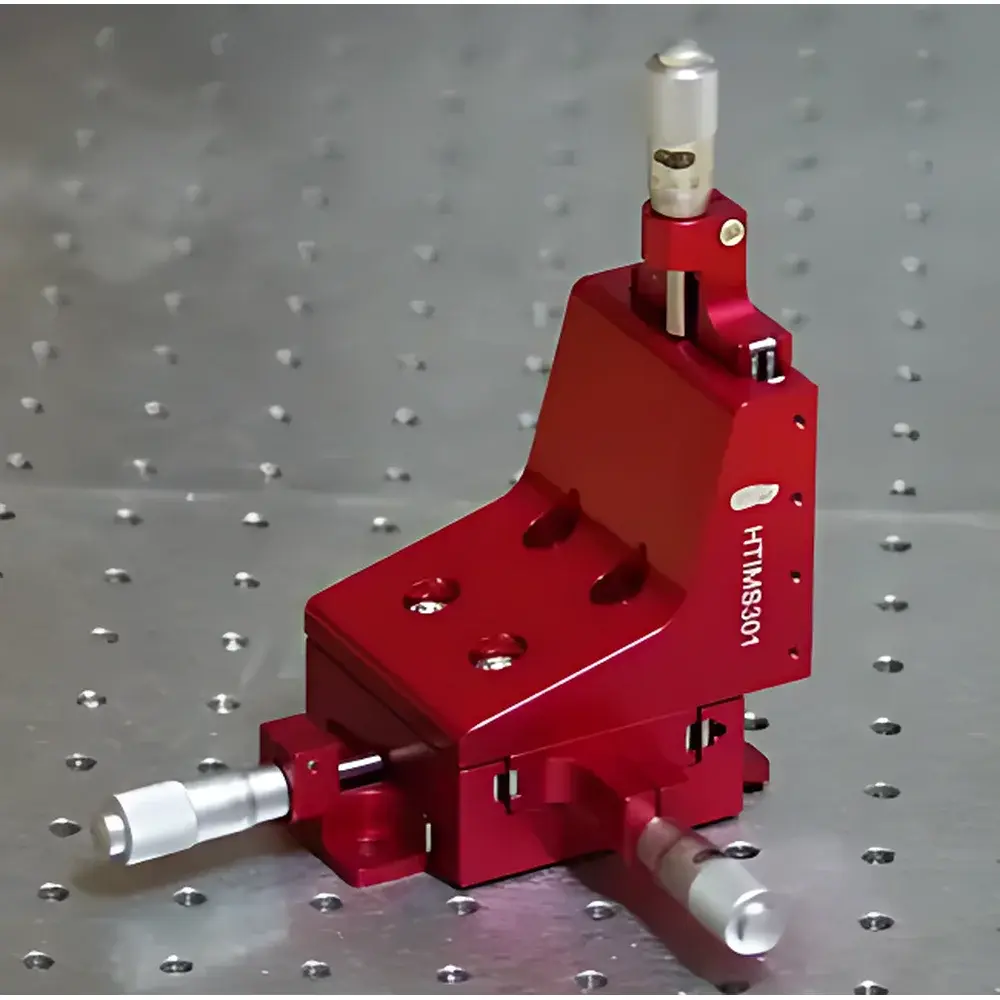
HTIMS301 Integrated XYZ Manual Translation Stage
| Brand | HanDing / HT |
|---|---|
| Origin | Jiangsu, China |
| Model | HTIMS301 |
| Travel (X/Y/Z) | 13 mm |
| Drive Mechanism | Differential Micrometer Head |
| Sensitivity | 0.002 mm |
| Guide Type | Precision Linear Ball Bearing Rail with Ground Steel Rods |
| Material & Finish | Anodized Aluminum (Crimson Red) |
| Max Load | 3.5 kg |
| Weight | 0.9 kg |
| Handedness | Right-Handed (HTIMS301R) |
| Product Category | Manual Translation Stage |
| Compliance | Designed for ISO/IEC 17025-aligned optical alignment workflows in R&D and metrology labs |
Overview
The HTIMS301 Integrated XYZ Manual Translation Stage is an engineered solution for high-fidelity spatial positioning in optical alignment, interferometry, laser cavity construction, and micro-optics assembly. Built upon a monolithic aluminum base architecture, it delivers three orthogonal translational degrees of freedom (X, Y, Z) within a compact footprint—enabling precise, coordinated motion without stacking discrete stages or introducing cumulative orthogonality errors. Its operation relies on mechanical displacement transmission via differential micrometer heads actuating precision-ground steel rods coupled with linear ball bearing rails—a configuration optimized for low hysteresis, minimal runout, and repeatable sub-micron positioning under static loading conditions up to 3.5 kg. The stage’s design prioritizes thermal stability, mechanical rigidity, and long-term dimensional integrity—critical for applications requiring alignment persistence over extended experimental cycles or environmental fluctuations.
Key Features
- Monolithic integrated XYZ architecture eliminates inter-stage coupling errors and reduces footprint by >40% compared to stacked configurations
- Precision linear ball bearing guidance system with hardened ground steel rods ensures straightness deviation < 5 µm over full 13 mm travel per axis
- Differential micrometer heads (HTDM-13 compatible) provide 2 µm resolution with spring-loaded backlash compensation and engraved dual-scale readouts (metric/imperial)
- Anodized aluminum body (Crimson Red finish) offers corrosion resistance, non-magnetic properties, and compatibility with cleanroom environments (ISO Class 5–7)
- Right-hand configuration (HTIMS301R) standard; left-hand variants available upon request for symmetric optical train layouts
- Pre-aligned orthogonal axes verified at factory using autocollimation and laser interferometry per ISO 10110-7 standards
Sample Compatibility & Compliance
The HTIMS301 accommodates optical components including mirrors (up to Ø50 mm), lens mounts, fiber couplers, detector packages, and microelectromechanical systems (MEMS) devices. Its load capacity supports typical optomechanical assemblies used in confocal microscopy, cavity ring-down spectroscopy (CRDS), and ultrafast laser beam steering setups. The stage conforms to mechanical interface standards including SM1 (1.035″-40) and M4/M6 tapped holes on all mounting surfaces. While not certified to specific regulatory frameworks (e.g., FDA, CE), its dimensional traceability, surface finish consistency, and material certification (per ASTM B567 for anodizing thickness) support compliance with GLP/GMP-aligned laboratory documentation protocols. It is routinely deployed in academic and industrial labs operating under ISO/IEC 17025 quality management systems for calibration and measurement uncertainty reporting.
Software & Data Management
As a purely manual stage, the HTIMS301 requires no firmware, drivers, or software integration. All positional data is recorded manually via micrometer scale readings—ensuring full auditability and eliminating electronic failure modes or cybersecurity dependencies. For laboratories maintaining digital lab notebooks (e.g., LabArchives, Benchling), users typically log position values alongside timestamped experiment metadata. Optional accessories—including calibrated micrometer adapters and NIST-traceable gauge blocks—enable direct linkage to metrological reference chains. No proprietary software or vendor-specific file formats are involved, preserving data sovereignty and long-term archival integrity.
Applications
- Alignment of laser cavities and external resonators in quantum optics experiments
- Positioning of photonic integrated circuit (PIC) test probes during wafer-level characterization
- Fine adjustment of retroreflectors in Michelson and Mach–Zehnder interferometers
- Stabilization of optical paths in time-resolved fluorescence lifetime imaging (FLIM) systems
- Mounting platform for miniature spectrometers and fiber-coupled detectors in portable analytical instruments
- Teaching tool for undergraduate optics laboratories demonstrating Cartesian coordinate manipulation and error propagation analysis
FAQ
Is the HTIMS301 compatible with vacuum environments?
No—standard anodized aluminum construction is not vacuum-rated; outgassing and thermal contraction characteristics preclude use below 10⁻³ mbar without modification.
Can I retrofit stepper motor actuators to this stage?
Not recommended—the mechanical interface lacks mounting provisions or torque-rated drive shafts; dedicated motorized versions (e.g., HTIMS301-M) are available separately.
What is the angular deviation tolerance between X/Y/Z axes?
Orthogonality error is ≤15 arcsec per pair (X-Y, Y-Z, Z-X), measured at 20 °C per ISO 230-1 Annex B protocols.
Does the stage include mounting hardware?
Yes—M4 cap screws, washers, and alignment pins are supplied; additional SM1-threaded adapters and kinematic baseplates are optional.
How often does the micrometer require recalibration?
Under normal lab use, annual verification against traceable gauge blocks is sufficient; no internal recalibration mechanism exists.




