
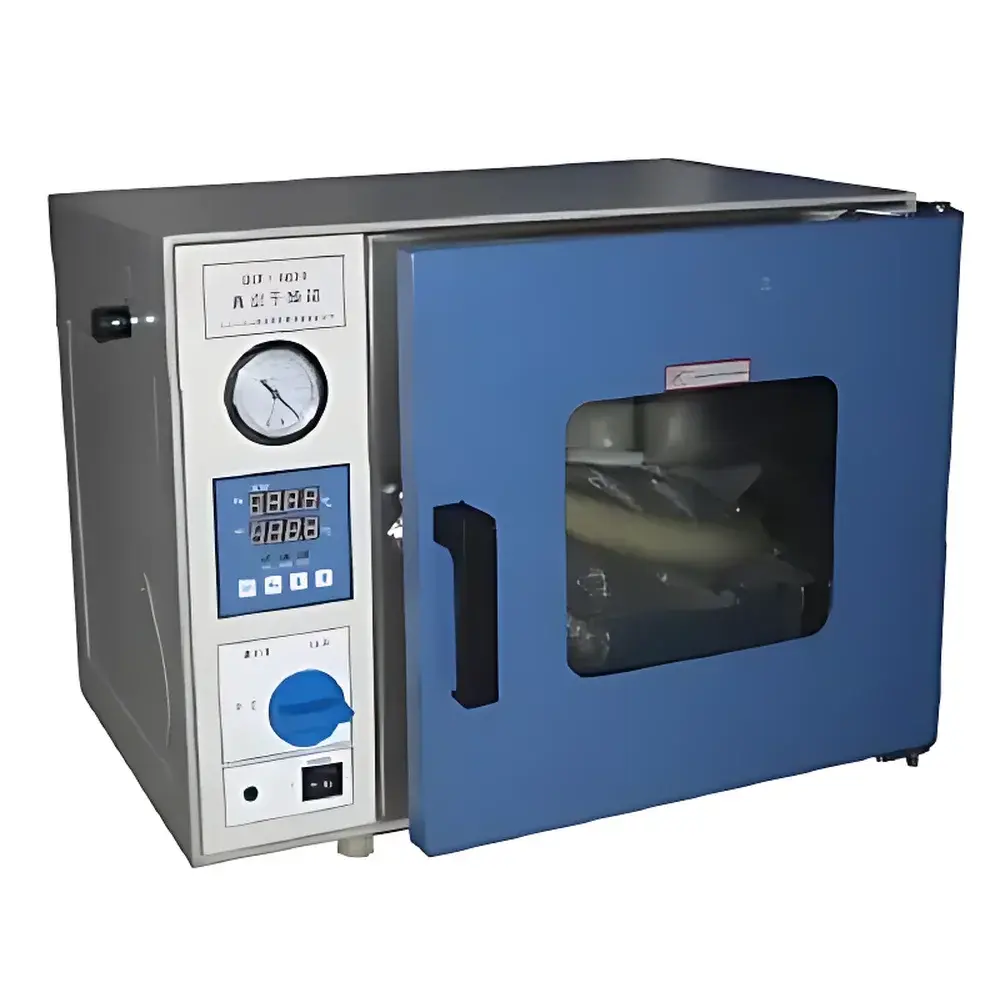
YIHENG DZF-6020 Benchtop Vacuum Drying Oven
| Brand | YIHENG |
|---|---|
| Origin | Jiangsu, China |
| Model | DZF-6020 |
| Instrument Type | Vacuum Oven |
| Temperature Range | RT+10 °C to 200 °C |
| Vacuum Level | ≤133 Pa |
| Temperature Resolution | 0.1 °C |
| Temperature Uniformity | ±1 °C |
| Chamber Material | AISI 304 Stainless Steel |
| Chamber Dimensions (W×D×H) | 320×320×300 mm |
| External Dimensions (W×D×H) | 630×510×490 mm |
| Power Supply | AC 220 V, 50 Hz |
| Input Power | 850 W |
| Observation Window | Dual-layer tempered glass |
| Door Seal | Molded silicone gasket |
| Inert Gas Inlet | Standard |
| Shelf Configuration | 2 adjustable stainless steel shelves |
| Operating Ambient | +5 °C to +40 °C |
Overview
The YIHENG DZF-6020 is a benchtop vacuum drying oven engineered for precise thermal processing under reduced-pressure environments. It operates on the fundamental principle of lowering the boiling point of solvents and moisture via vacuum application—enabling efficient, low-temperature drying of thermally labile, oxidation-prone, or compositionally complex samples. Unlike conventional convection ovens, this unit eliminates atmospheric oxygen during heating, thereby preventing oxidative degradation, polymer crosslinking, or decomposition of sensitive organic compounds, pharmaceutical intermediates, and biological matrices. Its chamber is fully sealed and rated for sustained operation at ≤133 Pa (≤1 Torr), compatible with standard two-stage rotary vane vacuum pumps (not included). The DZF-6020 is widely deployed in QC laboratories, R&D facilities, and academic institutions where controlled inert-atmosphere thermal treatment—such as solvent removal from APIs, pre-weighing sample stabilization, or moisture content validation per ISO 554 and ASTM E104—is required.
Key Features
- Stainless steel (AISI 304) working chamber with seamless welds and electropolished interior—resistant to corrosion, easy to decontaminate, and compliant with GLP cleaning traceability requirements.
- Shelf-heating architecture: Independent heating elements embedded within the stainless steel shelves ensure uniform thermal distribution across sample surfaces—reducing drying time by >40% versus perimeter-heated vacuum ovens (validated under empty-chamber conditions at 25 °C ambient).
- Dual-layer tempered glass observation window with integrated safety film—provides real-time visual monitoring without vacuum loss or thermal shock risk.
- Adjustable door compression mechanism with molded, high-elasticity silicone gasket—maintains vacuum integrity over repeated cycles and supports long-term sealing performance per ISO 2859-1 sampling plans.
- Microprocessor-based PID temperature controller with 0.1 °C resolution and ±1 °C stability (at setpoint)—calibration traceable to NIST-certified reference standards upon user request.
- Standard inert gas inlet port (1/4″ BSP) for nitrogen or argon purging prior to or during vacuum cycles—supports USP & ICH Q5C stability protocols requiring oxygen exclusion.
Sample Compatibility & Compliance
The DZF-6020 accommodates a broad range of sample formats—including Petri dishes, weighing boats, glass vials, aluminum pans, and custom fixtures—within its 30.7 L chamber volume. It is routinely used for drying heat-sensitive pharmaceutical excipients (e.g., lactose monohydrate, mannitol), lyophilized protein formulations, ceramic precursors, battery electrode slurries, and botanical extracts. The unit complies with general safety requirements outlined in IEC 61010-1:2010 for laboratory electrical equipment. While not certified to UL or CE for export markets without regional adaptation, its construction adheres to material biocompatibility (ISO 10993-5), surface finish (Ra ≤ 0.8 µm), and electromagnetic compatibility (EN 61326-1) benchmarks common in regulated laboratory environments. Vacuum integrity testing per ASTM E478 is supported via optional digital vacuum transducer integration.
Software & Data Management
The DZF-6020 operates via standalone front-panel control with non-volatile memory for up to 10 programmable drying profiles. Though it does not feature built-in data logging or Ethernet connectivity, analog output (0–5 V) is available for external recording systems. For laboratories operating under FDA 21 CFR Part 11 or EU Annex 11 requirements, third-party validated data acquisition modules (e.g., NI CompactDAQ with LabVIEW runtime) can be interfaced to capture time-stamped temperature, vacuum pressure, and cycle duration—enabling full audit trails, electronic signatures, and CSV/PDF report generation aligned with ALCOA+ principles. Optional RS-485 Modbus RTU interface enables integration into centralized facility monitoring systems (SCADA/BMS).
Applications
- Residual solvent removal from active pharmaceutical ingredients (APIs) per ICH Q3C guidelines.
- Moisture content determination in polymers and composites (ASTM D6980, ISO 15512).
- Pre-conditioning of reference standards and calibration weights per ISO/IEC 17025 clause 7.6.
- Drying of nanomaterial dispersions without agglomeration—leveraging vapor-phase mass transfer dominance under vacuum.
- Stabilization of hygroscopic reagents (e.g., anhydrous metal salts, organolithium compounds) under inert atmosphere.
- Accelerated aging studies for packaging materials and medical device components (ISO 11607-1).
FAQ
Does the DZF-6020 include a vacuum pump?
No. A compatible two-stage rotary vane vacuum pump (e.g., ultimate vacuum ≤10 Pa, pumping speed ≥2 L/s) must be sourced separately and connected via standard KF-16 or ISO-KF flange.
Can the chamber temperature exceed 200 °C?
Not natively. The DZF-6020 is rated for maximum 200 °C. Custom units with shelf-heating architecture supporting 300 °C operation are available with 20-day lead time and 20% premium—subject to modified gasket material (fluoroelastomer) and enhanced insulation validation.
Is the temperature controller compliant with GLP audit requirements?
Yes—the PID controller supports user-accessible calibration offset adjustment and retains last-set parameters after power loss. Full calibration certificates (with uncertainty budgets) can be issued by accredited metrology labs upon request.
What maintenance is required for long-term vacuum integrity?
Quarterly inspection of the silicone door gasket for compression set or cracking; annual replacement recommended. Vacuum gauge calibration every 12 months using a certified reference transducer (e.g., MKS Baratron 627B).
Can multiple shelves operate at independent temperatures?
No. All shelves share a single thermal zone. Independent shelf-zone control is available only on higher-tier DZF-62xx series models with dual PID loops.



