
GRINTECH GRIN Needle Microscope
| Brand | GRINTECH |
|---|---|
| Origin | Canada |
| Manufacturer Type | Authorized Distributor |
| Import Status | Imported |
| Model | GRIN Needle Microscope |
| Core Component | Solid-State Laser System |
Overview
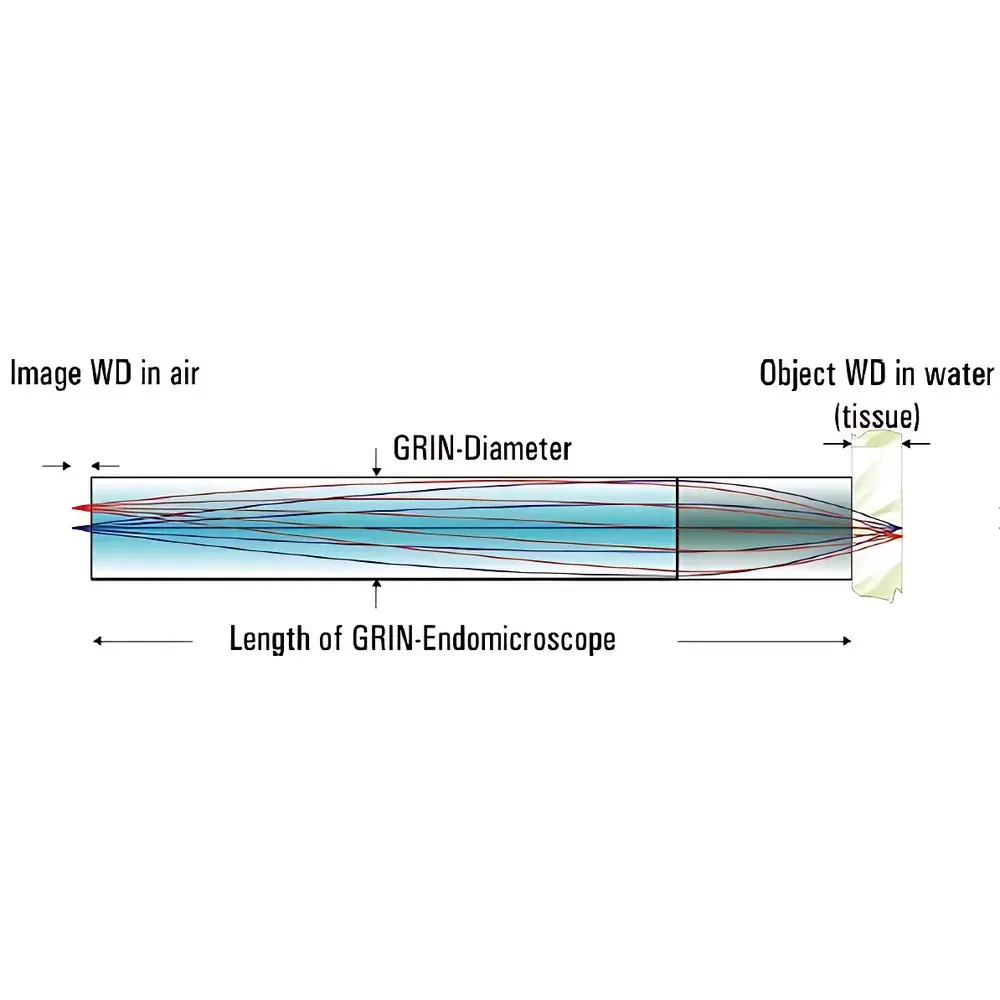
The GRINTECH GRIN Needle Microscope is a high-precision, minimally invasive optical imaging instrument engineered for deep-tissue microscopic visualization in biological and preclinical research. It leverages gradient-index (GRIN) lens technology—where refractive index varies radially across the lens material—to enable sub-millimeter-diameter optical probes capable of delivering diffraction-limited resolution at depths inaccessible to conventional microscopy. The system operates on two primary excitation modalities: multiphoton fluorescence imaging (optimized at 860 nm for reduced scattering and deeper penetration in scattering media) and epi-fluorescence imaging (optimized at 520 nm for high-contrast surface or shallow-layer visualization). Unlike bulk optics-based endomicroscopes, this needle-integrated design eliminates relay lens trains and maintains optical fidelity through a monolithic or dual-element GRIN stack, enabling real-time, in vivo cellular-resolution imaging during stereotactic procedures, intracranial monitoring, or intravital tumor margin assessment.
Key Features
- GRIN lens configurations: Single-element GRIN probe (NA = 0.5 on both object and image sides) or dual-element GRIN relay system (object-side NA = 0.5, image-side NA = 0.19), optimized for coupling with standard microscope ports or fiber-coupled laser sources
- Working distance defined in aqueous or tissue-equivalent medium (e.g., saline or agarose), with image-side output in air—ensuring compatibility with standard CCD/CMOS cameras and photomultiplier tube (PMT) detectors
- Dual-wavelength optical design validated for 520 nm (epi-fluorescence) and 860 nm (multiphoton excitation), supporting common fluorophores including GFP, FITC, and near-infrared dyes such as IRDye 800CW
- Probe diameters ranging from 350 µm to 1.0 mm, with lengths scalable up to 25 mm for stereotactic or catheter-based deployment
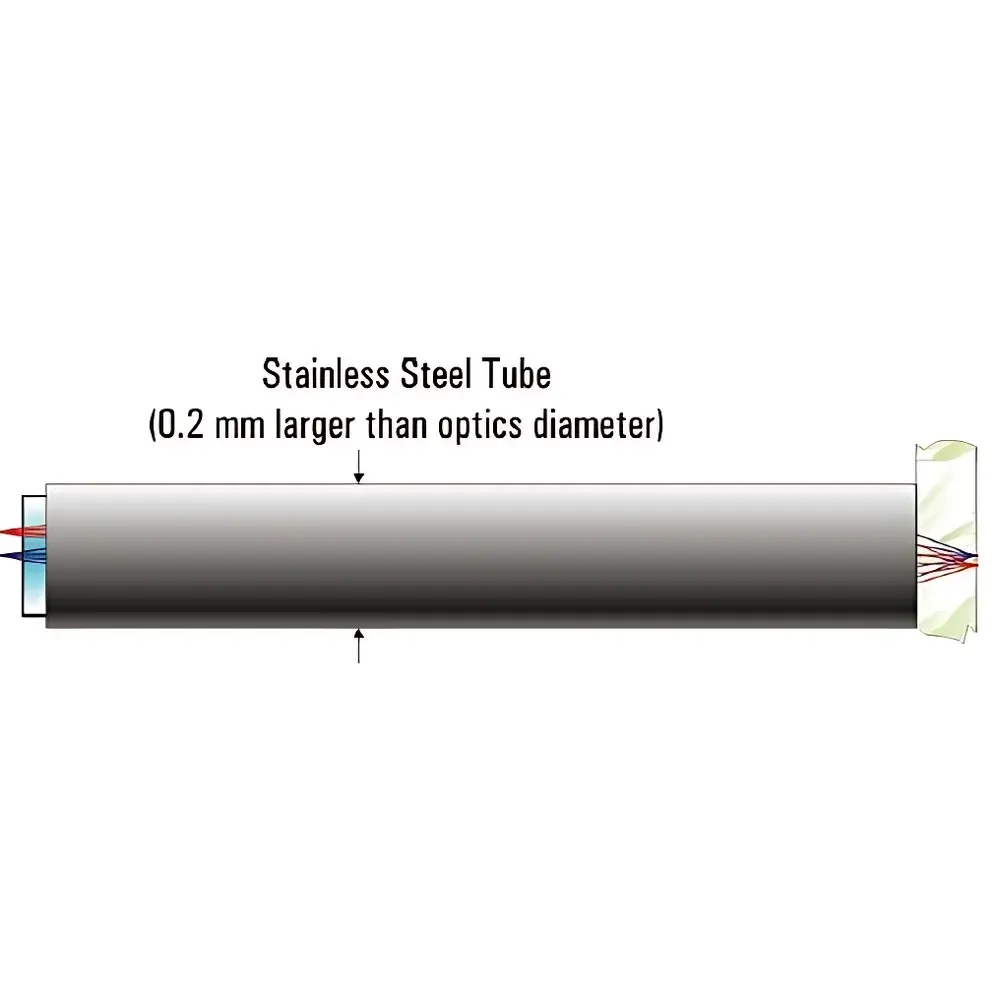
- Mechanically robust, biocompatible stainless-steel or polymer-coated housing suitable for repeated sterilization (autoclave-compatible housings available upon request)
- Designed for integration with commercial femtosecond laser systems (e.g., Ti:sapphire or Yb-fiber lasers) and modular scanning platforms (galvanometric or resonant scanners)
Sample Compatibility & Compliance
The GRIN Needle Microscope supports ex vivo and in vivo imaging of fixed or live biological specimens—including murine brain slices, tumor xenografts, intestinal mucosa, and embryonic tissues—without requiring tissue sectioning or clearing. Its compact form factor enables use in confined anatomical spaces (e.g., ventricles, ducts, or implanted chambers). All GRINTECH optical components comply with ISO 10110-1 (specification of optical elements) and are manufactured under cleanroom-controlled conditions (ISO Class 7). The probe assembly meets biocompatibility requirements per ISO 10993-5 (cytotoxicity) and ISO 10993-10 (irritation/sensitization) when used with approved coatings. For regulated preclinical studies, documentation packages support GLP-compliant audit trails when paired with validated laser sources and acquisition software.
Software & Data Management
The microscope does not include proprietary acquisition firmware; instead, it is fully compatible with open-architecture imaging platforms including MATLAB-based custom acquisition scripts, ScanImage (v2023+), and μManager (v2.0+). Image data streams conform to TIFF, HDF5, or OME-TIFF standards, ensuring interoperability with Fiji/ImageJ, Imaris, and commercial analysis suites (e.g., Arivis Vision4D). When integrated with FDA 21 CFR Part 11–compliant laser control systems (e.g., those certified by Coherent or Spectra-Physics), full electronic audit trails—including laser power logs, scan parameters, and timestamped metadata—are preserved for regulatory submissions. Exported datasets retain calibrated pixel-to-micron scaling based on manufacturer-provided point-spread function (PSF) characterization reports.
Applications
- Intracranial calcium imaging in awake, head-fixed mice using GCaMP6f-expressing neurons
- Real-time tracking of immune cell infiltration in orthotopic glioblastoma models
- Longitudinal monitoring of vascular leakage and angiogenesis in diabetic retinopathy models via intravitreal probe insertion
- High-resolution morphological assessment of epithelial crypt architecture in colitis-associated cancer models
- Guidance of microelectrode placement during optogenetic-electrophysiological experiments
- Validation of contrast agent biodistribution kinetics in targeted nanotherapeutics development
FAQ
What is the maximum achievable lateral resolution in tissue?
Lateral resolution is wavelength- and NA-dependent; at 860 nm excitation with NA = 0.5, theoretical diffraction-limited resolution is ~1.0 µm in water (n = 1.33); measured full-width-at-half-maximum (FWHM) in ex vivo brain tissue typically ranges from 1.2–1.5 µm.
Can the probe be autoclaved?
Standard stainless-steel-housed probes are rated for up to 10 autoclave cycles (121°C, 2 bar, 20 min); polymer-coated variants require low-temperature sterilization (e.g., ethylene oxide or hydrogen peroxide plasma).
Is custom GRIN lens length or NA configuration available?
Yes—GRINTECH offers engineering consultation for application-specific GRIN stacks, including non-standard periods, tapered geometries, and hybrid achromatic designs (subject to minimum order quantity and lead time).
Does the system support spectral unmixing or lifetime imaging?
The optical path supports time-correlated single-photon counting (TCSPC) modules and prism/grating-based spectral dispersion; however, FLIM or hyperspectral capability requires external detector integration and is not natively embedded in the probe hardware.
What laser safety class applies to integrated solid-state laser sources?
When paired with Class IV femtosecond lasers (e.g., >1 W average power at 860 nm), the full system must be operated within a Class I laser enclosure per IEC 60825-1; GRIN probe itself carries no inherent laser classification as a passive optical component.





