
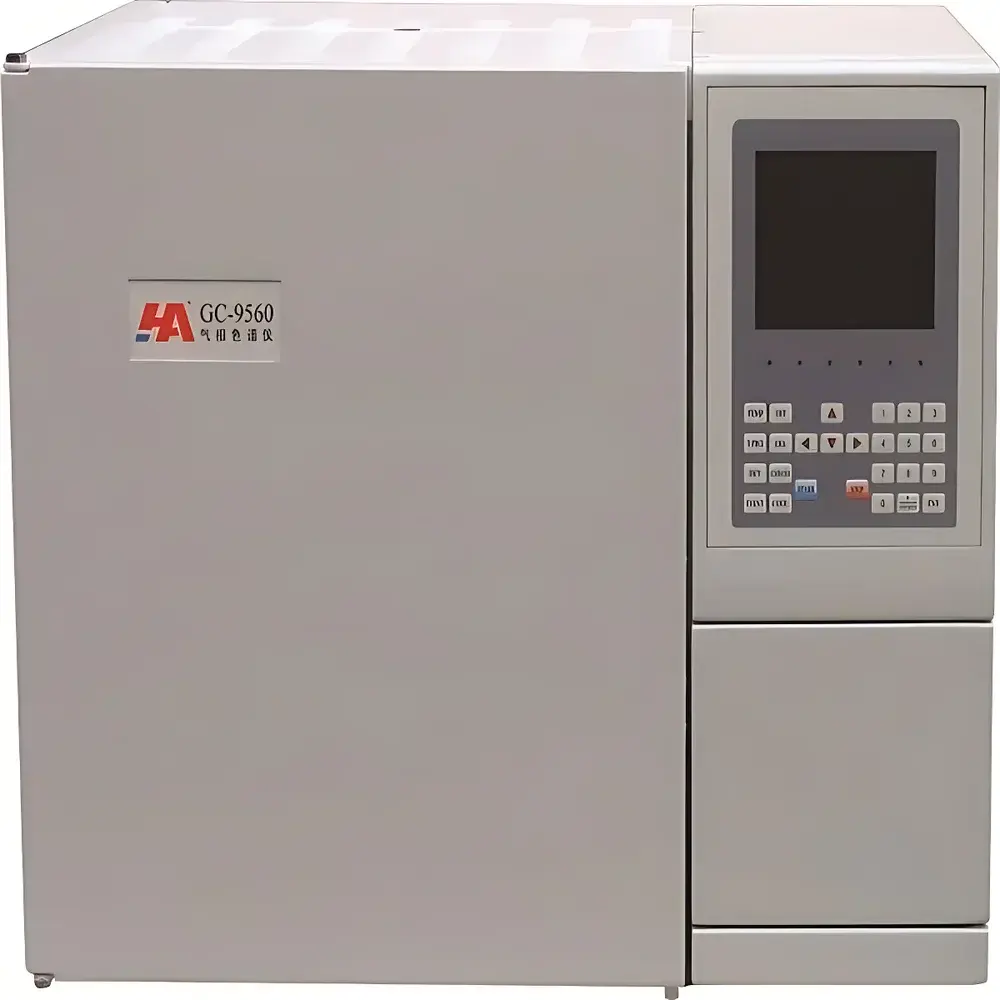
Huai Ai GC-9560-HM Gas Chromatograph for Coal Gas Analysis
| Brand | Huai Ai |
|---|---|
| Origin | Shanghai, China |
| Manufacturer Type | Direct Manufacturer |
| Regional Classification | Domestic (China) |
| Model | GC-9560-HM |
| Instrument Type | Laboratory Gas Chromatograph |
| Application Scope | Universal |
| Oven Temperature Range | 8 °C above ambient to 399 °C |
| Temperature Ramp Rate | 1–40 °C/min |
| Cooling Rate | ~50 °C in ≤7 min (from 350 °C to 50 °C) |
| Carrier Gas Flow Range & Control | 0–500 mL/min |
| Carrier Gas Pressure Range & Control | 0–0.4 MPa |
| Injector Maximum Operating Temperature | 399 °C |
| Injector Pressure Setting Range | 0–0.4 MPa |
| Injector Total Flow Setting Range | 0–500 mL/min |
| Column Oven Dimensions | 315 × 300 × 195 mm |
| Temperature Control Precision | ±0.1 °C (six independent zones) |
| Programmed Temperature Ramping | 8-step |
| Hold Time per Step | 0–655 min (1-min increments) |
| Detector | TCD (Thermal Conductivity Detector), dual-channel, rhenium-tungsten filament, constant-current operation |
| TCD Sensitivity | ≥2500 mV·mL/mg (n-hexadecane/isooctane) |
| Baseline Noise | ≤15 μV |
| Baseline Drift | ≤100 μV/30 min |
| Linearity | ≥10⁴ |
| Compliance | GB 10410–1989 |
Overview
The Huai Ai GC-9560-HM is a dedicated laboratory gas chromatograph engineered for precise, reproducible analysis of industrial coal-derived gases—including coke oven gas, blast furnace gas, and basic oxygen furnace (BOF) gas. Built upon a fully digital, microprocessor-controlled architecture, the instrument employs capillary or packed column separation coupled with a high-stability thermal conductivity detector (TCD) to resolve permanent gases (H₂, O₂, N₂, CH₄, CO, CO₂, C₂H₆, C₂H₄) and light hydrocarbons under isothermal or programmed temperature conditions. Its design adheres to the analytical requirements specified in GB 10410–1989, the Chinese national standard for gas composition analysis in metallurgical and coking industries. The GC-9560-HM operates on the principle of differential thermal conductivity—measuring changes in heat dissipation across a Wheatstone bridge configuration as analytes elute from the column and displace carrier gas (typically He or H₂). This enables quantitative determination without calibration dependency on flame ionization, making it intrinsically suitable for hydrogen-rich or oxygen-sensitive matrices where FID use is impractical or unsafe.
Key Features
- Six independently controlled temperature zones—including column oven, dual injectors, and up to three detector compartments—each stabilized to ±0.1 °C for method robustness and retention time reproducibility.
- Column oven with rapid thermal management: programmable 8-stage ramping (1–40 °C/min), extended hold times (0–655 min), and active post-run cooling via high-efficiency low-noise fan and motorized rear door, achieving 350 °C → 50 °C in under 7 minutes.
- TCD optimized for gas-phase analysis: four-arm rhenium-tungsten filaments in semi-diffusion configuration; constant-current bridge circuitry ensures long-term baseline stability (drift ≤100 μV/30 min) and sensitivity ≥2500 mV·mL/mg against n-hexadecane.
- Digital bidirectional communication interface (RS-232/USB) enabling full PC-based instrument control—including oven programming, injector pressure/flow setpoints, TCD bridge current, and event-triggered valve actuation (e.g., backflush, purge, re-injection).
- Integrated Y-700 Gas-Specific Chromatography Workstation supporting real-time signal acquisition, peak integration, retention time locking, and automated calorific value calculation per ISO 6976 and ASTM D3588, including higher heating value (HHV), lower heating value (LHV), volumetric and gravimetric energy density, and Wobbe index.
Sample Compatibility & Compliance
The GC-9560-HM is validated for direct injection of untreated or filtered industrial gas streams via gas-tight syringe or pressurized loop injection (0.25–1.0 mL). It accommodates standard packed columns (e.g., molecular sieve 5A, Porapak Q, Hayesep D) and fused-silica capillaries (e.g., PLOT Al₂O₃/KCl) for optimal resolution of H₂, O₂, N₂, CH₄, CO, CO₂, C₂H₆, and C₂H₄. The system meets the compositional reporting requirements of GB 10410–1989 and supports traceability under GLP-compliant workflows when paired with audit-trail-enabled data acquisition software. While not pre-certified to FDA 21 CFR Part 11, its digital control architecture and deterministic I/O behavior allow straightforward validation for regulated environments requiring electronic record integrity and operator accountability.
Software & Data Management
The Y-700 workstation provides a Windows-native platform for method development, sequence definition, and report generation. It logs all hardware state changes—including temperature setpoints, flow/pressure values, detector parameters, and external valve events—with timestamped metadata. Raw chromatograms are stored in vendor-neutral .CDF format (compatible with OpenChrom and Chromeleon). Calorimetric calculations apply stoichiometric combustion equations per ISO 6976 Annex A, incorporating real-gas compressibility corrections for volumetric heating value derivation. All quantitative results support export to CSV, Excel, or PDF with customizable templates aligned to internal QA/QC documentation standards.
Applications
- Real-time quality assurance of coke oven gas in by-product recovery plants, monitoring H₂ (50–60%), CH₄ (25–30%), and CO (5–8%) to optimize downstream ammonia synthesis feedstock.
- Blast furnace gas (BFG) analysis for energy balance modeling: quantifying CO (20–25%), CO₂ (18–22%), N₂ (50–55%), and residual H₂ to calibrate hot-blast stoves and waste-heat boilers.
- Basic oxygen furnace (BOF) gas monitoring during steelmaking campaigns, tracking CO surge profiles (up to 65%) and O₂ breakthrough to inform lance positioning and off-gas cleaning system loading.
- Verification of gas purity specifications prior to pipeline injection or utilization in fuel cells, ensuring compliance with ISO 8573-1 Class 2 particulate and Class 3 moisture limits when used with appropriate sample conditioning.
FAQ
What carrier gases are compatible with the GC-9560-HM TCD?
Helium and hydrogen are recommended; argon-methane mixtures may be used but reduce sensitivity due to lower thermal conductivity contrast.
Can the instrument analyze moisture or sulfur compounds in coal gas?
No—this configuration lacks detectors (e.g., Pulsed Discharge Helium Ionization or Sulfur Chemiluminescence) and specialized columns required for H₂O, H₂S, or COS. Sample drying and desulfurization pretreatment are mandatory.
Is method transfer possible from other GC platforms?
Yes—retention indices and relative response factors can be matched using standardized reference gases (e.g., Air Liquide CertiGas™), provided column dimensions and temperature programs are replicated.
What maintenance intervals are recommended for the TCD filament?
Filament lifetime exceeds 18 months under continuous operation with clean, dry carrier gas; quarterly resistance checks and annual bridge current recalibration are advised.
Does the system support unattended overnight operation?
Yes—the embedded controller maintains thermal and flow stability autonomously; the Y-700 software supports scheduled shutdown, auto-report generation, and email alerts upon sequence completion or fault detection.





