
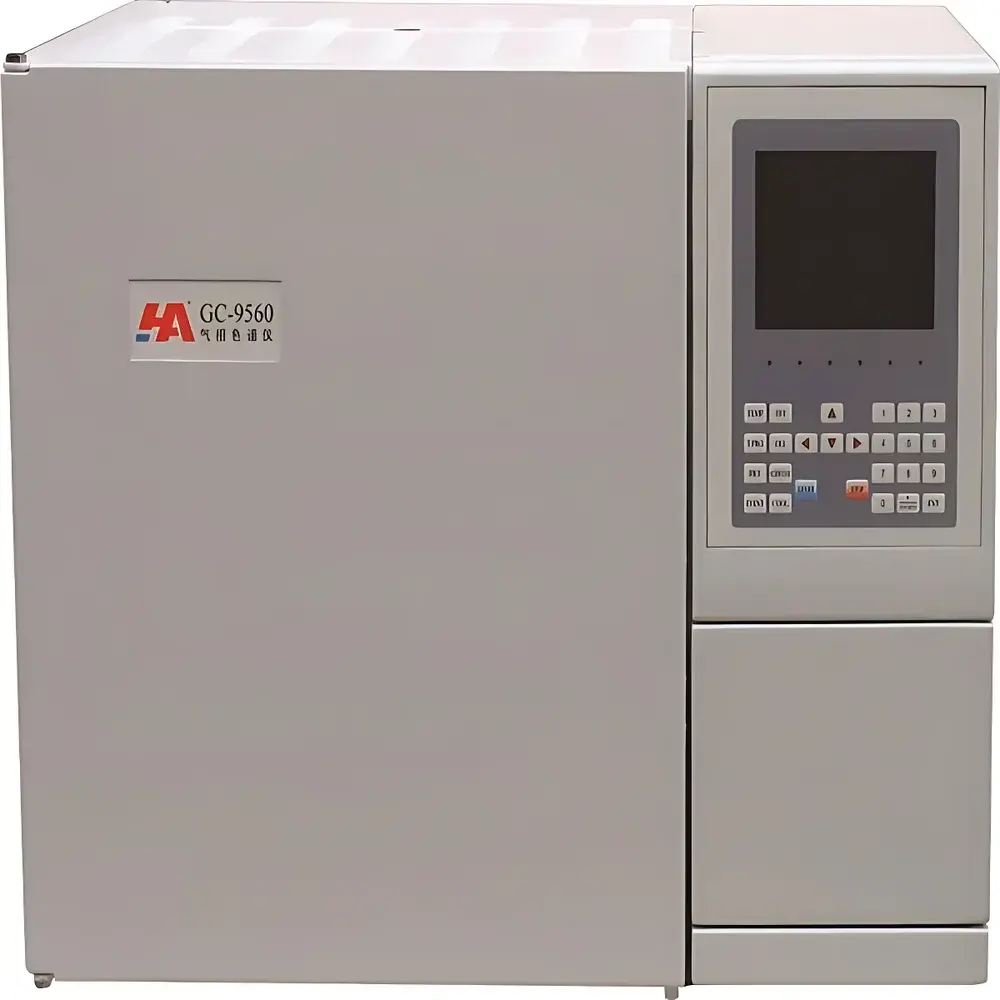
HuaiAi GC-9560-HQ Laboratory Gas Chromatograph System
| Brand | HuaiAi |
|---|---|
| Origin | Shanghai, China |
| Manufacturer Type | Direct Manufacturer |
| Product Origin | Domestic (China) |
| Model | GC-9560-HQ |
| Instrument Type | Laboratory Gas Chromatograph |
| Application Scope | General-purpose |
| Temperature Control Range | Ambient +8 °C to 399 °C |
| Oven Ramp Rate | 1–40 °C/min |
| Oven Cool-down Rate | ~7 minutes from 350 °C to 50 °C |
| Carrier Gas Flow Range & Control | 0–500 mL/min |
| Carrier Gas Pressure Range & Control | 0–0.4 MPa |
| Injector Maximum Operating Temperature | 399 °C |
| Injector Pressure Setting Range | 0–0.4 MPa |
| Injector Total Flow Setting Range | 0–500 mL/min |
Overview
The HuaiAi GC-9560-HQ is a dedicated laboratory gas chromatograph engineered for comprehensive compositional analysis of fuel gases and refinery streams. It operates on the principle of capillary or packed-column gas chromatography with dual-detector configuration—integrated thermal conductivity detection (TCD) and flame ionization detection (FID)—enabling simultaneous quantification of permanent gases (H₂, O₂, N₂, CO, CO₂, CH₄), light hydrocarbons (C₁–C₆), and heavier aliphatics (up to C₆⁺). The system employs a precisely timed ten-port valve backflush configuration to resolve complex mixtures in a single injection, eliminating manual re-injection and reducing analytical cycle time. Designed for compliance with Chinese national standards—including GB/T 13610-2003 (natural gas composition), GB/T 11062-1998 (calorific value calculation), and GB/T 10410-2008 (coal gas and LPG analysis)—the GC-9560-HQ delivers traceable, reproducible results suitable for quality control, custody transfer verification, and regulatory reporting in energy and petrochemical laboratories.
Key Features
- Integrated dual-detector architecture: TCD for inorganic gases (He, H₂, O₂, N₂, CO, CO₂) and FID for hydrocarbons (C₁–C₆⁺), ensuring orthogonal sensitivity and cross-validated quantitation.
- Programmable oven temperature control with precision ±0.1 °C stability across the full range (ambient +8 °C to 399 °C) and ramp rates adjustable from 1 to 40 °C/min.
- High-resolution ten-port valve backflush system optimized for rapid separation of methane through hexanes while eluting non-volatile residues away from the column.
- Flash vaporization inlet compatible with liquid LPG sampling, enabling direct analysis without pre-evaporation or phase separation.
- Carrier gas pressure and flow digitally regulated via electronic pneumatic control (EPC), supporting helium, hydrogen, or nitrogen as carrier with 0–0.4 MPa pressure and 0–500 mL/min flow ranges.
- Injector capable of operation up to 399 °C with independent pressure and total flow programming, accommodating high-boiling analytes including benzene, naphthalene, and sulfur compounds when equipped with optional modules.
Sample Compatibility & Compliance
The GC-9560-HQ supports gaseous samples (natural gas, coke oven gas, blast furnace gas, converter gas, water gas, manufactured gas, refinery gas) and liquefied petroleum gas (LPG) in both cylinder and liquid-phase formats. Its validated method packages align with GB17820-1999 (natural gas specifications), GB18047-2000 (CNG for vehicles), GB11174-1997 (LPG), and GB/T 12576-1997 (vapor pressure and octane number estimation). For regulatory environments, data acquisition supports audit-ready reporting with timestamped run logs, detector response calibration history, and user-accessible method parameters—facilitating GLP-compliant documentation and internal QA/QC review. While not inherently 21 CFR Part 11 compliant out-of-the-box, the system’s software architecture permits integration with validated third-party LIMS or ELN platforms that enforce electronic signature and change-control requirements.
Software & Data Management
The instrument is operated via HuaiAi’s proprietary chromatography data system (CDS), providing real-time signal monitoring, peak integration using tangent skim or valley-to-valley algorithms, retention time locking, and automated calibration curve generation. Quantitative results are exported in CSV or XML format for downstream processing in Excel or statistical analysis tools. The software includes built-in calculators for higher heating value (HHV), Wobbe index, relative density, and molar composition-based physical property estimation per GB/T 11062-1998. All raw data files retain full acquisition metadata—including column ID, oven program, detector settings, and valve timing sequences—ensuring full method traceability. Raw data storage adheres to ISO/IEC 17025:2017 clause 7.5.2 requirements for record integrity and retention.
Applications
- Natural gas quality assurance: Simultaneous determination of C₁–C₆, He, H₂, O₂, N₂, CO₂, and H₂S (with optional sulfur module) for HHV calculation and compliance with GB17820 Class I–III specifications.
- Liquefied petroleum gas (LPG) characterization: Quantification of propane, propylene, butanes, butenes, pentanes, and dienes for vapor pressure (DVP), density, and motor octane number (MON) estimation per GB/T 12576-1997.
- Industrial gas process monitoring: Analysis of coke oven gas, blast furnace gas, and converter gas for CO, CO₂, H₂, CH₄, and C₂+ content to support combustion efficiency optimization and emissions reporting.
- Fuel blending verification: Detection and quantification of dimethyl ether (DME) in LPG matrices at sub-0.1% (v/v) levels using calibrated FID response factors.
- By-product impurity screening: Optional benzene/naphthalene and H₂S analysis modules enable monitoring of aromatic and sulfur contaminants in syngas, town gas, and refinery off-gas streams.
FAQ
What detection technologies does the GC-9560-HQ employ?
It integrates a thermal conductivity detector (TCD) for permanent gases and a flame ionization detector (FID) for hydrocarbons, configured for concurrent detection in a single analytical run.
Can the system quantify calorific value directly?
Yes—the software performs automated higher heating value (HHV) calculation per GB/T 11062-1998 using molar composition results derived from chromatographic peak areas and certified calibration standards.
Is the instrument compatible with international standards such as ASTM or ISO?
While primarily designed for GB-series standards, its separation performance and detector linearity meet the technical equivalence of ASTM D1945 (natural gas analysis) and ISO 6974-2 (gas chromatographic determination of natural gas composition), subject to method validation per local regulatory requirements.
What sample introduction methods are supported?
Gas samples are introduced via pressurized loop injection; LPG samples use flash-vaporizing liquid injection. Optional heated sampling valves and cryogenic trapping modules support extended-range volatile organic compound (VOC) analysis.
Does the system support remote operation or networked data export?
The CDS supports TCP/IP-based communication for LAN connectivity, enabling centralized data archiving and remote diagnostics. Export formats include CSV, XML, and PDF reports with embedded chromatograms and calibration summaries.
Related Products






