
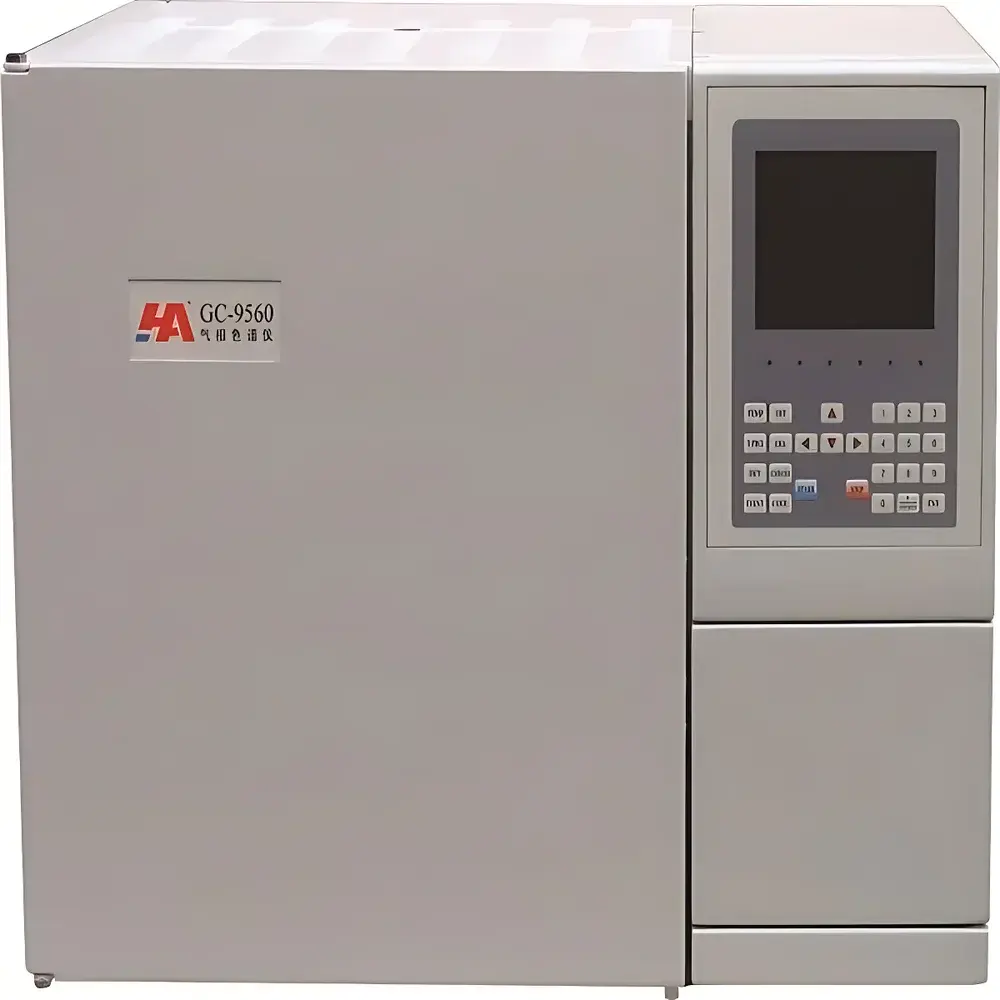
HuaiAi GC-9560-HS Dedicated Gas Chromatograph for Oxygenates in Gasoline
| Brand | HuaiAi |
|---|---|
| Origin | Shanghai, China |
| Manufacturer Type | Manufacturer |
| Product Origin | Domestic (China) |
| Model | GC-9560-HS |
| Instrument Type | Laboratory Gas Chromatograph |
| Application Field | Petroleum Refining & Fuel Quality Control |
| Temperature Control Range | Ambient +8 °C to 399 °C |
| Oven Ramp Rate | 1–40 °C/min |
| Oven Cool-down Time | ~7 min (350 °C to 50 °C) |
| Carrier Gas Flow Range & Control | 0–500 mL/min |
| Carrier Gas Pressure Range & Control | 0–0.4 MPa |
| Injector Max Operating Temperature | 399 °C |
| Injector Pressure Setting Range | 0–0.4 MPa |
| Injector Total Flow Setting Range | 0–500 mL/min |
Overview
The HuaiAi GC-9560-HS is a purpose-built gas chromatograph engineered for the precise, standardized quantification of oxygenated compounds—including alcohols (e.g., methanol, ethanol, tert-butanol) and ethers (e.g., MTBE, TAME, DIPE)—as well as aromatic hydrocarbons (benzene, toluene) in gasoline matrices. It operates on the principle of dual-column, valve-switching gas chromatography with backflush capability, enabling high-resolution separation of volatile and semi-volatile components under tightly controlled thermal and flow conditions. Designed specifically for compliance with Chinese national and industry standards—GB 17930-2006 (Automotive Gasoline), GB 18351-2004 (Ethanol-blended Gasoline), SH/T 0663-1998 (Determination of Alcohols and Ethers in Gasoline), and SH/T 0693-2000 (Determination of Aromatic Hydrocarbons in Gasoline)—the system delivers trace-level accuracy required for regulatory fuel certification, refinery process control, and quality assurance in downstream distribution.
Key Features
- Dual-valve, ten-port switching configuration with automated backflush functionality for selective elution and removal of non-target light and heavy hydrocarbons.
- Two-column analytical architecture: TCEP pre-column for preliminary fractionation and WCOT (wall-coated open tubular) capillary column for high-efficiency separation of oxygenates and aromatics.
- Programmable temperature-controlled oven with ±0.1 °C stability over the full range (ambient +8 °C to 399 °C) and ramp rates adjustable from 1 to 40 °C/min.
- Independent, electronically controlled carrier gas pressure and flow modules (0–0.4 MPa; 0–500 mL/min) ensuring reproducible retention times and method robustness across instrument lifetimes.
- High-temperature injector (up to 399 °C) with pressure-programmed injection capability to accommodate viscous or thermally labile gasoline blends.
- Integrated hardware synchronization with Y-600 dedicated chromatography workstation for real-time data acquisition, peak integration, and standardized reporting.
Sample Compatibility & Compliance
The GC-9560-HS accepts neat liquid gasoline samples (including conventional, ethanol-blended (E10), and MTBE-doped formulations) without derivatization or extraction. Internal standardization using dimethoxyethane (DME) for oxygenates and 2-hexanone for aromatics ensures quantitative reliability per SH/T 0663 and SH/T 0693 methodologies. All calibration protocols, linearity verification (R² ≥ 0.999), and system suitability tests align with GLP-aligned laboratory practices. While not FDA 21 CFR Part 11–certified out-of-the-box, the Y-600 software architecture supports audit-trail-enabling configurations when deployed in validated environments meeting ISO/IEC 17025 or CNAS accreditation requirements.
Software & Data Management
The Y-600 Gasoline Analysis Workstation—developed for Windows XP (with backward compatibility via virtualization in modern OS environments)—features a 24-bit analog-to-digital converter (input range: −1 V to +1 V) for high-fidelity signal digitization. Its expert calculation engine automatically computes: total oxygen content (mass % and vol %), individual oxygenate concentrations (mass/vol %), benzene/toluene mass fractions, response factor normalization, correlation coefficients, and density-corrected volumetric results based on user-input gasoline density and sample/internal standard masses. All calculations adhere strictly to the arithmetic logic defined in SH/T 0663-1998 and SH/T 0693-2000, eliminating manual transcription errors and supporting full traceability in QA/QC documentation.
Applications
- Regulatory testing of automotive gasoline for oxygenate content compliance (e.g., MTBE limits ≤ 15 vol %, ethanol ≤ 10 vol %).
- Refinery blending optimization and batch release verification of reformulated gasoline (RFG) and oxygenated fuel formulations.
- Monitoring phase separation risk in ethanol-gasoline mixtures via precise water-soluble alcohol quantification.
- Assessment of vapor pressure contribution from low-boiling oxygenates (e.g., methanol, ethanol) in Reid Vapor Pressure (RVP) modeling.
- Quality surveillance of finished fuel products at terminals, depots, and retail outlets per GB 17930-2006 specifications.
- Research into alternative oxygenate performance (e.g., ETBE, TAEE) and their combustion byproduct profiles.
FAQ
Does the GC-9560-HS support ASTM D4815 or D5599 methods for oxygenate analysis?
The system is configured per SH/T 0663-1998, which is technically equivalent to ASTM D4815 in separation strategy and internal standard usage. Method adaptation for ASTM D5599 (for ethanol in gasolines) is achievable via column selection and temperature program modification, subject to laboratory validation.
Can the Y-600 software generate reports compliant with LIMS interfaces?
Yes—Y-600 exports ASCII-delimited (.txt) and Excel-compatible (.csv) result files containing all raw peak areas, retention times, calculated concentrations, and metadata, facilitating import into most LIMS platforms.
What maintenance intervals are recommended for the ten-port valve and detector?
Valve rotor seal replacement is advised every 6–12 months depending on sample load; FID detector cleaning and jet inspection should occur quarterly, with baseline noise and sensitivity checks performed before each analytical batch.
Is the GC-9560-HS compatible with hydrogen carrier gas?
Yes—the pressure and flow controllers support H₂ carrier gas operation, enabling faster analysis and improved resolution for early-eluting oxygenates, provided appropriate safety interlocks and leak-check protocols are implemented.
How is method transfer validated when moving from another GC platform?
Retention time alignment, peak shape assessment, and recovery testing using certified reference materials (e.g., NIST SRM 2722) are required. The Y-600 software includes built-in comparison tools for overlaying chromatograms and calculating relative retention deviations.
Related Products




