
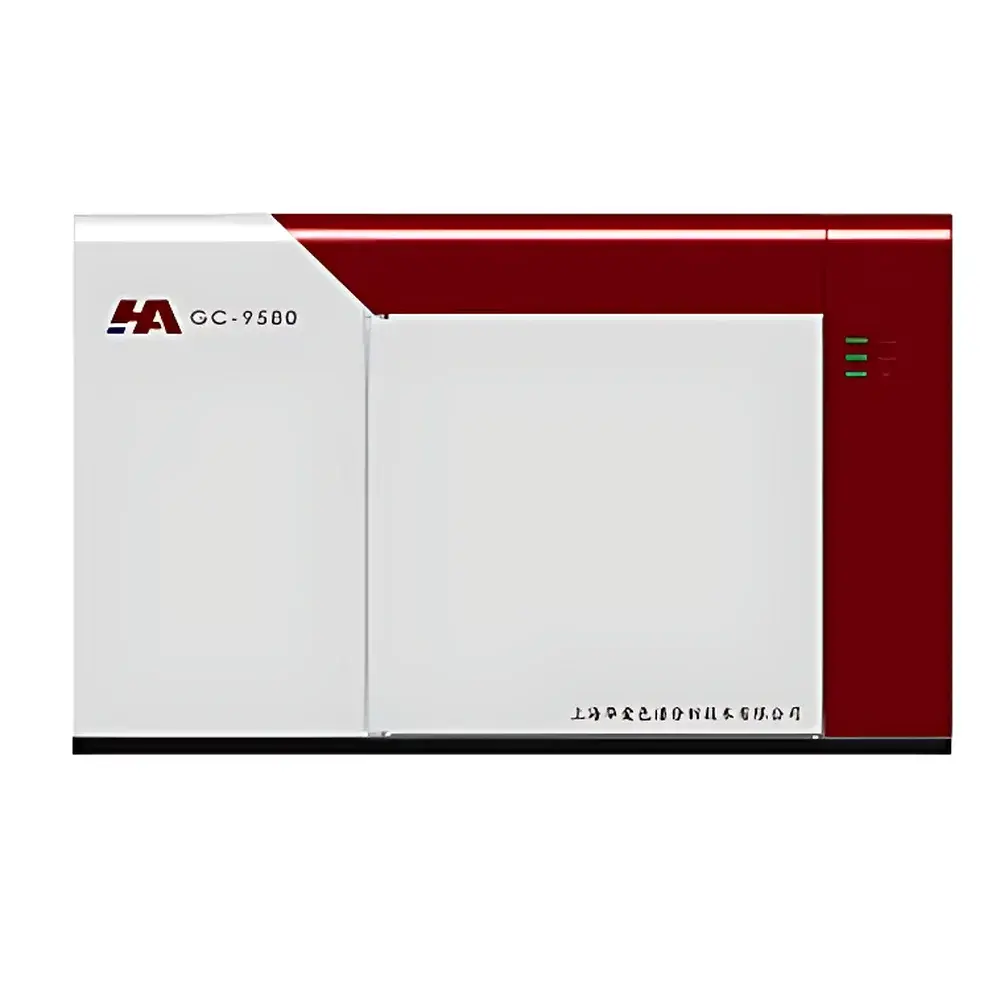
HuaiAi GC-9580-PDD Gas Chromatograph
| Brand | HuaiAi |
|---|---|
| Origin | Shanghai, China |
| Manufacturer Type | Original Equipment Manufacturer (OEM) |
| Instrument Type | Laboratory Gas Chromatograph |
| Application Focus | High-Purity Gas Analysis |
| Temperature Control Range | 0 °C to 400 °C |
| Oven Ramp Rate | 8 °C to 350 °C in ≤7 min |
| Oven Cool-Down Rate | 350 °C to 50 °C in ≤7 min |
| Carrier Gas Flow Range & Control | 0–1000 mL/min |
| Carrier Gas Pressure Range & Control | 0–500 kPa |
| Injector Maximum Operating Temperature | 400 °C |
| Injector Pressure Setting Range | 0–500 kPa |
| Injector Total Flow Setting Range | 0–1000 mL/min |
| Dimensions | 790 mm (W) × 502 mm (H) × 490 mm (D) |
| Weight | ~50 kg |
| Power Supply | 220 V ±10%, 50 Hz, ≥2 kW |
Overview
The HuaiAi GC-9580-PDD is a dedicated laboratory gas chromatograph engineered for trace-level impurity analysis in ultra-high-purity (UHP) industrial gases. It operates on the principle of capillary or packed-column gas chromatography, where sample components are separated based on differential partitioning between a mobile phase (high-purity helium carrier gas) and stationary phases within thermally stable, low-dead-volume columns. Its architecture integrates a pulsed discharge helium ionization detector (PDHID), known for sub-part-per-trillion (ppt) detection sensitivity toward permanent gases (H2, O2, N2, CH4, CO, CO2, Ne, Ar, Kr, Xe, He) and reactive species (NH3, SiH4, NF3, PH3, BCl3, Cl2, SF6). The system employs dual-zone oven control, precision pressure/flow regulation via electronic pneumatic control (EPC), and an integrated cryogenic cooling module enabling rapid thermal cycling—critical for high-throughput UHP gas QC workflows.
Key Features
- PDHID detector with sub-ppb detection limits for H2, O2, N2, CO, CO2, CH4, and noble gases under optimized helium carrier conditions
- Multi-zone column oven with independent temperature control for simultaneous operation of multiple separation columns (e.g., molecular sieve 5A + Plot Q + Hayesep D)
- Center-cutting valve system for heart-cut two-dimensional (2D) GC configuration, enabling selective transfer of target eluents to secondary columns without peak broadening
- Integrated helium purifier (≤0.1 ppb O2/H2O residual) and VCR-fitting gas delivery train to maintain integrity of carrier and calibration gases
- Low-dead-volume sampling valve with metal-sealed actuation and heated zones up to 400 °C, minimizing adsorption and memory effects for reactive analytes
- Automated flow/pressure calibration routine with built-in reference sensors; EPC modules support real-time feedback and drift compensation
- Power-saving “Eco Mode” reducing standby power consumption by >40% without compromising thermal stability or detector readiness
- Gas-specific oxygen removal and reduction module (catalytic Cu + heated ZnO) for accurate O2/Ar separation and quantification per GB/T 4844–2011 and SEMI F57
Sample Compatibility & Compliance
The GC-9580-PDD is validated for analysis of gaseous matrices compliant with Chinese national standards (GB/T) and international semiconductor industry specifications (SEMI, ASTM). It meets method requirements for GB/T 3634.2–2011 (hydrogen purity), GB/T 14599–2008 (oxygen), GB/T 8979–2008 (nitrogen), GB/T 4842–2017 (argon), GB/T 4844–2011 (helium), GB/T 17873–2014 (neon), GB/T 5829–2006 (krypton), GB/T 28125.1–2011 (air separation hazard monitoring), and GB/T 33102–2016 (methane). For electronics-grade gases, it supports GB/T 14600–2009 (argon-oxygen-nitrogen blends), GB/T 15909–2017 (silane), GB/T 14601–2009 (ammonia), GB/T 18867–2014 (SF6), GB/T 18994–2014 (Cl2), GB/T 21287–2007 (NF3), GB/T 14851–2009 (PH3), and GB/T 17874–2010 (BCl3). All hardware and software components conform to GLP/GMP-aligned design principles, including audit-trail-capable data logging and user-access controls aligned with FDA 21 CFR Part 11 expectations.
Software & Data Management
GC-9580V4.0 Chromatography Workstation provides full instrument control, sequence management, peak integration, and quantitative reporting. It supports ASTM E260-compliant calibration curve generation (linear, quadratic, multi-point), internal standard correction, and area normalization. Raw data files (.cdf) are stored with embedded metadata (instrument ID, operator, method version, audit log timestamp). The workstation includes native LIMS interface modules compliant with ASTM E1578 and ISO/IEC 17025–2017 data exchange protocols. Remote operation and real-time status monitoring are enabled via the “XiaoFang” mobile application (iOS/Android), which implements TLS 1.2 encrypted communication and session-based authentication. All software modules undergo annual verification against NIST-traceable reference standards.
Applications
- QC release testing of bulk and cylinder gases in semiconductor fabrication fabs
- Monitoring trace contaminants (O2, H2O, CO, CO2, THC) in hydrogen fuel cell feedstock per ISO 8573-8
- Verification of argon/oxygen ratios in medical gas mixtures per ISO 8573-1 Class 0
- Residual solvent analysis in cryogenically purified neon for EUV lithography lasers
- Leak detection and purity validation in high-vacuum process chambers using helium tracer gas
- Environmental monitoring of greenhouse gases (CH4, N2O, SF6) in ambient air sampling networks
FAQ
Does the GC-9580-PDD support compliance with FDA 21 CFR Part 11?
Yes—the GC-9580V4.0 software includes electronic signatures, role-based access control, immutable audit trails, and data integrity safeguards consistent with Part 11 Annex A guidance.
Can the system analyze corrosive gases such as Cl₂ or NF₃ without degradation?
Yes—using passivated stainless-steel flow paths, VCR metal gasket seals, and chemically resistant column coatings (e.g., fused silica deactived with siloxane bonding), the system maintains long-term stability during routine Cl₂/NF₃ analysis.
Is helium the only viable carrier gas for PDHID operation?
Helium is required as both carrier and plasma support gas for PDHID; however, optional helium recycling modules can reduce operational consumption by up to 60%.
What is the minimum detectable level for O₂ in argon when using the oxygen removal module?
With baseline noise optimization and 10 mL injection volume, typical MDL is 50 ppt O₂ in Ar (signal-to-noise ≥3, per ISO 11843-2).
How does the center-cutting system improve resolution for overlapping peaks like Ar/O₂?
By isolating the Ar/O₂ co-elution window and transferring it to a second column with orthogonal selectivity (e.g., alumina PLOT), the system achieves baseline separation with <0.1% cross-talk.
Related Products






