
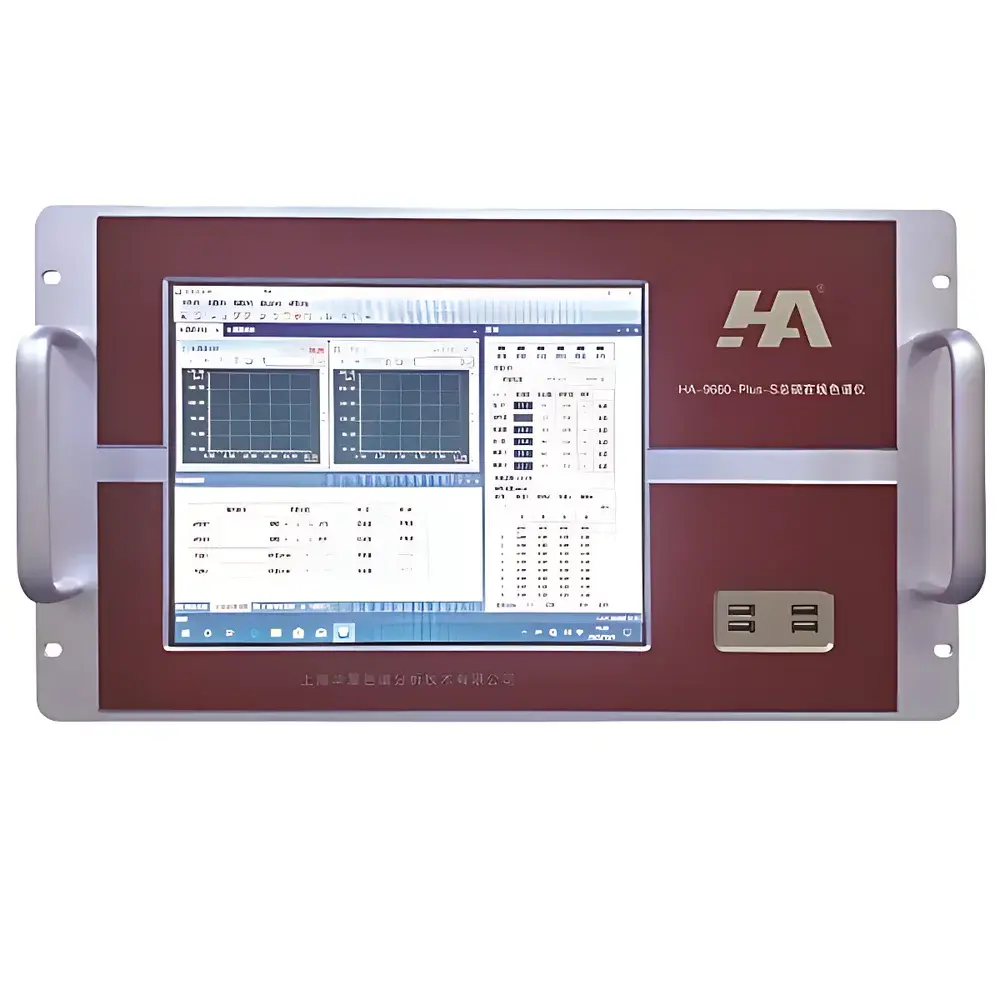
HuaiAi HA-9660-Plus-S Online Total Sulfur Gas Chromatograph
| Brand | HuaiAi |
|---|---|
| Origin | Shanghai, China |
| Manufacturer Type | Manufacturer |
| Regional Category | Domestic (China) |
| Model | HA-9660-Plus-S |
| Instrument Type | Online Gas Chromatograph |
| Application Field | High-Purity Gas Analysis |
| Detection Principle | Gas Chromatography with Pulsed Discharge Helium Ionization Detection (PDHID) |
| Detection Limit | <1 ppb for H₂S, COS, CS₂, CH₃SH |
| Linearity Range | 1 ppb – 5 ppm (R² > 0.999 across six orders of magnitude) |
| Precision | RSD < 3% (n = 6) |
| Dilution System | HA-11 Dual-Stage Precision Gas Dilutor (1–10,000×) |
| Flow Path | Ultra-Inert, Sulfur-Resistant Capillary and Valving Architecture |
Overview
The HuaiAi HA-9660-Plus-S Online Total Sulfur Gas Chromatograph is a purpose-built analytical platform engineered for the continuous, real-time quantification of ultra-trace sulfur compounds in high-purity process gases. It employs gas chromatographic separation coupled with pulsed discharge helium ionization detection (PDHID), a highly selective and sensitive detection mode optimized for sulfur-containing species—including hydrogen sulfide (H₂S), carbonyl sulfide (COS), carbon disulfide (CS₂), and methyl mercaptan (CH₃SH)—without chemical conversion or post-column reaction. Unlike conventional flame photometric detectors (FPD) or sulfur chemiluminescence detectors (SCD), PDHID delivers direct, stoichiometric response to elemental sulfur with minimal matrix interference, exceptional baseline stability, and inherent resistance to quenching effects from major gas carriers (e.g., H₂, N₂, He, CH₄). The system is deployed as a fully integrated online analyzer—designed for permanent installation in production environments where uninterrupted monitoring, regulatory compliance, and catalyst protection are mission-critical.
Key Features
- Sub-ppb total sulfur detection capability: Validated detection limits ≤0.8 ppb (v/v) for H₂S, COS, CS₂, and CH₃SH under routine operating conditions—meeting ISO 8573-5:2010 Annex B and ASTM D7622 requirements for ultrapure hydrogen certification.
- Ultra-inert flow path architecture: All-wetted surfaces constructed from electropolished stainless steel, sulfur-passivated fused silica capillaries, and metal-sealed diaphragm valves eliminate adsorption, memory effects, and catalytic decomposition of reactive sulfur species.
- Dual-stage precision dilution integration: Fully automated HA-11 gas dilution module enables accurate, reproducible calibration across six decades (1 ppb–5 ppm) without manual cylinder handling—critical for trace-level method validation and daily instrument verification.
- Robust online operation: Designed for 24/7 unattended operation with automatic zero/span checks, leak diagnostics, column bake-out cycles, and remote status reporting via Modbus TCP or OPC UA protocols.
- Modular column configuration: Pre-configured, temperature-stabilized GC oven accommodates dual parallel columns (e.g., Rt-QS-Bond for H₂S/COS; Rt-Sulfur for CS₂/CH₃SH) with backflush capability to extend column life and reduce maintenance frequency.
Sample Compatibility & Compliance
The HA-9660-Plus-S is validated for direct analysis of gaseous matrices including hydrogen (≥99.999% purity), natural gas, refinery off-gas, electronic-grade nitrogen/helium/hydrogen, ethylene, propylene, biogas, and ambient air. It complies with international standards governing sulfur specification in fuel and industrial gases—including ISO 8573-5 (compressed air purity classes), ISO 14687-2:2019 (hydrogen fuel quality for fuel cell vehicles), ASTM D7622 (sulfur in hydrogen by GC-PDHID), and China’s GB/T 37244–2018 (hydrogen fuel for fuel cell electric vehicles). Its hardware and firmware architecture supports audit-ready data integrity per FDA 21 CFR Part 11 requirements when paired with compliant LIMS or SCADA systems—enabling full electronic signature, user access control, and immutable audit trails for GLP/GMP-regulated facilities.
Software & Data Management
Control and data acquisition are managed through HuaiAi ChromaView™ v4.x, a Windows-based application supporting method scheduling, sequence definition, real-time chromatogram visualization, peak integration with retention time locking, and automated report generation (PDF/CSV). The software embeds built-in calibration curve fitting (linear, quadratic, weighted least-squares), QC flagging (e.g., drift >2%, peak asymmetry >1.5), and configurable alarm thresholds for out-of-spec events. Raw data files adhere to ASTM E1925-compliant .CDF format, ensuring long-term readability and third-party software interoperability. Optional cloud connectivity enables secure remote diagnostics, firmware updates, and centralized fleet monitoring across multiple deployment sites.
Applications
- Fuel cell hydrogen quality assurance: Continuous monitoring at hydrogen production units, purification skids, pipeline injection points, and refueling station inlet streams to verify compliance with ISO 14687-2 Class 1 (<4 ppb total sulfur) and prevent irreversible Pt-based catalyst poisoning.
- Petrochemical process gas control: In-situ measurement of sulfur breakthrough in amine scrubbers, Claus unit tail gas, and hydrodesulfurization (HDS) effluents—supporting catalyst lifetime extension and sulfur recovery optimization.
- Semiconductor manufacturing gas certification: Routine verification of electronic specialty gases (e.g., N₂, H₂, He) against SEMI F57-0318 specifications (≤100 ppt total sulfur).
- Environmental emissions monitoring: Quantitative analysis of SO₂, H₂S, and organic sulfides in stack emissions and flare gas—aligned with EPA Method 15/16 and EN 14791:2017.
- Research & development: Kinetic studies of sulfur adsorption/desorption on novel sorbents, catalyst deactivation profiling, and method transfer validation between laboratory and online platforms.
FAQ
What detection technology does the HA-9660-Plus-S use, and why is it preferred for sulfur analysis?
It utilizes pulsed discharge helium ionization detection (PDHID), which provides direct, element-specific response to sulfur atoms with high sensitivity, low chemical noise, and immunity to common carrier gas interferences—making it superior to FPD or SCD for ppb-level quantitation in complex gas matrices.
Can the system analyze multiple sulfur compounds simultaneously in a single run?
Yes—configured with dual-capillary columns and a microfluidic splitter, it resolves and quantifies H₂S, COS, CS₂, and CH₃SH in under 12 minutes with baseline separation and independent calibration curves.
Is the instrument suitable for hazardous area installation?
The analyzer enclosure meets ATEX/IECEx Zone 2 (gas) and Class I, Division 2 (NEC) requirements when specified with optional explosion-proof housing and intrinsically safe sample interface modules.
How is calibration maintained during extended unattended operation?
Automated daily zero/span verification using certified standard gas blends (NIST-traceable) is performed with integrated mass flow controllers and pressure-compensated injection—data logged with timestamp, operator ID, and pass/fail status.
Does the system support integration with existing plant DCS or MES?
Yes—native Modbus TCP, OPC UA, and 4–20 mA analog output interfaces enable seamless bidirectional communication with distributed control systems, historian databases, and enterprise manufacturing execution systems.





