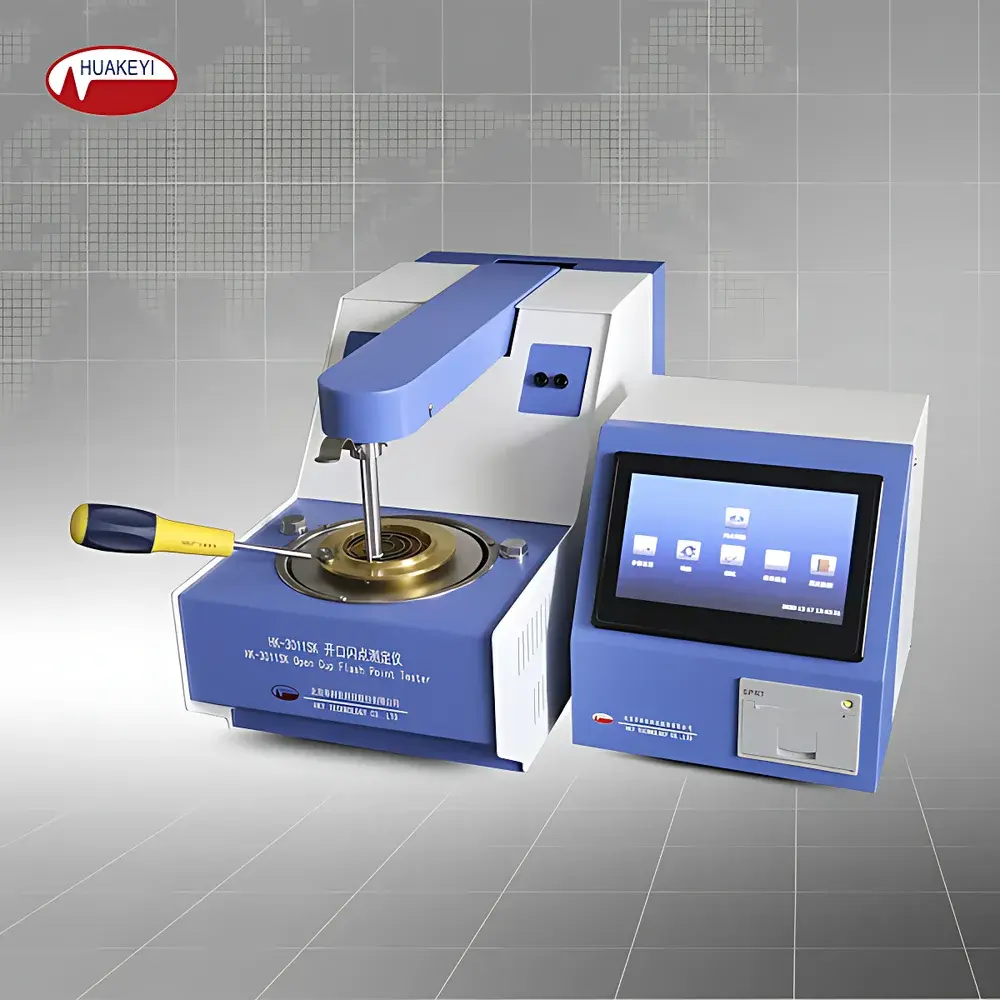
Huake Instrument HK-3011SK Cleveland Open Cup Flash Point Tester
| Brand | Huake Instrument |
|---|---|
| Origin | Beijing, China |
| Manufacturer Type | Authorized Distributor |
| Country of Origin | China |
| Model | HK-3011SK |
| Detection Method | Cleveland Open Cup (COC) Method |
| Temperature Range | Ambient to 400 °C |
| Accuracy | ±2 °C |
| Repeatability | ≤3 °C |
| Resolution | 0.1 °C |
| Heating Rate | 14–17 °C/min (from ambient to 56 °C below preset flash point) |
| Ignition | Automatic electronic ignition (silicon nitride igniter) |
| Cooling | Forced-air cooling |
| Power Consumption | ≤500 W |
| Data Storage | 1000 test records with date-based retrieval |
| Communication | RJ45 (LIMS integration), USB (firmware update & data export) |
| Power Supply | AC 170–264 V, 50/60 Hz or AC 120 V ±10%, 60 Hz ±1 Hz |
| Dimensions (Controller) | 270 × 170 × 130 mm, ~2.0 kg |
| (Testing Unit) | 480 × 245 × 280 mm, ~18.0 kg |
Overview
The Huake Instrument HK-3011SK Cleveland Open Cup Flash Point Tester is a fully automated analytical instrument engineered for precise determination of the open-cup flash point and fire point of petroleum products in accordance with ASTM D92 and GB/T 3536–2008. It implements the standardized Cleveland Open Cup (COC) method—a gravimetric thermal protocol wherein a sample is heated at controlled rates in an unsealed brass cup while an ignition source is periodically introduced across the vapor layer above the liquid surface. The flash point is defined as the lowest temperature at which application of the ignition source causes momentary ignition of vapors over the specimen. This measurement serves as a critical safety parameter for handling, storage, transportation, and regulatory compliance of lubricating oils, bitumens, heavy fuel oils, and other non-volatile petroleum derivatives with expected flash points above 79 °C. Unlike closed-cup methods (e.g., ASTM D56 or D93), the COC configuration reflects real-world exposure conditions where vapor dispersion occurs freely—making it particularly relevant for industrial risk assessment in power generation, rail logistics, aviation maintenance, and refinery quality control laboratories.
Key Features
- 7-inch true-color TFT touchscreen (640 × 480 resolution) with dual-language UI (English/Chinese) and context-sensitive help menus for intuitive operation under ISO/IEC 17025-compliant workflows
- Fully automated sequence: heating ramping, stirring, ignition timing, vapor detection, flame confirmation, auto-cooling, and result reporting—all synchronized via embedded fuzzy logic control algorithm
- Real-time graphical display of temperature vs. time curve, with dynamic annotation of key event markers (e.g., first flash, fire point, cooling initiation)
- Integrated ionization ring detector for high-sensitivity flame verification, minimizing false negatives from transient glow or radiant heat interference
- Silicon nitride ceramic igniter delivering stable, repeatable flame geometry closely matching traditional pilot flames—enhancing inter-laboratory reproducibility per ASTM E1838 guidelines
- Optional gas-assisted ignition module (propane or butane) with solenoid-controlled valve and auto-purge cycle for enhanced reliability in low-humidity environments
- Comprehensive self-diagnostic suite: system initialization check, thermocouple continuity validation, igniter resistance monitoring, fan RPM verification, and pressure sensor calibration status reporting
- Automatic barometric compensation using onboard absolute pressure sensor—eliminating manual input errors and ensuring traceable correction per ASTM D92 Annex A1
- Thermal safety interlocks: overtemperature cutoff (>405 °C), flame-out detection, and automatic gas shutoff upon test completion or anomaly detection
Sample Compatibility & Compliance
The HK-3011SK is validated for use with viscous and semi-solid petroleum products including residual fuel oils, cylinder oils, transformer oils, asphalt binders, and industrial lubricants—provided their expected open-cup flash point exceeds 79 °C. It excludes highly volatile fuels (e.g., gasoline, kerosene, jet fuel), which require closed-cup testing per GB/T 261 or ASTM D56. The instrument conforms to national and international standards including GB/T 3536–2008, ASTM D92, ISO 2592, and IP 36. All firmware and measurement algorithms are designed to support GLP and GMP documentation requirements, with audit-trail-capable data logging compliant with FDA 21 CFR Part 11 when deployed with validated LIMS interfaces via RJ45 Ethernet.
Software & Data Management
Data integrity is ensured through timestamped, immutable test records stored locally in non-volatile memory. Each entry includes operator ID (optional), sample ID, ambient pressure, ambient temperature, observed flash point, fire point (if determined), heating rate profile metadata, and diagnostic flags. Records are retrievable by date range or sequential index and exportable via USB mass-storage mode in CSV format for third-party statistical analysis (e.g., Minitab, JMP). The RJ45 interface supports TCP/IP-based communication with laboratory information management systems (LIMS), enabling automatic transmission of results—including pass/fail status against predefined specification limits—to central QA databases. Firmware updates are performed securely over USB or network, preserving all historical calibration coefficients and user-defined settings.
Applications
- Quality assurance of base oils and finished lubricants in manufacturing facilities
- Condition monitoring of in-service turbine and hydraulic oils in power plants and marine engines
- Regulatory submission testing for ASTM D92 compliance in petrochemical export documentation
- Research and development of high-temperature synthetic fluids and bio-based lubricants
- Fire safety evaluation of bituminous materials used in road construction and roofing applications
- Training and proficiency testing in accredited calibration laboratories operating under CNAS or UKAS accreditation scopes
FAQ
What standards does the HK-3011SK comply with?
It complies with GB/T 3536–2008, ASTM D92, ISO 2592, and IP 36 for open-cup flash point determination.
Is gas ignition mandatory or optional?
Gas ignition is an optional accessory; standard configuration uses the silicon nitride electronic igniter.
Can the instrument correct for atmospheric pressure without user input?
Yes—integrated absolute pressure sensor provides continuous, automatic correction throughout each test cycle.
How many test results can be stored internally?
Up to 1000 complete test records, each with full metadata and traceable timestamps.
Does the device support remote calibration verification?
While not equipped with onboard reference standards, its thermocouple linearity and igniter timing are verifiable via external NIST-traceable sources during routine PQ checks per ISO/IEC 17025 Clause 6.5.