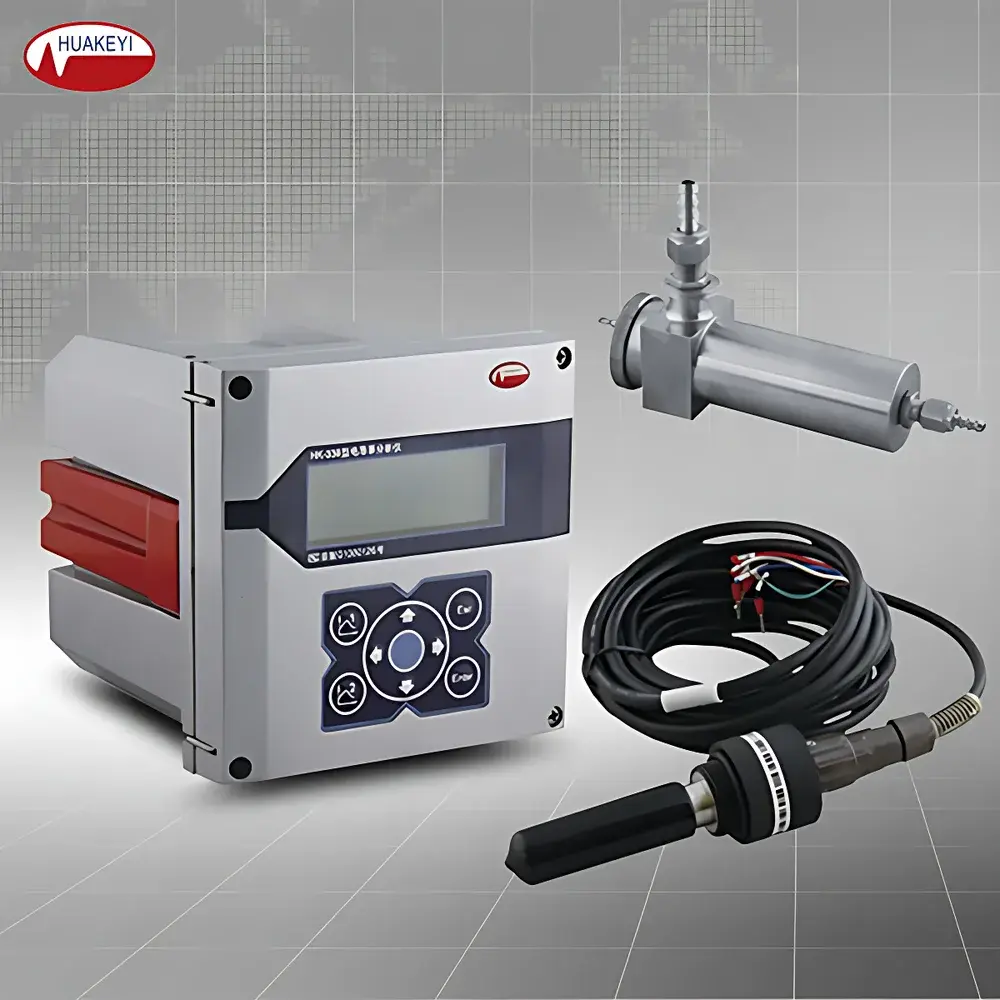
Huake Instrument HK-338 Online Conductivity Analyzer
| Brand | Huake Instrument |
|---|---|
| Model | HK-338 |
| Origin | Beijing, China |
| Enclosure | Die-cast aluminum housing |
| Display | 192 × 64 dot-matrix LCD (Chinese/English selectable) |
| Conductivity Range | 0.000–2.000 μS/cm (K=0.01), 0.00–20.00 μS/cm (K=0.1), 0.0–200.0 μS/cm (K=1.0), 0.000–2.000 mS/cm (K=10.0) |
| Resolution | 0.001 μS/cm (conductivity), 0.1 ℃ (temperature) |
| Accuracy | ±1.5% FS (conductivity), ±0.5 ℃ (temperature) |
| Temperature Compensation | Automatic (ATC: 0.1–60.0 ℃) or manual |
| Measurement Principle | Four-wire conductivity measurement (eliminates lead resistance effects) |
| Output | Two isolated 4–20 mA (or 0–10/0–20 mA) analog outputs |
| Communication | RS-485 (Modbus RTU), optional Profibus DP or HART protocol |
| Data Logging | Internal storage for historical conductivity & temperature data with trend curve recall |
| Sample Temp. | 5–50 ℃ |
| Max. Flow Rate | ≤6 L/h |
| Suspended Solids Limit | ≤5 μm (no colloids or oils) |
| Ambient Operating Temp. | 5–45 ℃ |
| Relative Humidity | ≤90% RH (non-condensing) |
| Power Supply | AC 100–240 V, 50–60 Hz |
| Power Consumption | 8 W |
| Dimensions | 146 × 146 × 154 mm (W × H × D) |
| Panel Cutout | 139 × 139 mm |
| Weight | 2 kg |
| Compliance | Designed for industrial process environments per IEC 61000-6-2 (EMC immunity) and IEC 61000-6-4 (EMC emission) standards |
Overview
The Huake Instrument HK-338 Online Conductivity Analyzer is an industrial-grade, microprocessor-controlled conductivity monitoring system engineered for continuous, high-stability measurement of aqueous solution conductivity in demanding process environments. It operates on the principle of four-wire (Kelvin) conductivity measurement—eliminating errors introduced by cable resistance and contact impedance—ensuring measurement integrity regardless of sensor cable length (up to 10 meters). The analyzer calculates solution conductivity based on the applied AC excitation voltage and measured current across a known electrode cell constant (K = 0.01, 0.1, 1.0, or 10.0 cm⁻¹), with automatic temperature compensation (ATC) referenced to 25 ℃ using a built-in Pt1000 or thermistor temperature sensor. Its cast-aluminum housing provides IP65-rated ingress protection, ESD shielding, and robust electromagnetic interference (EMI) rejection—critical for deployment near variable-frequency drives, motor starters, and other electrically noisy infrastructure common in power generation, pulp & paper, chemical processing, and municipal water treatment facilities.
Key Features
- Four-wire conductivity measurement architecture—decouples sensor excitation and sensing paths to nullify lead resistance influence and enhance long-term stability
- Dual isolated 4–20 mA analog outputs with configurable range mapping (e.g., 0–2000 μS/cm → 4–20 mA), supporting redundant control loop integration or DCS/PLC interfacing
- Two user-programmable solid-state relay outputs for high-priority process alarms (e.g., conductivity deviation, sensor fault, temperature out-of-range)
- Onboard non-volatile memory stores up to 30 days of timestamped conductivity and temperature readings at user-defined intervals (1 min to 24 h), accessible via scrollable trend curves on the local display
- Multi-language interface (English/Chinese) with intuitive menu navigation and real-time dual-parameter display (e.g., conductivity + temperature, or conductivity + % saturation)
- Flexible communication options: standard RS-485 Modbus RTU; optional Profibus DP (slave) or HART 7 protocol modules for legacy system integration
- Wide input power tolerance (100–240 VAC, 50/60 Hz) and low thermal dissipation (8 W) enable operation in unconditioned instrument cabinets or field-mounted enclosures
Sample Compatibility & Compliance
The HK-338 is designed for clean, low-turbidity aqueous streams compliant with ISO 7888 and ASTM D1125 guidelines for conductivity measurement. It requires sample temperatures between 5 ℃ and 50 ℃, flow rates ≤6 L/h, and suspended particle size <5 μm—making it suitable for boiler feedwater, reverse osmosis permeate, cooling tower blowdown, and process rinse water. Colloidal matter, oil films, or biofilm accumulation on the electrode surface must be prevented via appropriate prefiltration or periodic cleaning protocols. The analyzer meets IEC 61000-6-2 (immunity to electrostatic discharge, fast transients, and surge) and IEC 61000-6-4 (radiated/conducted emissions) for industrial environments. While not intrinsically safe, it may be installed in Zone 2/Class I Div 2 areas when housed in certified explosion-proof enclosures per ATEX/IECEx or NEC 500/505 requirements.
Software & Data Management
No proprietary PC software is required for basic commissioning—the device supports full configuration via front-panel keypad and LCD. For advanced diagnostics and data export, Huake provides optional Windows-based HK-Config Utility (v3.x), enabling firmware updates, calibration log review, alarm history download (CSV format), and custom curve scaling. All calibration events, alarm triggers, and output status changes are time-stamped and retained in audit-trail memory—supporting GLP-aligned documentation practices. The RS-485 interface supports Modbus function codes 03 (read holding registers) and 06 (preset single register), allowing seamless integration into SCADA systems with native Modbus support. Optional HART-enabled versions provide full device description (DD) compatibility with AMS Device Manager and DeltaV DCS platforms.
Applications
- Power plant demineralized water purity monitoring upstream of steam generators
- Pharmaceutical purified water (PW) and water-for-injection (WFI) loop surveillance per USP and EU Annex 1
- Pulp & paper mill white water and condensate return conductivity control
- Chemical dosing verification in corrosion inhibitor or pH adjustment loops
- Municipal wastewater effluent compliance reporting (e.g., conductivity as surrogate for total dissolved solids)
- Food & beverage CIP rinse water quality validation
FAQ
What electrode constants are supported, and how is K-value selected?
Electrode constants of 0.01, 0.1, 1.0, and 10.0 cm⁻¹ are factory-configurable. Selection depends on expected conductivity range: K=0.01 for ultrapure water (≤2 μS/cm), K=1.0 for municipal water (50–1500 μS/cm), and K=10.0 for brines or seawater (up to 2 mS/cm). The analyzer auto-scales its measurement circuitry upon K-value entry.
Is temperature compensation mandatory, and what reference standard is used?
ATC is enabled by default per DIN EN 27888 and ASTM D1125, using the nonlinear NaCl-based temperature coefficient curve. Manual compensation is available for non-aqueous or high-ionic-strength solutions where standard algorithms deviate.
Can the HK-338 meet FDA 21 CFR Part 11 requirements for electronic records?
While the base unit lacks digital signature or role-based access control, its audit-trail-capable memory and time-stamped event logging serve as foundational elements for Part 11 compliance when deployed within validated procedural controls and supplementary IT governance frameworks.