
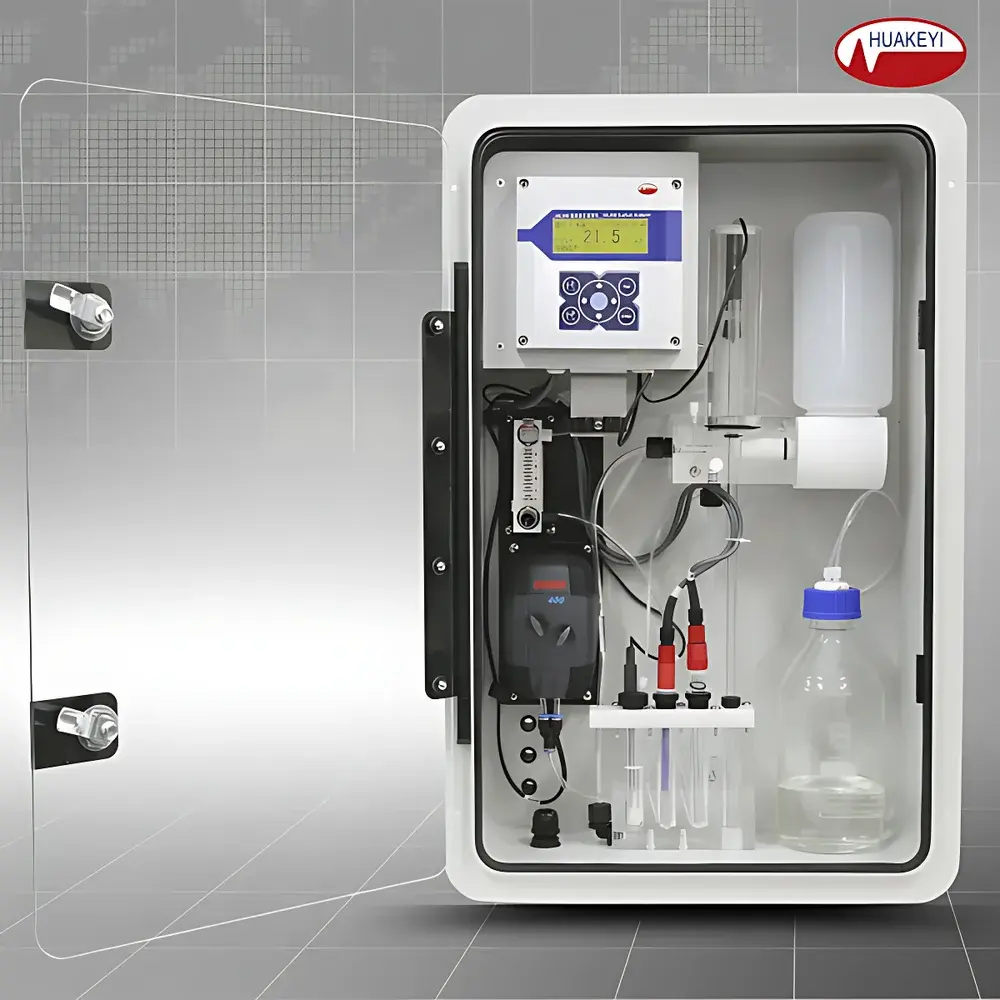
Huake Instrument HK-358 Cation Exchange Bed Sodium Ion Monitor
| Brand | Huake Instrument |
|---|---|
| Origin | Beijing, China |
| Model | HK-358 Cation Exchange Bed |
| Type | Online Sodium Ion Analyzer |
| Measurement Range | (1.00–8.00) pNa, 0.23 µg/L–2300 mg/L |
| Detection Limit | 0.01 pNa or 0.01 µg/L |
| Response Time (T90) | 2 min at 25 °C |
| Accuracy | ±0.05 pNa or ±5 µg/L (whichever is greater) |
| Temperature Range | (0.00–99.9) °C |
| Temperature Compensation | Automatic or Manual (0.1–60.0 °C) |
| Display | 192 × 64 dot-matrix LCD (English/Chinese selectable) |
| Resolution | 0.01 pNa / 0.01 µg/L / 0.1 mV |
| Output | Dual isolated (0–10) mA, (0–20) mA, or (4–20) mA |
| Power Supply | AC 100–240 V, 50–60 Hz |
| Power Consumption | ≤8 W |
| Enclosure Dimensions | 450 × 690 × 190 mm (W × H × D) |
| Panel Cutout | 410 × 645 mm |
| Weight | 20 kg |
Overview
The Huake Instrument HK-358 Cation Exchange Bed Sodium Ion Monitor is a dedicated online analytical system engineered for continuous, high-stability measurement of sodium ion concentration in the effluent stream of cation exchange beds—particularly in high-purity water production systems used in power generation, petrochemical refining, and semiconductor-grade water treatment. It operates on the principle of potentiometric ion-selective electrode (ISE) detection, utilizing a solid-state sodium-selective membrane electrode paired with a robust reference electrode. The instrument employs a controlled alkalization strategy to suppress hydrogen ion interference—a critical requirement for accurate sub-ppb sodium quantification in low-conductivity, high-pH boiler feedwater and condensate streams. Its design conforms to the functional requirements of ASTM D4582–22 (Standard Practice for Determining Sodium in High-Purity Water by Ion-Selective Electrode) and supports compliance with ASME PTC 19.11, EPRI guidelines for steam cycle chemistry control, and IEC 61511 for safety-related instrumentation in process industries.
Key Features
- Integrated alkalization module with precise reagent dosing and mixing geometry—minimizes pH-dependent Na+/H+ cross-sensitivity without requiring external chemical addition systems.
- Auto-stabilization algorithm continuously evaluates electrode potential drift and signal noise, delaying output reporting until electrochemical equilibrium meets ISO 15197:2013-defined stability criteria (ΔE < 0.2 mV over 60 s).
- Dual isolated current outputs (4–20 mA default) support redundant integration into DCS, PLC, or SCADA platforms with galvanic isolation rated to 1500 VAC per IEC 61000-4-5.
- Embedded temperature compensation using Pt1000 sensor with ±0.5 °C accuracy ensures traceable correction across the full operational range (0.00–99.9 °C), aligned with NIST-traceable calibration protocols.
- Industrial-grade aluminum chassis with EMI-shielded electronics compartment provides immunity to electromagnetic interference common in switchgear rooms and turbine halls (tested per IEC 61326-1 Class A).
- Non-volatile memory stores ≥100,000 timestamped data points, including raw mV readings, compensated pNa values, temperature, calibration events, and alarm logs—with configurable retention intervals (1 min to 24 h).
Sample Compatibility & Compliance
The HK-358 is validated for use with deionized water streams meeting ASTM D1193 Type I or II specifications. Sample inlet conditions must satisfy: flow rate 6–20 L/h, pressure 50–300 kPa, temperature 5–50 °C, suspended solids ≤5 µm (no colloids or oils). It complies with GLP data integrity principles via audit-trail-enabled event logging—including user login/logout, calibration parameter changes, and output range modifications. While not FDA 21 CFR Part 11 certified out-of-the-box, its firmware architecture supports electronic signature implementation and secure user role management (Admin/Operator/Calibration Technician) required for regulated pharmaceutical or biotech water systems.
Software & Data Management
Data export is supported via RS-232 serial interface (Modbus RTU protocol) for direct connection to historian systems such as OSIsoft PI or Emerson DeltaV. Internal storage enables retrieval of historical trends via front-panel navigation or optional USB export (FAT32 formatted drive). Calibration records include date/time stamp, standard concentrations used, measured mV values, slope (%/decade), and asymmetry potential—formatted to align with ISO/IEC 17025 documentation requirements. All stored data carry embedded UTC timestamps synchronized to internal real-time clock with ±2 s/month drift.
Applications
- Real-time monitoring of sodium breakthrough in mixed-bed and cation-only demineralizers serving ultra-high-pressure drum boilers.
- Early leak detection in condensate polishing units where sodium serves as an indicator of cooling water ingress or resin degradation.
- Verification of regeneration efficiency in nuclear plant service water purification loops per NEI 08-09 guidance.
- Quality assurance in pharmaceutical purified water (PW) and water for injection (WFI) distribution systems where sodium is a specified impurity (USP <1231>).
- Process validation support for semiconductor fab ultrapure water (UPW) systems targeting <10 ng/L Na+ at point-of-use.
FAQ
What sample pretreatment is required prior to analysis?
No filtration or degassing is needed if feedwater meets the stated particulate and oil specifications. However, a bypass flow regulator must be installed to maintain constant 6–20 L/h delivery to the flow cell.
Can the instrument operate without alkalization reagent?
Yes—but measurement accuracy degrades significantly below pH 10.2; alkalization is mandatory for reliable sub-1 µg/L detection per ASTM D4582.
Is remote calibration possible via Modbus?
No. Calibration requires physical access to initiate standard solution introduction and electrode verification—consistent with IEC 62443-3-3 SL2 security requirements for safety-critical analyzers.
How often does the sodium ISE require replacement?
Typical service life exceeds 18 months under continuous operation in optimized water chemistry; performance should be verified weekly using bracketing standards.
Does the unit meet explosion-proof certification for hazardous areas?
No. It is rated for general-purpose indoor installation only (IP54 enclosure rating per IEC 60529); zone-classified variants are not available.







