
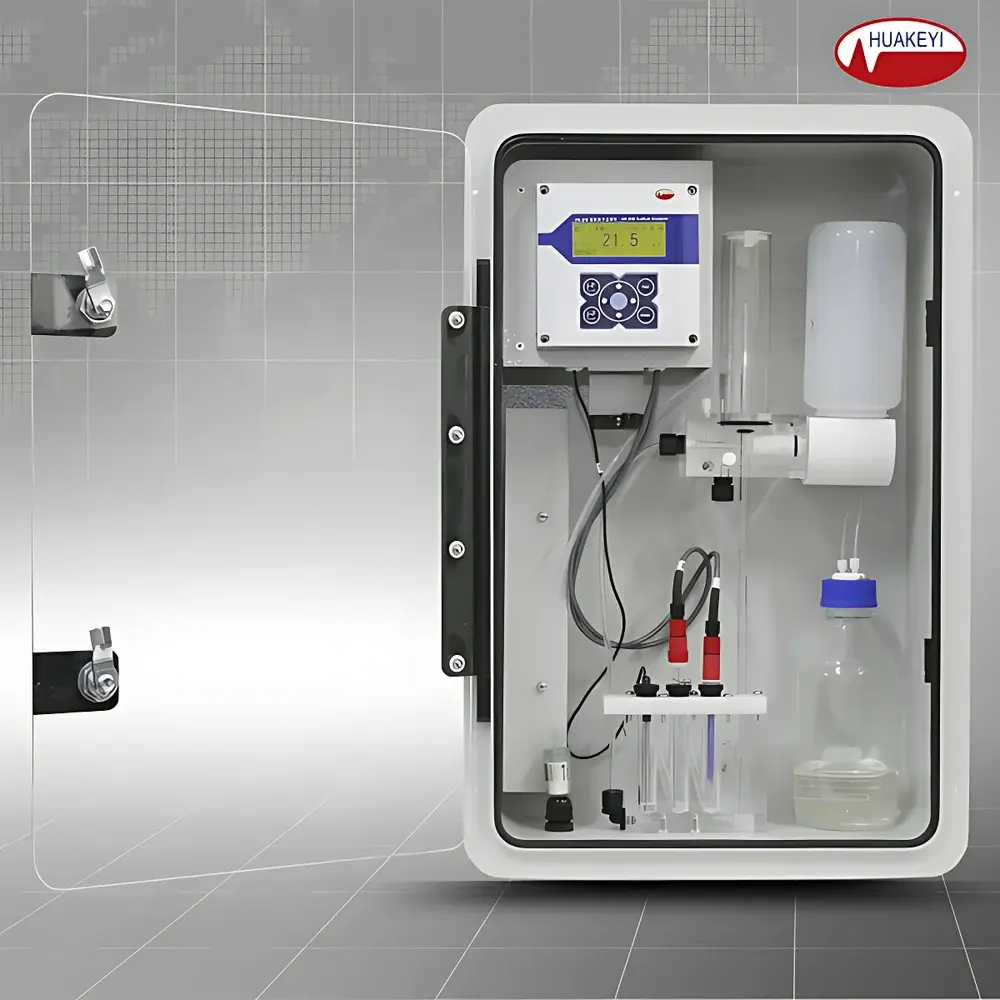
Huake Instrument HK-358 Steam Sodium Ion Monitor
| Brand | Huake Instrument |
|---|---|
| Origin | Beijing, China |
| Model | HK-358 Steam |
| Type | Online Sodium Ion Analyzer |
| Measurement Range | (1.00–8.00) pNa, 0.23 µg/L – 2300 mg/L |
| Detection Limit | 0.01 pNa or 0.01 µg/L |
| Response Time (T90) | 2 min at 25 °C |
| Accuracy | ±0.05 pNa or ±5 µg/L (whichever is greater, within ±10 °C of calibration temperature) |
| Temperature Range | (0.00–99.9) °C |
| Temperature Compensation | Automatic or Manual (0.1–60.0 °C) |
| Output | Dual isolated 4–20 mA (or 0–10/0–20 mA), dual programmable alarm relays |
| Display | 192 × 64 dot-matrix LCD (English/Chinese selectable) |
| Power Supply | AC 100–240 V, 50–60 Hz |
| Power Consumption | ≤8 W |
| Dimensions | 450 mm × 690 mm × 190 mm (W × H × D) |
| Weight | 20 kg |
| Enclosure | Aluminum chassis, panel-mount design |
| Compliance | Designed for continuous steam-phase sodium monitoring in high-purity water/steam cycles per IAPWS guidelines and power plant QA/QC protocols |
Overview
The Huake Instrument HK-358 Steam Sodium Ion Monitor is a dedicated online electrochemical analyzer engineered for continuous, real-time measurement of trace sodium ion concentration in high-temperature, high-purity steam and saturated steam streams—primarily within fossil-fueled and nuclear power plant secondary coolant loops. It operates on the potentiometric principle using a selective sodium ion-selective electrode (ISE) paired with a robust reference electrode, enabling direct quantification of Na⁺ activity in the pNa scale (pNa = −log₁₀[Na⁺]). Unlike conventional aqueous-phase analyzers, the HK-358 integrates optimized sample conditioning—including precise temperature-controlled alkalization (typically via NH₃ or morpholine addition) to suppress hydrogen ion interference and stabilize the liquid junction potential—ensuring reliable detection down to sub-ppb levels in steam condensate and main steam lines. Its design adheres to the operational constraints defined by the International Association for the Properties of Water and Steam (IAPWS) TR-10-01 and IEEE Std 1177 for steam purity monitoring, supporting early detection of boiler tube corrosion, superheater deposit formation, and turbine blade fouling.
Key Features
- Panel-mounted aluminum enclosure with EMI-shielded electronics architecture, rated for industrial control room and turbine hall environments (IP54 front panel, NEMA 12 equivalent)
- Embedded microcontroller platform with surface-mount technology (SMT) PCB assembly, ensuring long-term stability and reduced thermal drift
- Dual-channel isolation: two independently configurable 4–20 mA current outputs (±1% FS accuracy, 800 Ω max load) for integration with DCS/SCADA systems
- Programmable dual relay outputs for high/low alarm, maintenance alert, or electrode fault indication—each fully configurable via on-device menu or remote configuration
- Onboard Pt1000 temperature sensor with ±0.5 °C accuracy and 0.1 °C resolution; supports both automatic and manual temperature compensation across 0.1–60.0 °C range
- High-resolution 192 × 64 graphical LCD display with language toggle (English/Chinese); simultaneously shows pNa, µg/L, mV, temperature, and system status icons
- Internal non-volatile memory stores ≥12 months of timestamped measurement data (1-min intervals), calibration logs, and event history (power loss, alarm activation, electrode replacement)
Sample Compatibility & Compliance
The HK-358 is validated for use with steam condensate and cooled steam samples meeting strict physical and chemical criteria: sample temperature 5–50 °C, pressure 50–300 kPa, flow rate 6–20 L/h, suspended solids 1 µm is mandatory). It complies with sampling best practices outlined in ASTM D4582–22 (“Standard Practice for Sampling High-Purity Water”) and aligns with ISO 14687-2:2019 for hydrogen production feedwater purity verification. While not FDA 21 CFR Part 11-certified out-of-the-box, its audit trail functionality—including immutable timestamps, user ID logging for calibrations and configuration changes, and password-protected parameter editing—supports GLP/GMP-aligned validation protocols when deployed in regulated utility QA laboratories.
Software & Data Management
No proprietary PC software is required for routine operation; all configuration, calibration, and diagnostics are performed locally via intuitive menu navigation. However, optional RS-485 Modbus RTU interface (standard) enables seamless integration into plant-wide asset management systems. Historical data can be exported via USB flash drive (FAT32 formatted) in CSV format, preserving full metadata (date/time, pNa, µg/L, temperature, electrode mV, stability flag). Calibration records include solution lot numbers, expiration dates, and operator ID—facilitating traceability during regulatory audits. The auto-stabilization algorithm continuously evaluates signal noise and slope consistency, delaying output updates until measurement variance falls below ±0.01 pNa over 30 seconds—reducing false alarms in transient steam conditions.
Applications
- Continuous sodium monitoring in main steam lines and reheat steam headers of coal-fired, gas-fired, and nuclear power plants
- Saturation steam purity verification upstream of turbine throttle valves per ASME PTC 19.11 standards
- Boiler feedwater and condensate polishing system performance evaluation
- Startup/shutdown chemistry surveillance during wet layup or post-maintenance flush procedures
- Corrosion product transport tracking in combined-cycle HRSGs and district heating networks
FAQ
What sample conditioning is required prior to analysis?
Steam must be condensed through a stainless steel heat exchanger with controlled cooling to 25–40 °C, followed by pH adjustment to ≥10.0 using reagent-grade ammonia or morpholine—per IAPWS TR-10-01—to minimize H⁺ interference and ensure Nernstian response.
Can the HK-358 measure sodium in superheated steam directly?
No. Direct superheated steam sampling is not supported. The instrument requires conditioned condensate at stable temperature and pressure; an integrated steam sampling probe with certified isokinetic extraction and rapid quenching is mandatory.
How often does the sodium ISE require recalibration?
Typical recalibration interval is 7–14 days under steady-state operation; however, daily verification with a mid-range standard (e.g., 2.0 µg/L Na⁺) is recommended per EPRI TR-102529 and ANSI/ISA-77.40.01.
Is the system compatible with redundant sensor architectures?
Yes—the dual 4–20 mA outputs and Modbus address mapping support 2-out-of-3 voting configurations when deployed alongside parallel HK-358 units or third-party analyzers in SIL-2 safety-rated applications.
What maintenance is required for the reference electrode?
The Ag/AgCl reference electrode requires periodic refilling with saturated KCl gel (supplied) every 3–6 months; membrane cleaning with dilute nitric acid (0.1 M) is advised if response lag exceeds 90 s during verification.
Related Products







