
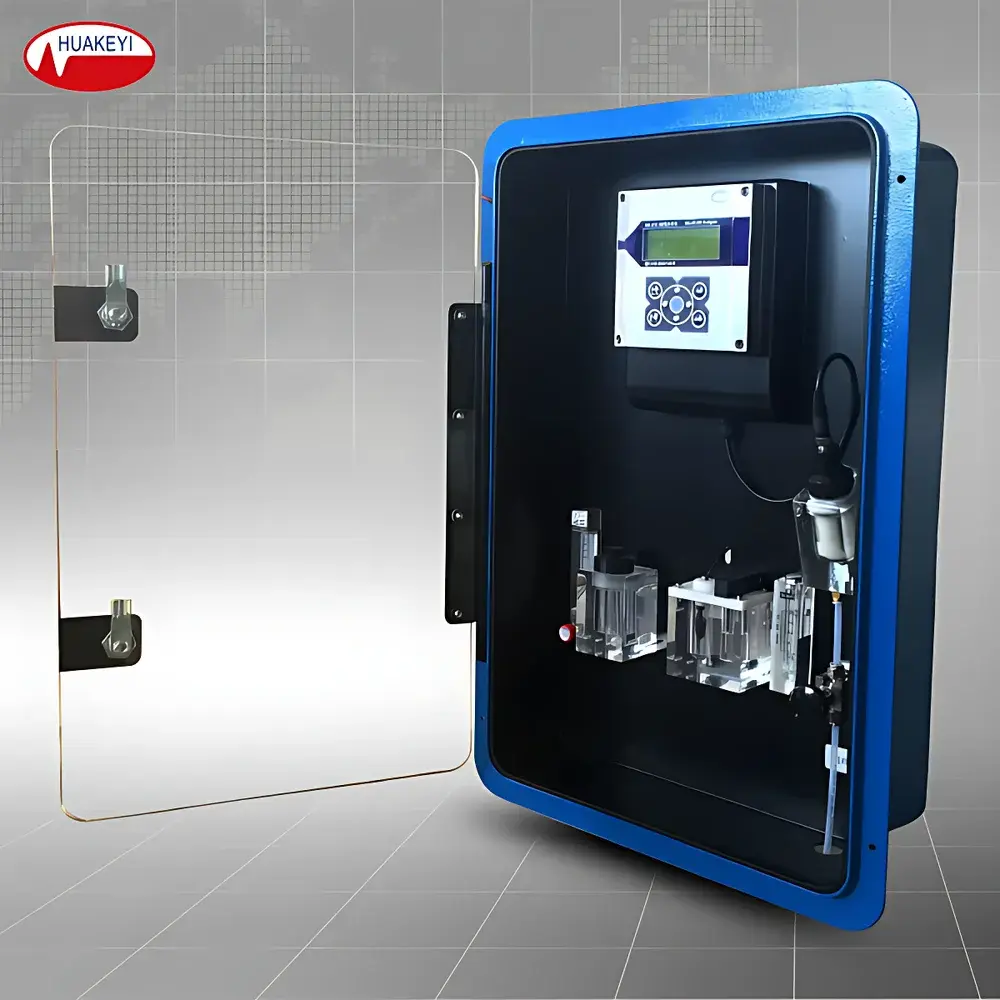
Huake Instrument HK-378 Online Dissolved Hydrogen Analyzer
| Brand | Huake Instrument |
|---|---|
| Origin | Beijing, China |
| Manufacturer Type | Authorized Distributor |
| Country of Origin | China |
| Model | HK-378 |
| Price Range | USD 14,000 – 42,000 |
| Measurement Range | 0–10 µg/L and 0–100 µg/L |
| Resolution | 0.01 µg/L |
| Accuracy | ±3% FS or ±0.5 µg/L (whichever is greater) |
| Response Time (T90) | ≤5 s |
| Temperature Compensation Range | 5.0–45.0 °C (auto/manual) |
| Sample Flow Rate | 50–350 mL/h |
| Sample Temperature Range | 5.0–45.0 °C |
| Max. Suspended Particle Size | ≤5 µm (no colloids or oils) |
| Output | Dual isolated 4–20 mA (configurable as 0–10/0–20 mA) |
| Communication | RS485 Modbus RTU, USB data export |
| Power Supply | AC 100–240 V, 50–60 Hz, ≤8 W |
| Dimensions (W×H×D) | 690 × 450 × 215 mm |
| Weight | 22 kg |
Overview
The Huake Instrument HK-378 Online Dissolved Hydrogen Analyzer is a dedicated electrochemical measurement system engineered for continuous, real-time monitoring of dissolved hydrogen (H₂) in high-purity water and steam streams—particularly in thermal power generation environments. Unlike general-purpose dissolved oxygen analyzers, the HK-378 employs a specialized Clark-type amperometric sensor with a gas-permeable membrane and catalytic cathode optimized for sub-ppb-level H₂ detection in saturated and superheated steam condensate. Its core principle relies on the selective diffusion of molecular hydrogen through a hydrophobic polytetrafluoroethylene (PTFE) membrane into an electrolyte-filled chamber, where it undergoes electrochemical reduction at a polarized noble metal cathode (typically platinum), generating a current linearly proportional to H₂ concentration. This design ensures minimal interference from dissolved oxygen, CO₂, or other redox-active species commonly present in boiler feedwater and turbine steam cycles.
Key Features
- High-sensitivity amperometric sensor with 0.01 µg/L resolution and guaranteed accuracy of ±3% full scale or ±0.5 µg/L (whichever is greater), validated per ASTM D869–22 for trace hydrogen quantification in ultrapure water systems.
- Rugged cast-aluminum enclosure rated IP65, ESD-shielded, and designed for electromagnetic compatibility (EMC) in industrial control rooms and turbine halls per IEC 61326-1.
- Embedded microcontroller architecture with surface-mount technology (SMT) PCBs ensures long-term stability, low drift (<0.5 µg/L/month zero shift), and mean time between failures (MTBF) exceeding 60,000 hours.
- Dual isolated 4–20 mA analog outputs support integration into DCS/PLC systems with galvanic isolation up to 1500 VAC, compliant with IEC 61000-4-5 surge immunity standards.
- Configurable alarm relays with user-defined setpoints and hysteresis; supports fail-safe logic for turbine trip interlocks per ANSI/ISA-84.00.01.
- Onboard non-volatile memory stores >100,000 timestamped data points with 1-second logging interval; historical trend curves accessible via front-panel LCD or USB export in CSV format.
Sample Compatibility & Compliance
The HK-378 is validated for use with deaerated, demineralized water and steam condensate meeting ASTM D1193 Type I specifications. Sample requirements include flow rates of 50–350 mL/h through the supplied flow-through cell, temperature stability within 5.0–45.0 °C, and particulate content ≤5 µm (free of colloidal silica, oil, or organic fouling agents). The analyzer complies with ISO 5667-3 for sampling integrity and meets electrical safety requirements per IEC 61010-1. It supports GLP/GMP data integrity workflows through optional audit-trail-enabled firmware (upgradeable via USB), aligning with FDA 21 CFR Part 11 principles for electronic records in regulated utility operations.
Software & Data Management
Data acquisition and configuration are managed via a built-in 192×64 dot-matrix LCD supporting both English and Chinese UI languages. Real-time parameters—including H₂ concentration, temperature, pressure (via integrated barometric sensor, ±1 mbar accuracy), and electrode status—are displayed simultaneously. All measurement events, calibration logs, alarm activations, and configuration changes are time-stamped and stored with immutable metadata. USB port enables secure offline data extraction without network connectivity—critical for air-gapped nuclear or fossil-fueled plant networks. Firmware updates preserve all user settings and historical archives. Optional Modbus RTU over RS485 allows seamless integration with SCADA platforms such as Siemens Desigo, Honeywell Experion, or ABB 800xA.
Applications
- Continuous monitoring of dissolved hydrogen in boiler feedwater and turbine condensate to detect early-stage copper alloy corrosion (e.g., admiralty brass tube degradation) and assess hydrazine or carbohydrazide dosing efficacy.
- Verification of hydrogen blanketing effectiveness in high-pressure steam generators operating above 10 MPa.
- Supporting ASME PTC 19.11 and IAPWS TR-2 guidelines for steam purity compliance in combined-cycle and ultra-supercritical power plants.
- Integration into automated chemistry control systems (CCS) for closed-loop reagent dosing feedback based on real-time H₂ trends.
- Research applications in hydrogen permeation studies for materials testing under simulated primary coolant conditions (e.g., pressurized water reactor secondary side).
FAQ
What is the recommended calibration frequency for the HK-378 in continuous power plant operation?
Calibration is advised every 7–14 days using certified zero-gas (nitrogen sparged ultrapure water) and span standard (certified H₂-saturated water prepared per ASTM D869 Annex A2), with verification against in-line reference electrodes where available.
Can the HK-378 operate reliably in high-vibration environments near steam turbines?
Yes—the cast-aluminum housing, fully potted electronics, and solid-state sensor design meet IEC 60068-2-6 vibration resistance standards (5–500 Hz, 2 g RMS), validated during third-party testing at Shanghai Electric Turbine & Electric Co.
Is the dissolved hydrogen electrode replaceable in-field without recalibration?
The membrane-electrolyte assembly is field-serviceable using included tools and consumables (2 membranes + 1 electrolyte vial per kit); post-replacement zero and span verification is required, but full multi-point calibration is not necessary if baseline drift remains within specification.
Does the analyzer support remote diagnostics or predictive maintenance alerts?
While the base firmware does not include cloud connectivity, the RS485/Modbus interface enables integration with asset performance management (APM) platforms such as GE Digital Predix or Siemens MindSphere via gateway middleware for condition-based maintenance modeling.







