
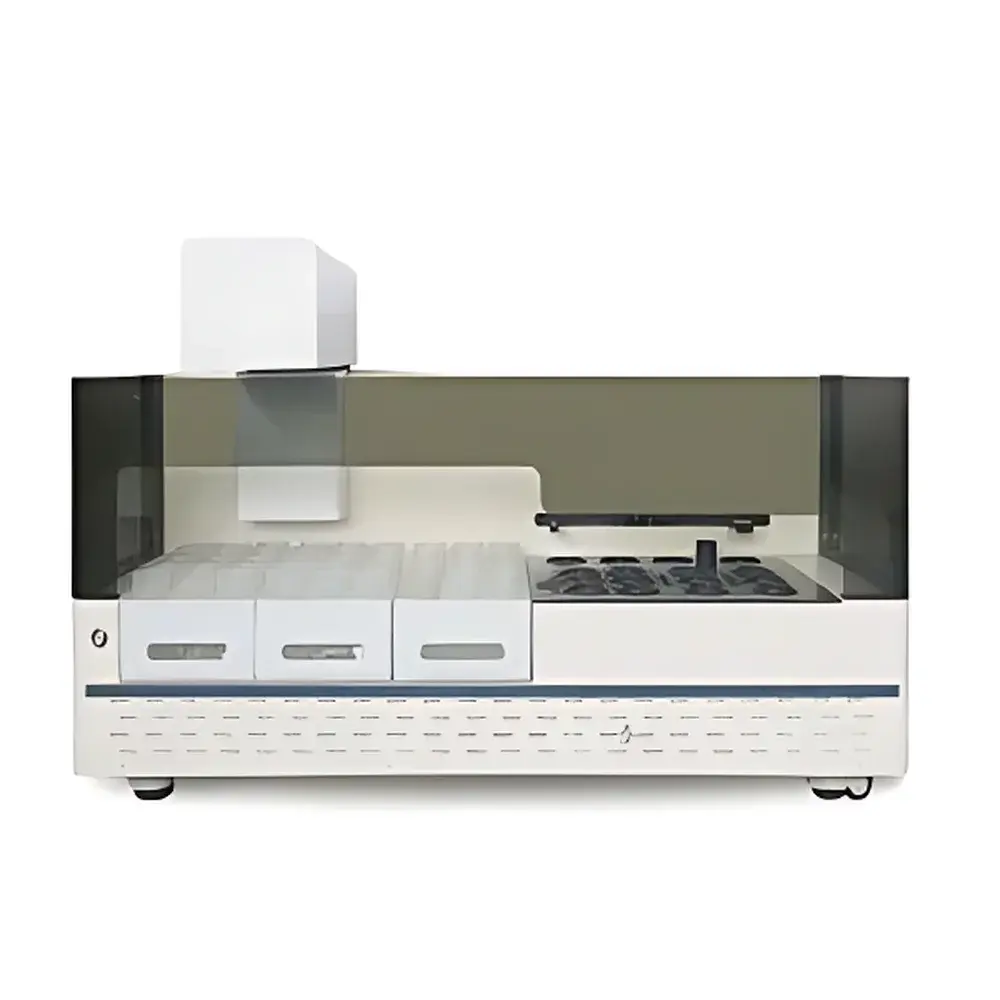
HUANKONG 1610 High-Manganese Index Analyzer (54-Position)
| Brand | HUANKONG |
|---|---|
| Origin | Shandong, China |
| Manufacturer Type | Manufacturer |
| Product Category | Domestic |
| Model | 1610 |
| Measurement Principle | Acidic Potassium Permanganate Oxidation (Boiling Water Bath + Colorimetric Endpoint Detection) |
| Instrument Type | Laboratory Benchtop Analyzer |
| Range | 0–6.0 mg/L O₂ |
| Accuracy | ≤2% RSD |
| Single Sample Analysis Time | ≤3 min |
Overview
The HUANKONG 1610 High-Manganese Index Analyzer is a fully automated, benchtop laboratory system engineered for precise and reproducible determination of the permanganate index (CODMn) in water samples—aligned with ISO 8467 and national standards including GB/T 11892 and GB/T 5750.7. Unlike manual titration or semi-automated platforms, this analyzer implements the classical acidic potassium permanganate oxidation method under rigorously controlled boiling water bath conditions, followed by thermally stabilized colorimetric endpoint detection. The system eliminates operator-dependent variables—such as inconsistent heating duration, subjective endpoint judgment, or manual reagent dosing—by integrating robotic sample handling, synchronized multi-channel digestion, and adaptive optical endpoint recognition. Designed for high-throughput environmental labs, it delivers traceable, auditable results suitable for regulatory reporting, quality assurance programs, and long-term trend analysis of organic load in drinking water, surface water, and source water.
Key Features
- 54-position sample capacity with modular, removable sample trays—enabling flexible batch configuration without mechanical recalibration
- 12-channel boiling water bath station with fiber-optic liquid level sensing, auto-refill function, and low-water cut-off protection to ensure consistent 100 °C thermal exposure per GB/T 11892
- Three independent, temperature-stabilized titration modules operating at constant 60–65 °C to minimize thermal drift during endpoint detection
- Non-contact, full-spectrum dynamic color recognition system: captures RGB intensity gradients across multiple angles and timepoints to identify the faint pink-to-colorless transition—eliminating reliance on fixed-threshold photometry
- Dual-reagent dispensing arms with dual peristaltic pumps for KMnO₄ and H₂SO₄—ensuring stoichiometric accuracy and zero cross-contamination between reagent lines
- Self-calibrating optical sensor array with automatic dark-current compensation and ambient light rejection—requiring no routine maintenance or manual alignment
- Integrated reagent volume monitoring with configurable low-level alerts and real-time consumption logging—supporting GLP-compliant reagent traceability
Sample Compatibility & Compliance
The 1610 Analyzer accommodates standard 25 mL borosilicate glass vials (or equivalent polypropylene containers), compatible with raw, filtered, and preserved water matrices—including chlorinated drinking water, river/lake surface water, groundwater, and reservoir influent. It complies with analytical requirements defined in GB/T 11892 (equivalent to ISO 8467:1993), GB/T 5750.7, and supports method validation per ISO/IEC 17025:2017. All critical process parameters—including digestion time (30 ± 0.5 min), acid concentration (H₂SO₄ final concentration ≥0.52 mol/L), KMnO₄ dosage (10.00 ± 0.05 mL), and titration temperature—are digitally enforced and logged with timestamped audit trails. System operation meets data integrity expectations aligned with FDA 21 CFR Part 11 when deployed with validated software configuration and user access controls.
Software & Data Management
The embedded workstation software provides a unified interface for method setup, run scheduling, real-time status visualization, and result export. Each sample position is mapped to an interactive graphical tray diagram—allowing on-the-fly sample insertion, deletion, or reassignment without interrupting active runs. All analytical events—including reagent dispense volumes, digestion start/end timestamps, optical signal curves, and endpoint confirmation logic—are stored in a relational SQLite database with SHA-256 checksum integrity verification. Export formats include CSV (for LIMS integration), PDF analytical reports (with digital signature support), and XML files compliant with ASTM E1469-22 for instrument data interchange. Audit trail functionality records all user actions, parameter changes, and system events with immutable timestamps—enabling full traceability during internal audits or regulatory inspections.
Applications
- Routine monitoring of permanganate index in municipal drinking water treatment plants for compliance with GB 5749–2022
- Organic pollution assessment in watershed management programs and ecological status evaluation (e.g., WFD classification)
- Quality control of source water entering advanced oxidation or membrane filtration units
- Method comparison studies and inter-laboratory proficiency testing under CNAS-accredited protocols
- Research applications requiring high-reproducibility CODMn data for correlation with TOC, UV254, or fluorescence indices
FAQ
Does the system require consumables such as electrodes, membranes, or proprietary cuvettes?
No—the 1610 Analyzer operates without disposable sensors, electrochemical cells, or single-use reaction vessels. All fluidic pathways are constructed from chemically resistant PTFE and borosilicate glass; optical components are sealed and self-calibrating.
Can the instrument be integrated into an existing LIMS environment?
Yes—via configurable CSV export, HTTP-based API endpoints (available upon software license activation), and optional OPC UA server module for industrial network compatibility.
Is method validation documentation available for regulatory submissions?
HUANKONG provides a comprehensive IQ/OQ protocol package, including linearity (0.2–6.0 mg/L O₂), precision (≤2% RSD at 2.0 mg/L), spike recovery (95–105%), and robustness testing against pH, chloride, and turbidity interferences—as required for GLP/GMP-aligned laboratories.
What maintenance intervals are recommended for routine operation?
Daily: Visual inspection of water bath level and reagent tubing integrity. Quarterly: Optical window cleaning and pump tubing replacement. Annual: Full system performance verification using certified reference materials (CRM) traceable to NIM.







