
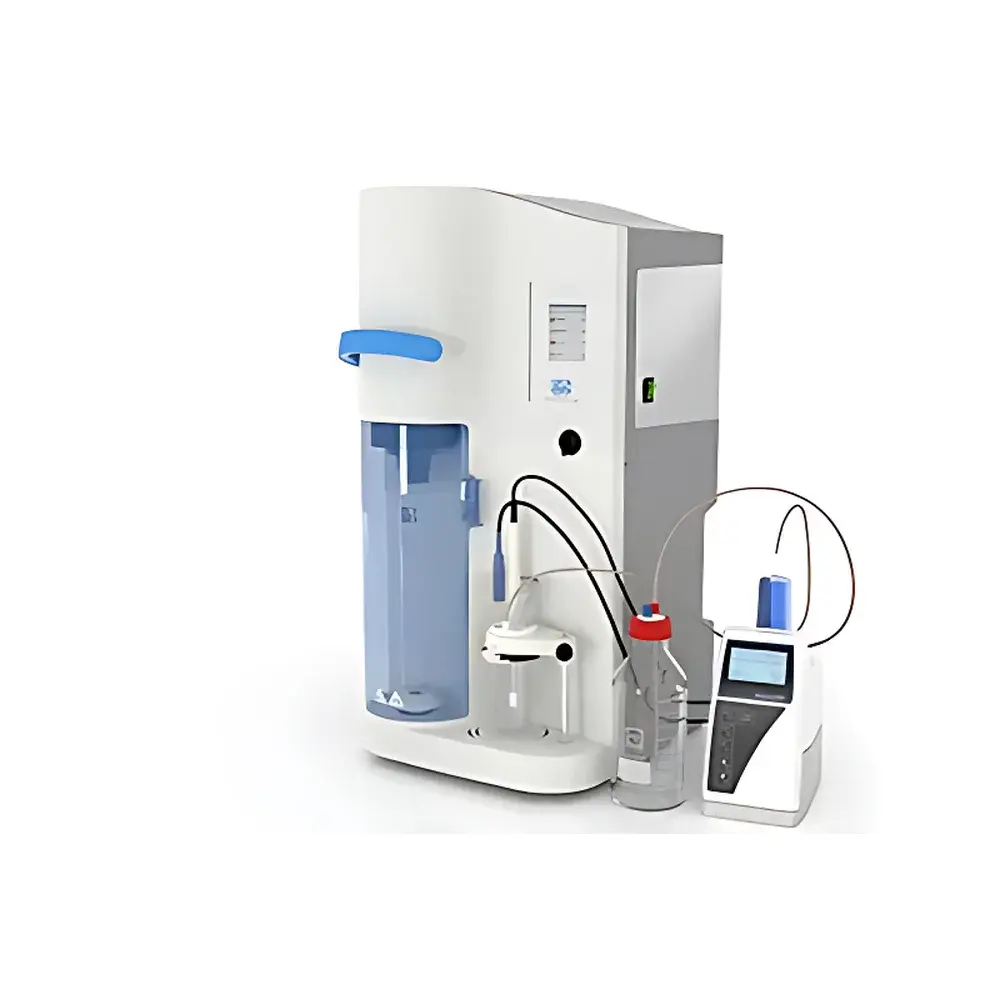
VELP UDK 149 Automated Kjeldahl Distillation System
| Brand | VELP |
|---|---|
| Origin | Italy |
| Model | UDK 149 |
| Instrument Type | Kjeldahl Nitrogen Determinator |
| Nitrogen Determination Range | 0.1–200 mg |
| Distillation Time | 3–4 min/sample |
| Repeatability | ±0.5% |
| Sample Weight Capacity | ≤5 g |
| Nitrogen Recovery Rate | ≥99% |
| Power Consumption | 2100 W |
| Dimensions (W×D×H) | 380 × 416 × 780 mm |
Overview
The VELP UDK 149 Automated Kjeldahl Distillation System is a CE-marked, ISO/IEC 17025-aligned benchtop instrument engineered for precise and reproducible nitrogen determination in accordance with AOAC, ISO 8968, ISO 1871, ASTM D1122, and USP General Chapter <2420> methodologies. It implements the classical Kjeldahl principle—acid digestion followed by alkaline distillation and titrimetric quantification—to deliver trace-level nitrogen measurement across diverse matrices including food, feed, environmental samples, pharmaceutical excipients, and agricultural products. Designed for high-throughput laboratory environments, the UDK 149 integrates steam generation, reagent dosing, condensation, and distillate collection into a single automated workflow, minimizing manual intervention while maintaining strict analytical integrity. Its modular architecture supports seamless integration with external potentiometric titrators (e.g., Metrohm, Hanna, or Thermo Scientific models) via RS-232 or USB, enabling fully unattended distillation-to-titration analysis.
Key Features
- 3.5-inch full-color capacitive touchscreen interface with intuitive icon-driven navigation and multilingual support (English, German, French, Spanish, Italian, Chinese)
- 20 user-configurable distillation programs—each defining steam intensity (10–100%), NaOH volume, boric acid volume, water volume, and distillation duration
- Programmable steam flow control ensures consistent thermal energy delivery across sample types, critical for volatile nitrogen compounds and low-mass samples
- Automated reagent dispensing with gravimetric calibration capability for NaOH, boric acid, and dilution water—reducing inter-operator variability
- Integrated residual removal system evacuates condensate and carryover post-distillation, preventing cross-contamination between runs
- Onboard data logging with timestamped records (date/time, program ID, sample ID, N-content, recovery %, operator ID)
- Direct export of CSV-formatted results to USB flash drive or network-connected PC via Ethernet or USB host port
- Full password protection (admin + user levels) compliant with GLP/GMP documentation requirements and FDA 21 CFR Part 11 audit trail readiness
Sample Compatibility & Compliance
The UDK 149 accommodates solid, semi-solid, and liquid samples up to 5 g (or equivalent volume), including dairy powders, cereals, meat homogenates, soil extracts, wastewater digests, and botanical matrices. Its optimized condenser geometry and reflux trap design minimize ammonia loss during distillation—contributing to the ≥99% nitrogen recovery rate verified per ISO 5983-1. The system meets EN ISO/IEC 17025:2017 clause 7.2.2 for method validation, and its repeatability of ±0.5% (RSD) satisfies AOAC Official Method 981.10 performance criteria. All wetted components are constructed from borosilicate glass and PTFE-lined stainless steel, ensuring chemical resistance to concentrated NaOH (40% w/v) and H3BO3 solutions under continuous operation.
Software & Data Management
No proprietary software installation is required—the UDK 149 operates as a standalone instrument with embedded firmware v3.2+. All configuration, execution, and reporting occur directly on-device. Logged data includes raw titration endpoints (if interfaced), calculated %N, mg N, and recovery metrics relative to certified reference materials (e.g., BCR-386, NIST SRM 8414). Exported CSV files are structured for direct import into LIMS platforms (e.g., LabWare, STARLIMS) or statistical packages (JMP, Minitab). Audit logs retain operator actions, parameter modifications, and system events for ≥12 months, supporting internal quality audits and regulatory inspections under ISO 9001, ISO 15189, or FDA cGMP frameworks.
Applications
- Crude protein estimation in animal feed and aquaculture formulations (AOAC 984.13)
- Casein and whey protein quantification in dairy QA/QC labs
- Nitrogen balance studies in clinical nutrition and metabolic research
- Compliance testing for fertilizer labeling (ISO 5315)
- Environmental monitoring of total Kjeldahl nitrogen (TKN) in municipal wastewater (EPA 351.2)
- Pharmaceutical raw material identity testing per USP monographs requiring nitrogen content verification
FAQ
Does the UDK 149 include an integrated titrator?
No—it is a dedicated distillation module designed for interoperability with third-party potentiometric titrators via standardized serial or USB protocols.
Can the UDK 149 be validated for GxP environments?
Yes. Its password-protected configuration, electronic signature support, and tamper-evident audit trail meet core requirements for 21 CFR Part 11 compliance when deployed with appropriate procedural controls.
What maintenance intervals are recommended?
Daily: rinse condenser and distillation chamber; weekly: inspect steam generator water level and clean NaOH reservoir filter; annually: verify temperature sensor calibration and steam pressure regulator response.
Is method transfer from older UDK models straightforward?
Yes. Program parameters (steam %, reagent volumes, timing) are backward-compatible across UDK 129–169 series; users may import/export program sets via USB.
What safety certifications does the instrument hold?
CE marked per Machinery Directive 2006/42/EC and Low Voltage Directive 2014/35/EU; conforms to IEC 61010-1:2010 for laboratory electrical equipment safety.





