
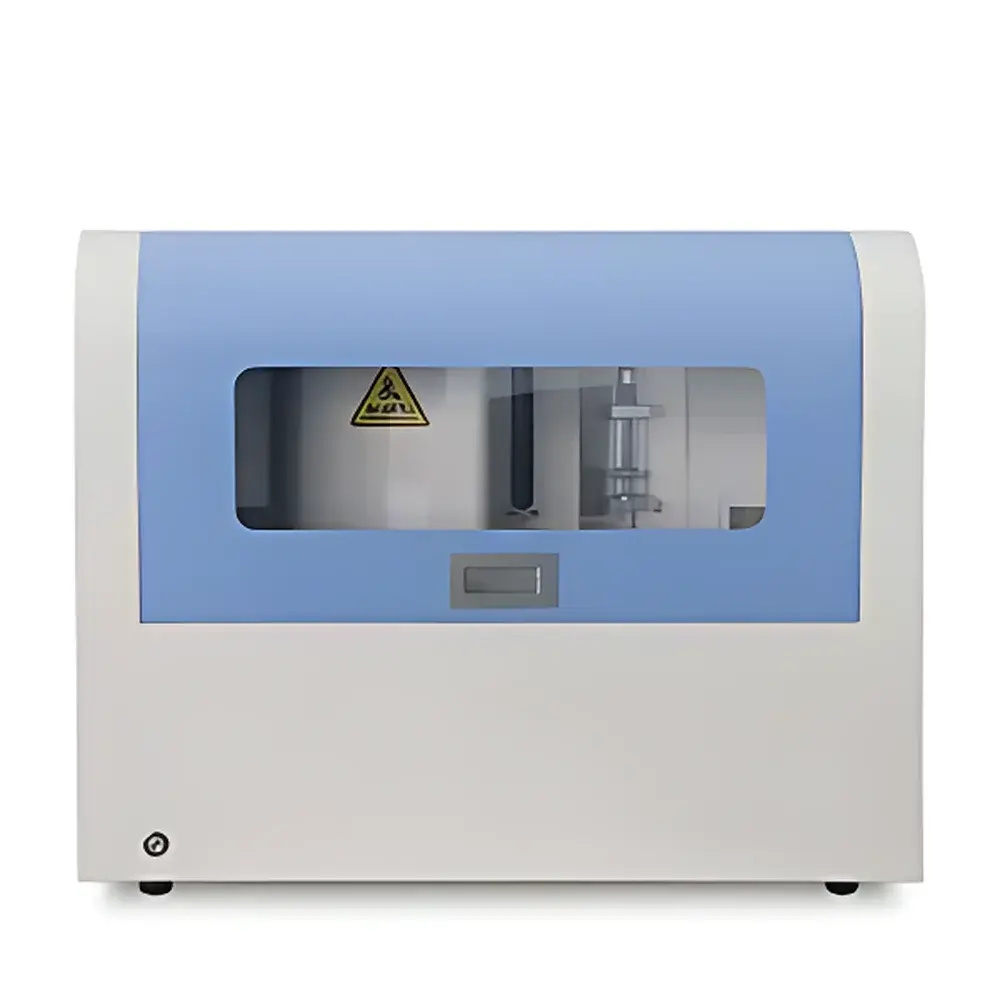
HUANKONG 5000 Automated UV Spectrophotometric Oil Analyzer
| Brand | HUANKONG |
|---|---|
| Origin | Shandong, China |
| Manufacturer Type | Direct Manufacturer |
| Product Category | Domestic |
| Model | 5000 |
| Instrument Type | Laboratory-Based |
| Measurement Principle | UV Spectrophotometry (225 nm) |
| Detection Limit | < 0.01 mg/L |
| Accuracy | ±3% |
| Resolution | 0.005 mg/L |
| Wavelength Range | 200–400 nm |
Overview
The HUANKONG 5000 Automated UV Spectrophotometric Oil Analyzer is a dedicated laboratory instrument engineered for the quantitative determination of petroleum hydrocarbons in aqueous matrices using ultraviolet absorption spectroscopy. It operates on the fundamental principle of Beer–Lambert law, measuring absorbance at 225 nm — the characteristic absorption maximum of aromatic and unsaturated aliphatic hydrocarbons present in mineral oil. Sample preparation follows standardized liquid–liquid extraction under acidic conditions (pH ≤ 2), employing n-hexane as the extraction solvent. The extract is subsequently dehydrated with anhydrous sodium sulfate and purified through magnesium silicate adsorption to remove polar interferences—primarily plant and animal oils—ensuring selectivity for petroleum-based hydrocarbons. This method aligns with regulatory requirements for Class I–III surface water, groundwater, and marine waters (Types I–II), where high sensitivity and low detection capability are critical for compliance monitoring.
Key Features
- Fully automated workflow: integrated sample introduction, n-hexane extraction, phase separation, dehydration, magnesium silicate column purification, filtration, and spectrophotometric measurement — minimizing manual intervention and operator variability.
- Sealed system architecture: all organic solvents and aqueous waste streams are handled within closed pathways; hazardous reagents and spent extracts are automatically segregated and collected in designated containment vessels, supporting OSHA-compliant lab safety protocols.
- Disposable, cartridge-style magnesium silicate columns: enable rapid, contamination-free replacement between samples — eliminating carryover risk and reducing maintenance downtime.
- Integrated dual-phase separation cup: facilitates efficient oil–water partitioning directly within the autosampler tray, enhancing extraction recovery and reproducibility across heterogeneous sample types (e.g., turbid wastewater, saline seawater).
- Intelligent calibration management: automatic standard curve generation via serial dilution of stock reference solutions; onboard volumetric dispensing ensures traceable dilution accuracy per ISO/IEC 17025 metrological guidelines.
Sample Compatibility & Compliance
The HUANKONG 5000 is validated for use with freshwater, estuarine, marine, and industrial effluent matrices. It meets the technical specifications outlined in HJ 970–2018 “Determination of Petroleum Hydrocarbons in Water by Ultraviolet Spectrophotometry” — China’s national standard for petroleum analysis in environmental water. While not intended for direct quantification of total petroleum hydrocarbons (TPH) containing significant biogenic oil fractions, its selectivity for aromatic-rich mineral oils provides complementary data to infrared-based methods (e.g., HJ 637–2018). The system supports GLP-aligned operation through audit-trail-enabled software logging of all critical events (e.g., extraction time, solvent volume, absorbance readings, calibration history), facilitating regulatory review and internal QA/QC verification.
Software & Data Management
The instrument is controlled via a Windows-based application featuring intuitive workflow configuration, real-time status monitoring, and ISO 17025–compatible data integrity safeguards. All raw absorbance values, calculated concentrations, calibration parameters, and system logs are stored in encrypted SQLite databases with immutable timestamps. Export options include CSV, PDF analytical reports, and XML-formatted data compliant with LIMS integration standards. Audit trail functionality records user actions, method modifications, and instrument error events — satisfying requirements for FDA 21 CFR Part 11–aligned environments where electronic records must be attributable, legible, contemporaneous, original, and accurate (ALCOA+ principles).
Applications
- Environmental monitoring agencies conducting routine surveillance of river, lake, and coastal water quality.
- Wastewater treatment plants performing influent/effluent compliance testing against discharge limits (e.g., GB 8978–1996).
- Petroleum refineries and offshore platforms implementing spill response and process water release verification.
- Research laboratories investigating hydrocarbon fate and transport in aquatic ecosystems.
- Drinking water utilities verifying source water integrity prior to treatment.
- Academic institutions supporting undergraduate and graduate coursework in environmental analytical chemistry and instrumental methods.
FAQ
What regulatory standards does the HUANKONG 5000 comply with?
It conforms to HJ 970–2018 (China’s national standard for petroleum hydrocarbons by UV spectrophotometry) and supports alignment with ISO 7827, ASTM D3878, and EPA Method 1664B when adapted for method validation studies.
Can the system analyze seawater samples without matrix interference?
Yes — the integrated salinity-tolerant extraction protocol and post-extraction purification minimize chloride-induced spectral artifacts; validation data demonstrate consistent performance up to 35 g/L NaCl.
Is method transfer possible from manual UV oil analysis procedures?
Absolutely — the instrument replicates all key steps of HJ 970–2018, including pH adjustment, n-hexane volume control (25 mL ± 0.2 mL), and 225 nm photometric measurement; method equivalence studies show R² > 0.998 versus reference manual workflows.
How is data integrity ensured during long-term unattended operation?
All measurements are timestamped, digitally signed, and archived with checksum-verified backups; system logs capture ambient temperature, lamp intensity drift, and cuvette position verification at every cycle.
What maintenance intervals are recommended for routine operation?
Silica gel desiccant cartridges require replacement every 200 extractions; magnesium silicate columns are single-use; optical path cleaning is advised after every 500 analyses or upon observed baseline drift > 0.005 AU.







