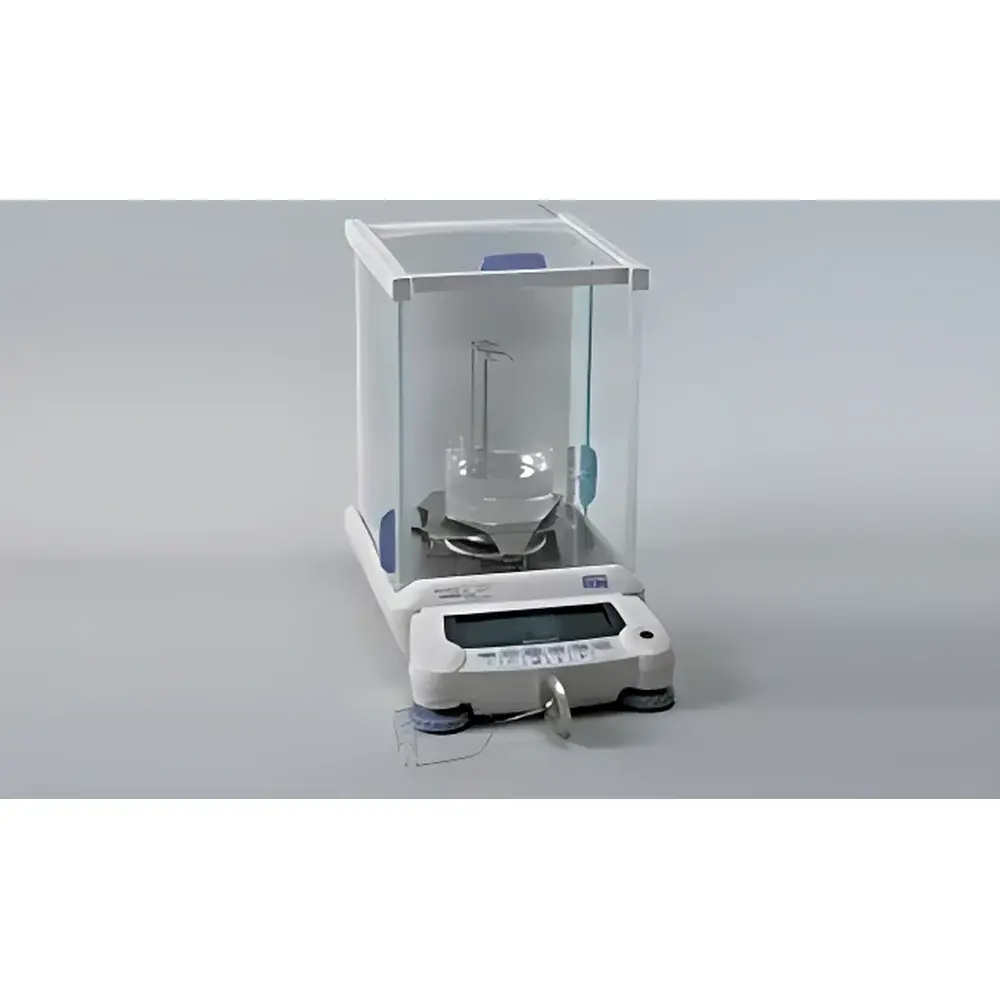
Shimadzu AU-SGM Series Precision Density Analyzer
| Brand | Shimadzu |
|---|---|
| Origin | Japan |
| Product Type | Imported Laboratory Density Analyzer |
| Model Series | AU-SGM (including AUW-D-SGM, AUW-SGM, AUX-SGM, AUY-SGM) |
| Density Resolution | 0.0001 |
| Solid Density Measurement | Standard |
| Liquid Density Measurement | Optional (with accessory sinker P/N 321-60640) |
| Weighing Capacity Range | 40–320 g (model-dependent) |
| Minimum Readability | 0.01 mg to 0.1 mg (model-dependent) |
| Sensor Technology | Uni Bloc Monolithic Load Cell |
| Enclosure | Integrated Draft Shield |
| Compliance | Designed for GLP/GMP environments with audit-ready operation |
Overview
The Shimadzu AU-SGM Series Precision Density Analyzer is a fully integrated laboratory instrument engineered for high-accuracy density determination of solid and liquid samples based on Archimedes’ principle. Unlike standalone balances or manual calculation workflows, this system combines a high-resolution analytical balance with dedicated density measurement firmware and hardware architecture—including a precision immersion assembly and calibrated sinker sets—to deliver traceable, repeatable results without external computation. The core measurement methodology relies on the differential weighing of a sample in air versus its buoyant weight when fully immersed in a reference fluid (typically distilled water at standardized temperature), enabling direct calculation of true density (ρ = mair / [(mair − mimmersed) / ρfluid]). Each model in the AU-SGM family—AUW-D-SGM, AUW-SGM, AUX-SGM, and AUY-SGM—is built around Shimadzu’s proprietary Uni Bloc monolithic load cell technology, which eliminates mechanical joints and thermal drift pathways to ensure long-term stability and metrological integrity under routine lab conditions.
Key Features
- Integrated Archimedean density measurement platform with automated calculation and real-time display of density values (up to 0.0001 resolution)
- Uni Bloc single-piece electromagnetic force compensation sensor delivering exceptional repeatability (<0.001% RSD) and resistance to environmental vibration and temperature fluctuation
- Modular design accommodating multiple balance configurations: semi-micro (0.01 mg readability), analytical (0.1 mg), and standard precision tiers—selected per sample mass and required uncertainty budget
- Compact footprint with built-in draft shield; all components—including suspension hook, immersion pan, and sample platform—optimized for spatial efficiency and operator ergonomics
- Dual-mode capability: solid density measurement as standard; liquid density measurement enabled via optional certified sinker (P/N 321-60640), traceable to NIST-traceable calibration standards
- Internal temperature monitoring and user-configurable fluid density input for thermal compensation during measurements at non-standard temperatures
Sample Compatibility & Compliance
The AU-SGM Series supports a broad range of solid materials—including metals, ceramics, polymers, pharmaceutical tablets, geological specimens, and porous composites—as well as homogeneous liquids such as solvents, oils, electrolytes, and aqueous solutions. Sample geometry constraints are minimal: irregular solids up to 320 g may be measured provided they fully submerge without trapping air bubbles. For regulatory compliance, the system operates in full alignment with ISO 1183-1 (Plastics — Methods for Determining Density), ASTM D792 (Standard Test Methods for Density and Specific Gravity of Plastics), and USP (Density and Specific Gravity). Data acquisition supports 21 CFR Part 11–compliant electronic signatures and audit trails when used with Shimadzu LabSolutions software, making it suitable for quality control laboratories operating under GMP/GLP frameworks.
Software & Data Management
While the AU-SGM Series functions autonomously via front-panel interface, optional integration with Shimadzu LabSolutions DA (Density Analysis) module enables advanced data handling: automated report generation (PDF/CSV), batch processing of multi-sample sequences, statistical analysis (mean, SD, CV%), and export to LIMS or ELN platforms. All measurement events—including balance calibration logs, ambient temperature readings, operator ID, timestamp, and raw air/immersed weights—are time-stamped and stored with immutable metadata. Audit trail functionality satisfies FDA and EMA requirements for data integrity, including user access controls, change history, and electronic signature validation.
Applications
This instrument serves critical roles across R&D, production QA/QC, and regulatory testing domains. Typical use cases include: verification of alloy composition via density deviation from theoretical values; porosity assessment of sintered metal parts; density profiling of polymer blends and composite laminates; specific gravity validation of excipients and finished dosage forms in pharmaceutical manufacturing; and purity evaluation of organic solvents and battery electrolytes. In academic settings, it supports materials science curricula involving phase identification, crystallinity estimation, and thermodynamic property correlation.
FAQ
Is liquid density measurement possible without additional hardware?
No. Liquid density requires the optional sinker (P/N 321-60640), which is calibrated for volumetric displacement and supplied with individual certificate of calibration.
Does the system support temperature-controlled fluid baths?
The AU-SGM itself does not include active thermal regulation; however, it accepts user-input fluid density values at defined temperatures, allowing post-acquisition correction when used with external thermostatted baths.
Can the instrument be calibrated for traceable density measurements?
Yes. Shimadzu provides factory calibration certificates traceable to JCSS (Japan Calibration Service System), and users may perform internal verification using certified density reference standards (e.g., stainless steel, borosilicate glass, or quartz).