
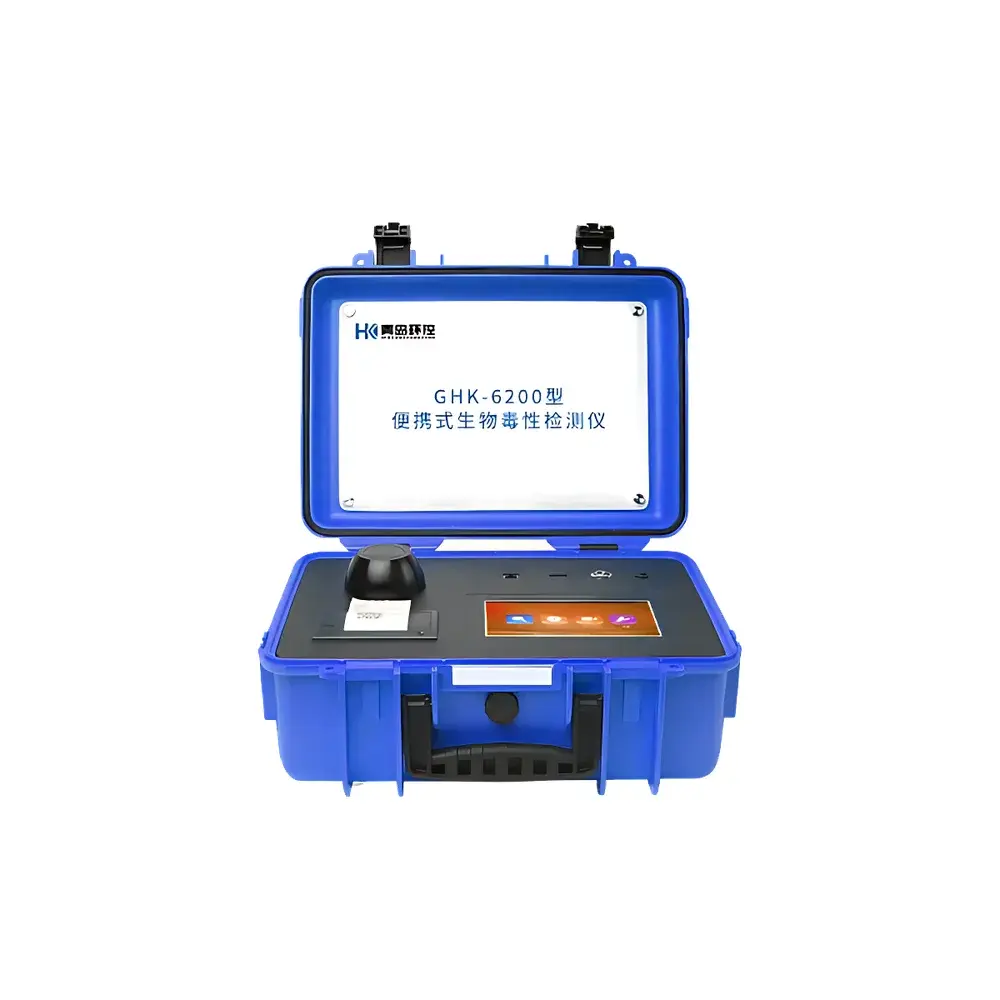
HUANKONG GHK-6200 Portable Water Toxicity Analyzer
| Brand | HUANKONG |
|---|---|
| Origin | Shandong, China |
| Manufacturer Type | Direct Manufacturer |
| Country of Origin | China |
| Model | GHK-6200 |
| Instrument Type | Portable |
| Biological Indicator | Bioluminescent Bacteria (Aliivibrio fischeri) |
| Detection Time | ≤15 min |
| Display | 7-inch Color TFT Touchscreen |
| Power Supply | Rechargeable Lithium Battery (8 h Continuous Operation) |
| Sample Chamber | Motorized Auto-Lift Design |
| Data Storage Capacity | ≥80,000 Test Records |
| Communication Interfaces | USB 2.0, Bluetooth 5.0, Wi-Fi 802.11 b/g/n, 4G LTE, RS-232, RJ45 Ethernet |
| Compliance Standards | GB/T 15441–1995, ISO 11348-3:2007 |
Overview
The HUANKONG GHK-6200 Portable Water Toxicity Analyzer is a field-deployable, bioluminescence-based instrument engineered for rapid assessment of acute aquatic toxicity in water samples. It operates on the principle of metabolic inhibition detection in the marine bacterium Aliivibrio fischeri, which emits visible light (λ ≈ 490 nm) as a byproduct of cellular respiration. Upon exposure to toxicants—including heavy metals, organophosphates, carbamates, nerve agents, surfactants, and industrial effluents—the bacterial bioluminescence intensity declines proportionally to the concentration and potency of the toxicant. This photonic response is quantified via high-sensitivity photomultiplier tube (PMT) detection, enabling quantitative toxicity estimation expressed as percentage inhibition relative to control luminescence. Designed for environmental emergency response, regulatory field screening, wastewater treatment plant monitoring, and source water surveillance, the GHK-6200 delivers standardized, reproducible results within 15 minutes—significantly faster than conventional whole-organism bioassays using Daphnia magna or fish.
Key Features
- Integrated 7-inch capacitive touchscreen interface with intuitive, icon-driven navigation—optimized for glove-compatible operation in field conditions.
- Motorized sample chamber with automatic lift-and-seal mechanism eliminates ambient light interference during measurement, ensuring photometric integrity without manual lid handling.
- Pre-programmed assay protocols aligned with ISO 11348-3:2007 and GB/T 15441–1995, including reagent blank calibration, positive/negative controls, and dose-response curve generation.
- High-sensitivity optical detection system featuring thermoelectrically stabilized PMT and narrow-band optical filtering (FWHM < 10 nm), minimizing background noise and enhancing signal-to-noise ratio.
- Onboard rechargeable lithium-ion battery supporting ≥8 hours of continuous operation under typical field duty cycles (including screen use, data transfer, and repeated assays).
- Multi-modal testing capability: single-point inhibition screening, serial dilution analysis, kinetic mode (luminescence decay profiling over time), and comparative toxicity index (CTI) calculation.
- Robust IP54-rated enclosure with shock-absorbing silicone bumper, suitable for transport in rugged terrain and deployment in variable ambient temperatures (5–40 °C).
Sample Compatibility & Compliance
The GHK-6200 accepts raw, filtered (0.45 µm), or centrifuged aqueous matrices—including surface water, groundwater, drinking water, wastewater influent/effluent, leachates, and decontamination rinse solutions. Sample volume requirement is 2.0 mL per test. The instrument supports matrix-matched calibration and built-in dilution factor compensation to mitigate interferences from turbidity, color, or residual chlorine. All assay procedures comply with ISO 11348-3:2007 (Water quality — Determination of the inhibitory effect of water samples on the light emission of Vibrio fischeri (Luminescent bacteria test) — Part 3: Method using freeze-dried bacteria) and Chinese national standard GB/T 15441–1995. Data audit trails, user access logs, and electronic signature support are implemented in accordance with GLP principles; optional firmware upgrade enables 21 CFR Part 11-compliant electronic records when paired with validated LIMS integration.
Software & Data Management
The embedded operating system runs proprietary toxicity analysis firmware with real-time curve fitting, IC50 estimation (via four-parameter logistic regression), and automated pass/fail decision logic against configurable toxicity thresholds (e.g., 20% inhibition = alert level). Data export formats include CSV, PDF reports (with instrument ID, operator ID, timestamp, GPS coordinates if enabled), and XML for LIMS ingestion. Wireless connectivity options—Wi-Fi, Bluetooth, and 4G LTE—enable secure cloud synchronization to centralized environmental dashboards. Local storage retains ≥80,000 complete assay records with full metadata (sample ID, dilution series, raw photon counts, inhibition %, QC flags). USB host port allows direct connection to portable printers or external flash drives for offline backup.
Applications
- Rapid on-site screening of accidental chemical spills or illicit discharges into rivers, lakes, or municipal sewer systems.
- Compliance verification at wastewater treatment plants prior to discharge—supporting NPDES or local permit requirements.
- Drinking water safety validation during disaster response (e.g., post-flooding, infrastructure failure) or routine distribution system monitoring.
- Toxicity fingerprinting of industrial effluents to prioritize hazardous waste streams for advanced chemical analysis (e.g., LC-MS/MS).
- Educational and research use in environmental toxicology labs for teaching standardized bioassay methodology and ecotoxicological risk assessment frameworks.
FAQ
What biological indicator organism does the GHK-6200 use?
It employs lyophilized Aliivibrio fischeri (formerly Vibrio fischeri) cells, supplied in certified, lot-controlled vials meeting ISO 11348-3 viability specifications.
Can the instrument quantify specific contaminants like lead or glyphosate?
No—it measures total acute toxicity (nonspecific inhibitory effect) rather than compound-specific concentration; confirmatory chemical analysis is required for identification and quantification.
Is calibration traceable to national standards?
Yes—photometric calibration uses NIST-traceable luminance standards; biological performance verification is conducted using potassium dichromate reference toxicant per ISO 11348-3 Annex A.
How is data integrity ensured during field use?
All measurements include timestamped operator ID, GPS geotagging (optional), digital signature fields, and immutable audit logs stored in encrypted internal memory.
Does the GHK-6200 require annual recalibration or service certification?
Optical path verification is recommended annually using factory-provided check standards; no user-serviceable optical alignment components are present—field maintenance is limited to battery replacement and sensor cleaning per SOP.







