
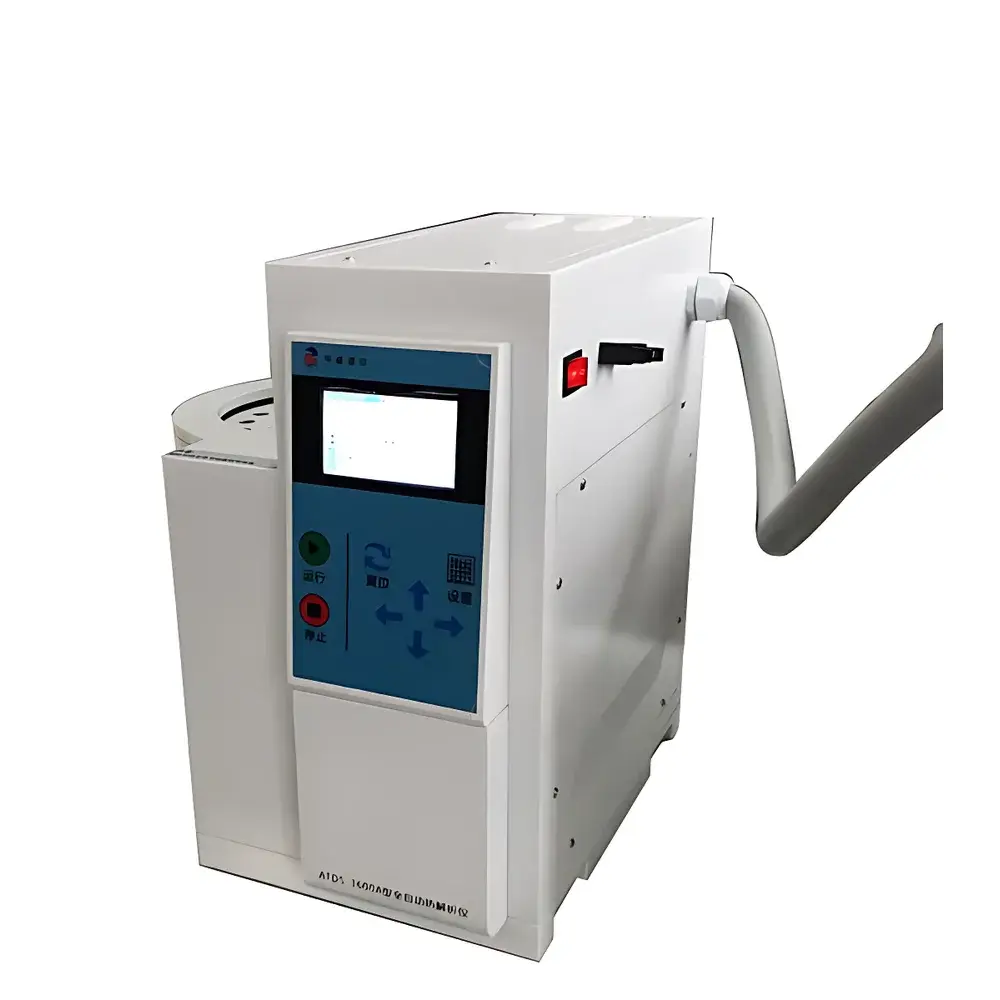
HuaShengPuXin ATDS-3600A Dual-Channel Automated Two-Stage Thermal Desorber with 40-Position Cryo-Focusing Trap
| Brand | HuaShengPuXin (HSPX) |
|---|---|
| Origin | Beijing, China |
| Manufacturer Type | Direct Manufacturer |
| Model | Dual-Channel Low-Temperature Cryo-Trap, 40-Position |
| Automation Level | Fully Automated |
| Desorption Temperature Range | 150–380 °C |
| Valve Injection Zone Temperature Range | Ambient to 240 °C |
| Transfer Line Temperature Range | Ambient to 240 °C |
| Cryo-Trap Temperature Range | −30 to 50 °C (1 °C increments) |
| Temperature Control Accuracy | ±1 °C |
| Analyte Recovery Rate | >95% |
| Sample Capacity | 40 adsorption tubes |
Overview
The HuaShengPuXin ATDS-3600A is a fully automated, dual-channel two-stage thermal desorber engineered for high-throughput, quantitative analysis of volatile and semi-volatile organic compounds (VOCs and SVOCs) in environmental, occupational health, and indoor air quality applications. It operates on the principle of cryogenic focusing followed by rapid thermal desorption into a gas chromatograph (GC) or GC–mass spectrometer (GC–MS). The instrument integrates two independent thermal desorption channels—each equipped with programmable heating zones, precision temperature-controlled valve manifolds, insulated transfer lines, and a Peltier-cooled cryo-trap capable of trapping analytes at −30 °C prior to focused thermal elution. This two-stage architecture ensures sharp, reproducible analyte bands, minimizes breakthrough, and maximizes sensitivity—particularly for light VOCs (e.g., C2–C6) and polar compounds prone to degradation or loss during single-stage desorption.
Key Features
- Dual-channel parallel operation enables uninterrupted sample processing: while one channel performs desorption and GC injection, the other loads and conditions the next adsorption tube—reducing cycle time and increasing daily throughput.
- 40-position rotary autosampler with standardized 6 mm OD × 89 mm length tube compatibility (including Tenax®, Carbopack™, and mixed-bed sorbents), supporting both single- and multi-bed configurations per tube.
- Independent, PID-controlled temperature zones: sample bed (up to 400 °C), valve manifold (up to 240 °C), transfer line (up to 240 °C), and secondary desorption zone (up to 400 °C), all adjustable in 1 °C increments.
- Cryo-focusing trap with Peltier-based cooling (−30 to 50 °C range, 1 °C resolution) and rapid heating (>2400 °C/min ramp rate) to ensure narrow band widths (<50 ms width at base) and minimal peak dispersion.
- High-fidelity pneumatic control system with leak-tight stainless-steel valves and inert flow path (electropolished 316L tubing) to prevent carryover, oxidation, or catalytic decomposition.
- Robust mechanical architecture (450 × 360 × 510 mm; ~25 kg) designed for benchtop integration in ISO/IEC 17025-accredited laboratories and routine QC environments.
Sample Compatibility & Compliance
The ATDS-3600A is validated for use with standard EPA, ISO, and Chinese national methods requiring thermal desorption–GC coupling. It fully supports method requirements for HJ 644–2013 (ambient air VOCs), HJ/T 400–2007 (in-vehicle VOCs), GB/T 18883–2002 (indoor air), HJ 734–2014 (stationary source emissions), HJ 583–2010 (solid-phase adsorption–thermal desorption), and GB 50325–2020 (civil construction IAQ compliance). Its hardware design meets critical performance criteria outlined in ASTM D6196–21 (Standard Practice for Selecting Adsorbents for the Analysis of Volatile Organic Compounds) and ISO 16017-1:2000 (Indoor, ambient and workplace air — Sampling and analysis of volatile organic compounds by sorbent tube/thermal desorption/capillary gas chromatography). All temperature and timing parameters are traceable to NIST-certified references, and system suitability tests (SST) can be executed using certified multicomponent standards (e.g., TO-17 test mix).
Software & Data Management
Controlled via Windows-based HSPX TD Manager software, the ATDS-3600A supports full method development, sequence programming, real-time temperature/pressure monitoring, and event logging. Software features include audit trail functionality compliant with FDA 21 CFR Part 11 requirements (user authentication, electronic signatures, immutable log files), customizable reporting templates (PDF/CSV), and direct export to major GC data systems (Agilent OpenLab, Thermo Chromeleon, Shimadzu GCsolution). All method parameters—including cryo-trap hold times, desorption ramps, back-flush durations, and valve switching logic—are stored with version timestamps and user metadata. System validation documentation (IQ/OQ/PQ protocols) and GxP-ready calibration records are provided as part of the delivery package.
Applications
- Regulatory monitoring of ambient and indoor air for benzene, toluene, ethylbenzene, xylenes (BTEX), aldehydes, and halogenated VOCs.
- Occupational exposure assessment in manufacturing, printing, coating, and petrochemical facilities per OSHA and NIOSH guidelines.
- Material emission testing (e.g., carpets, furniture, adhesives) under chamber-based protocols (ASTM D5116, ISO 16000-9).
- Quality control of activated carbon, polymer sorbents, and coated adsorption tubes prior to field deployment.
- Method development and validation studies for emerging contaminants including oxygenated VOCs (e.g., MEK, acetone, acetaldehyde) and low-boiling fluorinated compounds.
FAQ
Does the ATDS-3600A support splitless, split, and cold trap modulation injection modes?
Yes—the instrument’s programmable valve architecture allows configuration for splitless desorption (standard), split injection (for high-concentration samples), and cryo-focused modulation (for enhanced resolution of co-eluting peaks).
Can it accommodate non-standard tube dimensions or custom sorbent beds?
The autosampler accepts 6 mm OD tubes up to 110 mm in length; custom tube holders and method parameters can be defined for proprietary or multi-bed configurations (e.g., Carbopack B + Carbopack C + Carboxen 1000 stacks).
Is remote diagnostics and firmware update capability available?
Yes—via secure Ethernet connection, authorized service engineers can perform remote health checks, parameter diagnostics, and over-the-air firmware updates without onsite intervention.
What maintenance intervals are recommended for optimal performance?
Valve manifold cleaning every 500 runs; cryo-trap desiccant replacement every 6 months; full system leak check and calibration verification annually—or per GLP/GMP internal SOPs.
Does the system meet electromagnetic compatibility (EMC) and electrical safety standards for international deployment?
Yes—it complies with IEC 61326-1 (EMC for laboratory equipment) and IEC 61010-1 (safety requirements), with CE marking and RoHS certification included in shipment documentation.






