
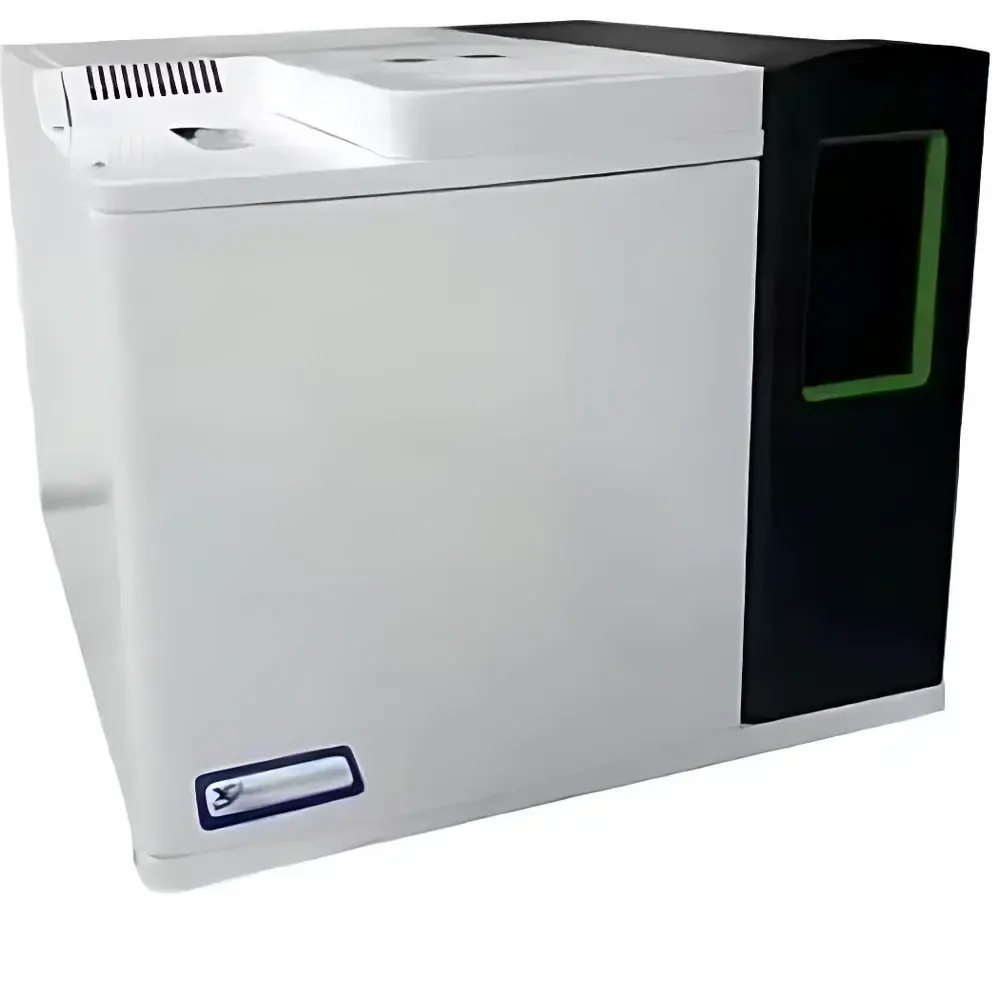
HuaShengPuXin HSPX GC-BA1000 Beverage-Specific Gas Chromatograph for Methanol and Fusel Oil Analysis in Distilled & Blended Alcoholic Beverages
| Brand | HuaShengPuXin (HSPX) |
|---|---|
| Origin | Beijing, China |
| Manufacturer Type | OEM Manufacturer |
| Product Category | Domestic |
| Model | GC-BA1000 |
| Price Range | USD 4,200–7,000 |
| Instrument Type | Laboratory Gas Chromatograph |
| Application Field | Beverage Quality Control & Regulatory Compliance |
| Oven Temperature Range | Ambient to 400 °C |
| Oven Ramp Rate | 0.1–40 °C/min |
| Oven Cooling Rate | From 450 °C to 50 °C in ~6 min |
| Carrier Gas Flow Range & Control | 0–60 mL/min |
| Carrier Gas Pressure Range & Control | 0–0.6 MPa |
| Injector Maximum Operating Temperature | 400 °C |
| Injector Pressure Setting Range | 0–0.6 MPa |
| Injector Total Flow Setting Range | 0–1200 mL/min |
Overview
The HuaShengPuXin GC-BA1000 is a dedicated laboratory gas chromatograph engineered for routine, regulatory-grade quantification of methanol and fusel oils (higher alcohols including propanol, isobutanol, and active amyl alcohol) in distilled spirits and blended alcoholic beverages. Designed in strict alignment with the analytical requirements of China’s national standard GB/T 5009.48–2003 “Hygienic Standard for Distilled and Blended Alcoholic Beverages”, this system employs flame ionization detection (FID) coupled with either GDX-102 packed columns or FFAP wide-bore capillary columns. Its architecture reflects a balance between robustness for daily QC operation and sufficient thermal and flow control fidelity to ensure method transferability and inter-laboratory reproducibility. The instrument operates on the principle of differential partitioning of volatile analytes between a mobile phase (helium, nitrogen, or hydrogen carrier gas) and a stationary phase (polar FFAP or porous polymer GDX-102), followed by carbon-specific detection via FID — delivering linear response over three orders of magnitude and sub-ppm detection capability for target congeners under optimized conditions.
Key Features
- Temperature-programmable oven with precise ramp control (0.1–40 °C/min) and rapid cooling (450 °C → 50 °C in ≈6 minutes), enabling high-throughput analysis of complex spirit matrices without carryover.
- Dual independent inlet configuration supporting both split/splitless injection modes; injector temperature up to 400 °C ensures complete volatilization of high-boiling fusel oil components.
- Integrated carrier gas pressure and flow control (0–0.6 MPa / 0–60 mL/min) with digital feedback regulation, critical for retention time stability and method robustness across varying ambient conditions.
- FID detector with optimized jet geometry and stable polarization voltage, providing 10⁷ linear dynamic range for accurate peak-area-based external calibration.
- Modular hardware design facilitates field upgrades—including optional electronic pressure control (EPC), auto-sampler integration, and data system compatibility with third-party chromatography data systems (CDS).
Sample Compatibility & Compliance
The GC-BA1000 is validated for direct injection of diluted spirit samples following simple aqueous dilution or internal standard addition (e.g., 1-propanol). It accommodates both undenatured ethanol solutions (up to 60% v/v) and fortified reference standards in water or low-concentration ethanol. Method performance meets all precision, accuracy, and specificity criteria defined in GB/T 5009.48–2003, including limit of detection (LOD) ≤ 0.02 g/L for methanol and ≤ 0.05 g/L for total fusel oils. While developed for Chinese regulatory compliance, the method is readily adaptable to international frameworks such as AOAC Official Method 977.11 (Alcoholic Beverages) and ISO 11907:2021 (Wine and other fermented beverages — Determination of higher alcohols), provided column selection and calibration protocols are aligned with respective validation requirements.
Software & Data Management
The system operates with HSPX’s proprietary GC Navigator™ software, supporting full method development, sequence definition, real-time monitoring, and integrated report generation per GB/T 5009.48–2003 reporting templates. Raw data files adhere to ASTM E1947-compliant formats and include full audit trail metadata (user ID, timestamp, method version, instrument parameters). Software supports 21 CFR Part 11-compliant user access control, electronic signatures, and secure data archiving—making it suitable for GLP- and GMP-regulated laboratories conducting beverage safety testing. Export options include CSV, PDF, and XML for LIMS integration and cross-platform review.
Applications
- Regulatory testing of baijiu, huangjiu, brandy, and flavored liqueurs for methanol content (toxicity control) and fusel oil profile (sensory quality assessment).
- Batch release testing in distillery QC labs where rapid turnaround (<12 min/run) and minimal sample prep are essential.
- Method verification and instrument qualification per ISO/IEC 17025:2017 requirements for accredited testing laboratories.
- Research into fermentation byproduct formation kinetics using targeted congener profiling across yeast strains and fermentation conditions.
- Forensic alcohol analysis where differentiation between endogenous and exogenous methanol is required under chain-of-custody protocols.
FAQ
What detection technology does the GC-BA1000 use, and why is it appropriate for methanol and fusel oil analysis?
It uses flame ionization detection (FID), which offers excellent sensitivity, linearity, and stability for organic compounds containing C–H bonds — making it ideal for quantitative analysis of methanol, ethanol, and higher alcohols without derivatization.
Can this instrument comply with international standards beyond GB/T 5009.48–2003?
Yes — with appropriate column selection (e.g., FFAP for polar congeners), calibration strategy, and system suitability testing, the GC-BA1000 supports AOAC, ISO, and EU Regulation (EC) No 110/2008 Annex I methods for spirit analysis.
Is electronic pressure control (EPC) available as an upgrade?
Standard configuration includes mechanical pressure regulators; EPC is offered as a factory-installed option for enhanced method transferability and multi-method scheduling.
What sample preparation is required prior to injection?
Minimal preparation: spirit samples are typically diluted 1:10 with deionized water or spiked with internal standard (e.g., 1-propanol), then filtered through a 0.45 µm nylon syringe filter.
Does the system support unattended operation?
Yes — when paired with an optional 108-position autosampler and GC Navigator™ sequence scheduling, the GC-BA1000 supports overnight batch processing with automatic shutdown and data backup.



