
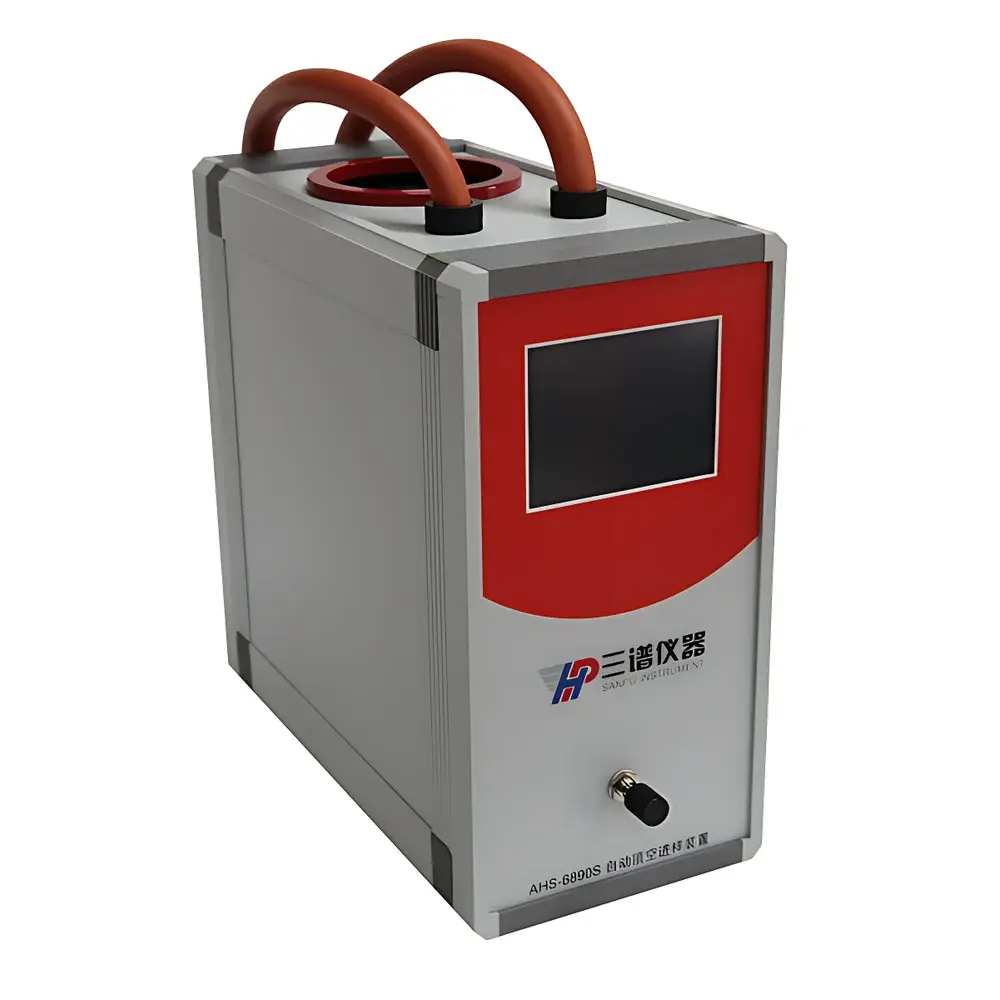
Huayisanpu AHS-6890S Static Headspace Sampler
| Brand | Huayisanpu |
|---|---|
| Origin | Beijing, China |
| Model | AHS-6890S |
| Instrument Type | Static Headspace Sampler |
| Automation Level | Semi-Automatic |
| Sample Vial Capacity | 9 positions |
| Vial Size | 20 mL (customizable: 10 mL, 50 mL) |
| Oven Temperature Range | Ambient to 350 °C (1 °C increment) |
| Valve & Transfer Line Temperature Range | Ambient to 180 °C (1 °C increment) |
| Temperature Accuracy | < ±0.5 °C |
| Pressure Control Range | 0–0.2 MPa (up to 0.7 MPa optional) |
| Pressure Monitoring | Digital display, 0–0.2 MPa |
| RSD for Repeatability | < 1% (GC-dependent) |
| Dimensions | 260 × 360 × 420 mm |
| Weight | ~15 kg |
| Power Supply | AC 220 V ±10%, 50 Hz |
| Operating Environment | 10–40 °C, RH < 85% |
Overview
The Huayisanpu AHS-6890S Static Headspace Sampler is a precision-engineered sample introduction system designed for reliable, reproducible analysis of volatile and semi-volatile organic compounds in solid, liquid, or viscous matrices via gas chromatography (GC). Based on the static headspace principle, it equilibrates samples in sealed vials at controlled temperature and pressure, allowing partitioning of analytes into the vapor phase above the sample matrix. The equilibrium headspace gas is then transferred—via heated valve and transfer line—to the GC injector for separation and detection. This method eliminates matrix interference, reduces column contamination, and enhances sensitivity for trace-level volatiles without solvent extraction or derivatization. The AHS-6890S supports method development and routine QA/QC workflows in environmental testing labs, pharmaceutical stability studies, food flavor profiling, forensic toxicology, and polymer residual monomer analysis.
Key Features
- Independent, PID-controlled heating zones for sample oven (ambient to 350 °C), injection valve (ambient to 180 °C), and transfer line (ambient to 200 °C), each adjustable in 1 °C increments with accuracy better than ±0.5 °C.
- Semi-automated operation with programmable sequence control for up to 9 standard 20 mL headspace vials; compatible with 10 mL and 50 mL vials upon request.
- Digitally monitored and continuously adjustable pressurization (0–0.2 MPa standard; 0–0.7 MPa optional), enabling precise control over headspace volume and analyte transfer efficiency.
- Low-voltage heating circuits for valve and transfer line (≤60 W and ≤40 W respectively), enhancing operational safety and thermal stability during extended runs.
- Robust mechanical architecture with compact footprint (260 × 360 × 420 mm) and lightweight design (~15 kg), facilitating integration into benchtop GC laboratories with limited space.
- Compliance-ready configuration: All temperature and pressure parameters are digitally logged and accessible for audit trails, supporting GLP/GMP-aligned documentation practices.
Sample Compatibility & Compliance
The AHS-6890S accommodates a broad range of sample types—including aqueous solutions, soils, polymers, pharmaceutical tablets, beverages, and biological fluids—without requiring derivatization or pre-concentration. Its inert, heated flow path minimizes adsorption or condensation of polar or high-boiling volatiles. The system meets fundamental requirements for ISO 17025-accredited laboratories performing headspace-GC analyses per ASTM D6866 (biobased content), USP <467> (residual solvents), EPA Method 502.2/8260, and ICH Q2(R2) validation guidelines. While not FDA 21 CFR Part 11–certified out-of-the-box, its parameter logging capability enables integration with validated LIMS or chromatography data systems (CDS) that provide electronic signature and audit trail functionality.
Software & Data Management
The AHS-6890S operates via front-panel keypad with intuitive menu navigation and real-time digital display of all active parameters: oven temperature, valve temperature, transfer line temperature, applied pressure, and elapsed run time. Method storage supports up to 10 user-defined protocols, each configurable with equilibration time, pressurization duration, loop fill time, and injection delay. For full traceability, all method parameters and run timestamps are retained in non-volatile memory. When interfaced with third-party GC software (e.g., Agilent OpenLab, Thermo Chromeleon, or Shimadzu GCsolution), the sampler accepts TTL or RS-232 trigger signals and reports status flags—enabling synchronized acquisition, automated batch processing, and alignment with laboratory-wide data integrity frameworks.
Applications
- Pharmaceutical quality control: Residual solvent quantification in APIs and final dosage forms per USP <467> and ICH Q3C.
- Environmental monitoring: Determination of chlorinated hydrocarbons, BTEX, and trihalomethanes in groundwater and soil extracts.
- Food & beverage safety: Ethanol, acetaldehyde, and off-flavor compound screening in wines, dairy products, and packaged foods.
- Polymers & packaging: Migration testing of monomers (e.g., vinyl chloride, styrene) and plasticizers from food-contact materials.
- Clinical & forensic toxicology: Quantification of ethanol, methanol, isopropanol, and acetone in blood and urine specimens.
FAQ
Is the AHS-6890S fully automated or manually triggered?
The AHS-6890S is semi-automatic: vial loading and method selection are manual, but all thermal equilibration, pressurization, sampling, and GC triggering are programmable and executed without operator intervention per run.
Can it be used with any gas chromatograph?
Yes—it features universal GC interface compatibility via standard 1/16″ stainless-steel transfer tubing and TTL/RS-232 communication ports, supporting integration with Agilent, Thermo Fisher, Shimadzu, PerkinElmer, and other major GC platforms.
What maintenance is required for long-term reliability?
Routine maintenance includes periodic inspection of septa, O-rings, and valve seals; cleaning of the sample needle and transfer line; and verification of temperature calibration using NIST-traceable thermometers—recommended every 6 months or after 200 runs.
Does it support method validation per regulatory standards?
While the hardware itself does not carry formal regulatory certification, its stable temperature control (<±0.5 °C), pressure repeatability (RSD <1%), and digital parameter logging enable users to meet method validation criteria outlined in USP <1225>, ICH Q2(R2), and ISO/IEC 17025 for precision, accuracy, and robustness assessments.
Related Products





