
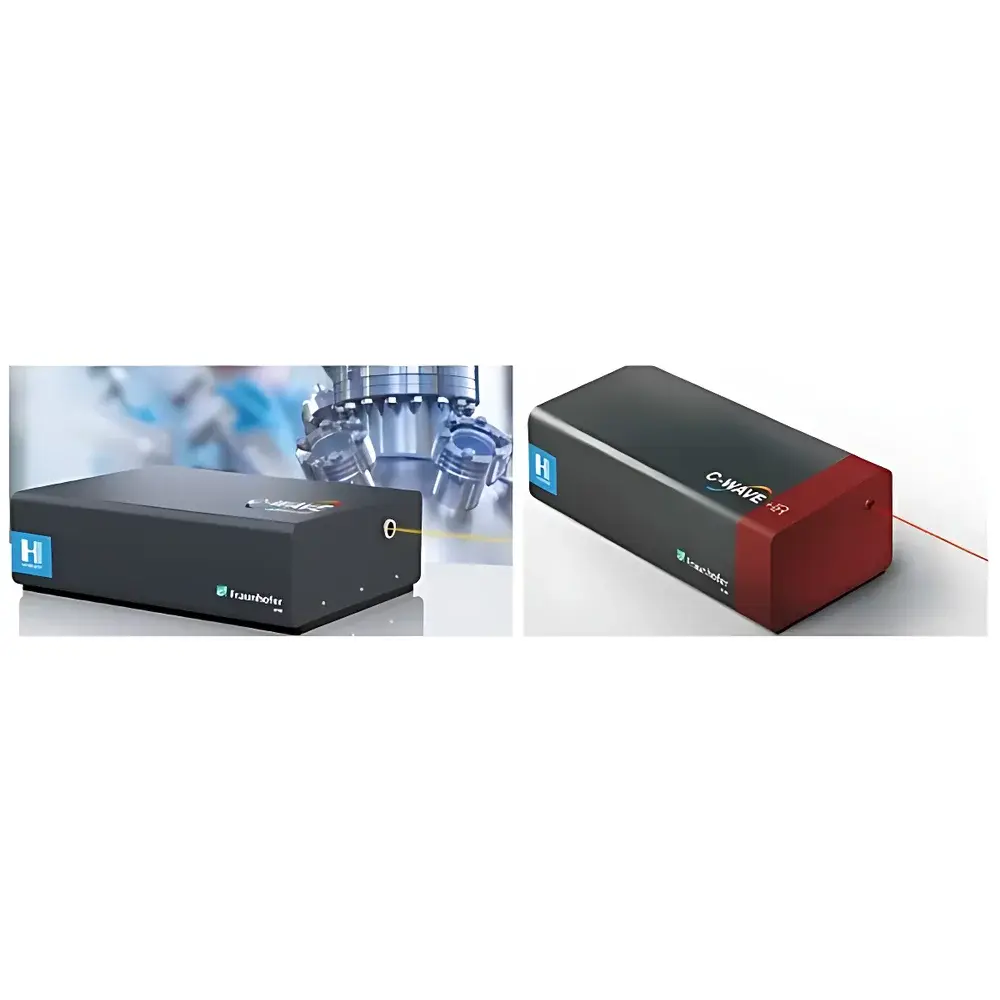
Hubner C-WAVE Visible–Near-Infrared Broadband Tunable Laser Source
| Brand | Hubner |
|---|---|
| Origin | Germany |
| Model | C-WAVE |
| Type | Continuous-wave Optical Parametric Oscillator (OPO)-based Tunable Laser Source |
| Spectral Range | 450–650 nm (visible, via SHG of idler/signal) + 900–1300 nm (NIR, intracavity signal/idler) |
| Linewidth | <100 kHz (C-WAVE advanced) |
| Tuning Mechanism | Motorized cavity length & nonlinear crystal angle control |
| Interface | GUI (Windows/Linux) and SCPI-compliant USB/Ethernet programming interface |
| Compliance | CE, RoHS, IEC 60825-1 Class 4 Laser Product |
Overview
The Hubner C-WAVE is a continuous-wave (CW), broadly tunable laser source based on intracavity optical parametric oscillation (OPO) combined with second-harmonic generation (SHG). Engineered for precision spectroscopy and quantum optics applications, it delivers seamless, mode-hop-free tuning across the visible spectrum (450–650 nm) by frequency-doubling intracavity signal and idler waves generated in a near-infrared (NIR) OPO stage (900–1300 nm). Unlike conventional diode lasers or dye-based systems, the C-WAVE avoids discrete gain media limitations—offering uninterrupted spectral coverage where traditional sources exhibit gaps or instability. Its dual-stage nonlinear architecture enables high coherence, narrow instantaneous linewidth (<100 kHz for the C-WAVE advanced variant), and exceptional long-term frequency stability (sub-MHz drift over hours under laboratory temperature control). The system operates as a fully integrated laser platform: pump-laser-stabilized, thermally managed, and optomechanically isolated to maintain alignment integrity during extended wavelength scans.
Key Features
- Continuous, gap-free tuning from 450 nm to 650 nm (visible) and 900 nm to 1300 nm (NIR), enabled by intracavity OPO + SHG architecture
- C-WAVE advanced variant optimized for atomic physics: <100 kHz intrinsic linewidth, active frequency stabilization options, and sub-MHz absolute accuracy traceable to atomic references
- Motorized, software-controlled cavity length and nonlinear crystal angular positioning ensure repeatable, automated wavelength selection
- Integrated pump laser (typically 532 nm or 1064 nm solid-state source) with power regulation and thermal feedback loops
- Standard output port for full-power visible beam; optional tap port for simultaneous extraction of residual NIR signal/idler (e.g., for pump-probe or dual-wavelength experiments)
- Robust mechanical design compliant with ISO 10110 optical mounting standards; vibration-insensitive cavity layout suitable for shared-lab or cleanroom integration
Sample Compatibility & Compliance
The C-WAVE is designed for use with vacuum-compatible optical tables, ultra-high-vacuum (UHV) atomic beam apparatuses, and cryogenic optical setups (down to 4 K with appropriate beam path isolation). Its Class 4 laser classification per IEC 60825-1 mandates interlocked enclosures and administrative controls in accordance with local occupational safety regulations (e.g., ANSI Z136.1 in the US, DIN EN 60825-1 in EU member states). All firmware and hardware meet CE marking requirements for electromagnetic compatibility (EMC Directive 2014/30/EU) and low-voltage safety (LVD Directive 2014/35/EU). RoHS 2011/65/EU compliance ensures restriction of hazardous substances in printed circuit boards and optomechanical housings. For GLP/GMP-regulated environments, optional audit-trail logging (via Ethernet interface) supports 21 CFR Part 11–compliant data integrity workflows when paired with validated third-party acquisition software.
Software & Data Management
The C-WAVE is controlled via a native cross-platform GUI (Windows 10/11, Ubuntu LTS) providing real-time wavelength display, scan sequencing, power monitoring, and error diagnostics. All operational parameters—including setpoint wavelength, cavity temperature, pump power, and harmonic conversion efficiency—are logged with timestamped metadata in HDF5 format. A SCPI 1999-compliant command set enables integration into LabVIEW, Python (PyVISA), MATLAB, or EPICS-based control frameworks. Remote operation supports TLS-encrypted Ethernet communication for secure network deployment in multi-user facilities. Firmware updates are delivered as signed binary packages with SHA-256 checksum verification to ensure traceability and prevent unauthorized modification.
Applications
- High-resolution Doppler-free spectroscopy of alkaline-earth atoms (e.g., Sr, Yb) and rare-earth ions in optical lattices
- Coherent Raman scattering (CARS) and stimulated Raman adiabatic passage (STIRAP) in molecular physics
- Calibration of wavelength meters and spectrometers against primary standards (e.g., iodine-stabilized HeNe references)
- Quantum memory interfacing using telecom-band idler photons (1200–1300 nm) and visible write/read channels
- Multi-wavelength photoluminescence excitation (PLE) mapping of 2D materials and perovskite thin films
- Development of frequency combs via self-referencing of C-WAVE output in f–2f interferometers
FAQ
What is the fundamental difference between C-WAVE and conventional tunable diode lasers?
C-WAVE relies on nonlinear frequency conversion in a resonant OPO cavity, delivering higher output power (>100 mW typical in visible), narrower linewidth, and broader continuous tuning—without mode hops—whereas diode lasers suffer from limited gain bandwidth and inherent mode competition.
Can the C-WAVE be integrated into an existing vacuum chamber system?
Yes—standard C-WAVE models include UHV-compatible feedthroughs for electrical control lines and optional fiber-coupled output modules with FC/APC connectors rated for 10⁻⁹ mbar base pressure.
Is external frequency stabilization supported?
Yes—the C-WAVE advanced variant provides analog modulation inputs (±5 V, 100 kHz bandwidth) and digital lock interfaces compatible with commercial PID controllers and Pound–Drever–Hall electronics.
Does the system require water cooling?
No—C-WAVE uses conductive and forced-air thermal management only; no liquid coolant connections or chiller dependencies are required for nominal operation.
How is wavelength calibration verified at installation?
Each unit ships with a NIST-traceable calibration certificate referencing iodine hyperfine transitions at 532 nm and 578 nm, validated using a high-finesse confocal étalon and a calibrated wavemeter (±0.3 pm uncertainty).




