
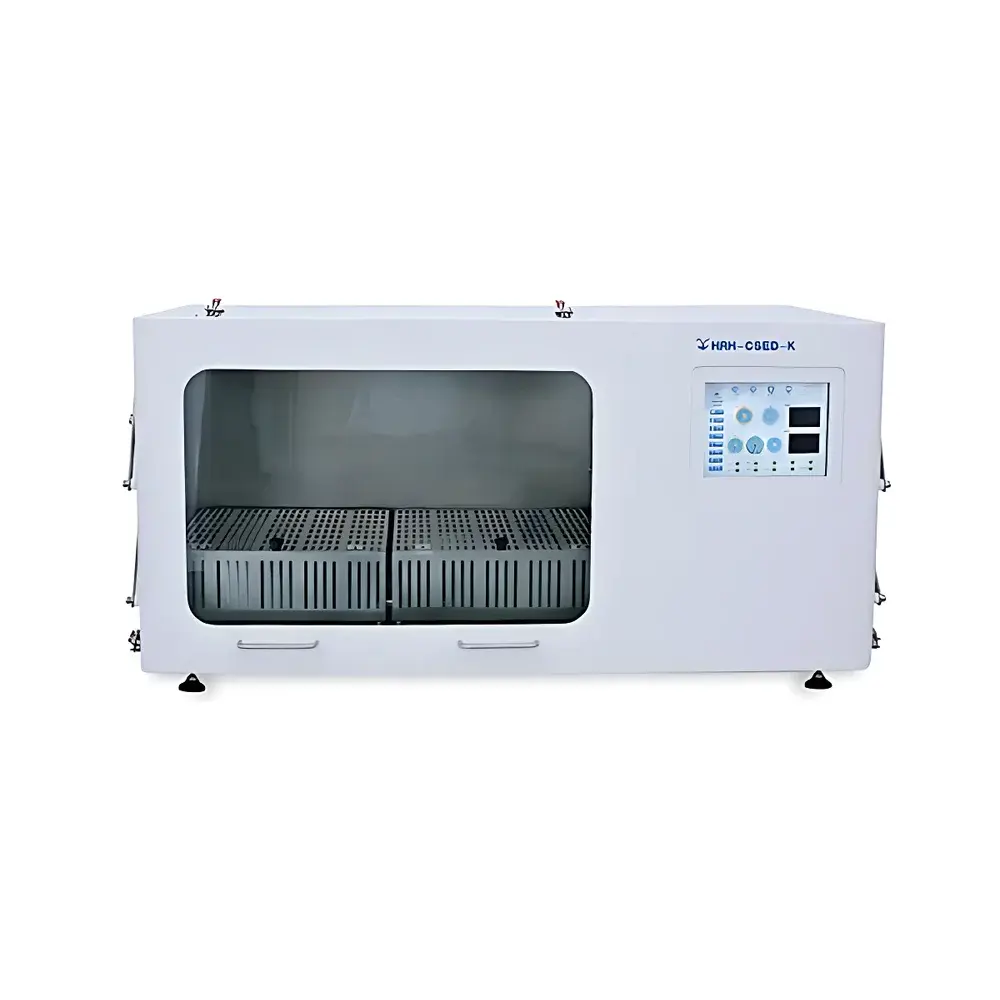
Huiron HRH-CSED-K Animal Whole-Body Gas Exposure System
| Brand | Huiron |
|---|---|
| Origin | Beijing, China |
| Model | HRH-CSED-K |
| Chamber Volume | 186 L |
| Animal Capacity | 80 mice or 10 rats |
| Temperature Range | 0–100 °C (0.1 °C resolution) |
| Humidity Range | 0–100% RH (1% resolution) |
| Differential Pressure Range | −1000 to +1000 Pa (control range: 0–200 Pa negative, ±10 Pa accuracy) |
| O₂ Measurement | 0–25% (0.1% resolution) |
| CO₂ Measurement | 0–5% (0.01% resolution) |
| Dilution Flow Controller | 30 L/min, 2–100% F.S., ±1.0% F.S. accuracy |
| Exhaust Flow Controller | 60 L/min, 5–100% F.S., ±1.0% F.S. accuracy |
| Chamber Dimensions (L×W×H) | 780 × 450 × 530 mm |
| Overall Dimensions (L×W×H, w/o accessories) | 1260 × 672 × 724 mm |
| Construction | 304 stainless steel animal cages |
Overview
The Huiron HRH-CSED-K Animal Whole-Body Gas Exposure System is an engineered platform for controlled, quantitative inhalation toxicology studies in rodents. Designed according to the fundamental principles of whole-body exposure chamber methodology, it enables precise regulation of gaseous atmospheres—including single toxicants (e.g., CO, formaldehyde, benzene, radon), complex mixtures (e.g., smoke, industrial off-gases), and hypoxic/hyperoxic/hypobaric/hyperbaric gas blends—within a dynamically monitored, ISO/IEC 17025-aligned environmental chamber. The system operates on volumetric flow balancing: independent dilution and exhaust mass flow controllers maintain stable chamber concentration, pressure differential, and residence time—critical parameters defined in OECD Test Guidelines 403, 412, 413, and 436. Its 186 L stainless-steel exposure chamber supports standardized group exposures under GLP-compliant conditions, with real-time feedback loops ensuring traceable, reproducible dosimetry across acute (≤24 h), subacute (28-day), and subchronic (90-day) protocols.
Key Features
- Multi-parameter closed-loop control: simultaneous regulation of O₂ (0–25%, ±0.1%), CO₂ (0–5%, ±0.01%), relative humidity (0–100% RH, ±1%), temperature (0–100 °C, ±0.1 °C), and differential pressure (−1000 to +1000 Pa, ±10 Pa stability).
- Dual high-accuracy mass flow control architecture: 30 L/min dilution controller (2–100% F.S., ±1.0% F.S.) and 60 L/min exhaust controller (5–100% F.S., ±1.0% F.S.) enable rapid equilibration and steady-state maintenance for volatile and reactive gases.
- Modular gas inlet manifold with standardized fittings (¼″ VCR/NPT) supporting up to six independent gas sources—compatible with compressed air, N₂, medical O₂, calibration standards, and certified gas mixtures.
- Real-time data acquisition at 1 Hz sampling rate: all sensor outputs logged with timestamps; dynamic trend curves displayed on integrated 10.1″ touchscreen HMI; automatic alarm triggers for out-of-specification events (e.g., O₂ ±15 Pa).
- Robust 304 stainless-steel animal housing modules designed for cage-based rodent restraint, corrosion resistance, and autoclavable cleaning—validated for repeated use without material degradation or adsorption artifacts.
Sample Compatibility & Compliance
The HRH-CSED-K accommodates standard IVC-compatible mouse and rat cages (up to 80 mice or 10 rats per run), with uniform airflow distribution verified via tracer gas mapping (SF₆ pulse injection). Chamber geometry ensures >90% spatial homogeneity of target gas concentrations (per ASTM D6196-20 Annex A3). All operational parameters comply with regulatory frameworks governing inhalation toxicology: OECD TG 403 (acute), TG 412 (28-day), TG 413 (90-day), and TG 436 (stepwise acute); additionally aligned with US EPA OPPTS 870.1300 and ISO 10993-12 for biocompatibility assessment of inhaled materials. Data integrity meets FDA 21 CFR Part 11 requirements through electronic audit trails, user-access controls, and immutable raw-data archiving.
Software & Data Management
Embedded firmware (v3.2+) provides intuitive configuration of exposure profiles—including ramped concentration gradients, multi-stage oxygen modulation, and timed pressure cycling—with pre-loaded templates for OECD-compliant protocols. All measurements are stored in encrypted SQLite databases with automatic daily backup to external USB drives. Export options include CSV (for Excel/Prism), PDF reports (with embedded trend plots), and XML (for LIMS integration). Audit logs record operator ID, timestamp, parameter changes, and alarm acknowledgments—fully traceable for GLP/GMP inspections. Optional remote monitoring via secure HTTPS API enables centralized lab management across multi-chamber installations.
Applications
- Environmental toxicology: assessment of urban air pollutants (NO₂, O₃, PM-bound VOCs), wildfire smoke condensates, and indoor formaldehyde emissions.
- Pharmaceutical safety pharmacology: evaluation of inhaled drug candidates’ respiratory tract irritation, systemic bioavailability, and pulmonary deposition kinetics.
- Occupational health research: simulation of industrial exposure scenarios (e.g., welding fumes, solvent vapors, confined-space CO accumulation).
- Radiation biology: combined low-dose ionizing radiation + hypoxia exposure to model tumor microenvironment responses.
- Veterinary toxicology: species-specific sensitivity profiling for agricultural chemical vapors and livestock barn air contaminants.
- Military CBRN defense: testing of decontamination efficacy and prophylactic countermeasures against chemical warfare agent simulants.
FAQ
What exposure durations does the HRH-CSED-K support?
The system supports exposures from 15 minutes (acute irritancy screening) to continuous 90-day protocols (subchronic toxicity), with programmable intermittent cycles (e.g., 6 h on / 18 h off) to model shift-work or episodic environmental exposure.
Can it operate under hypobaric or hyperbaric conditions?
Yes—the chamber’s pressure control module permits stable operation at −200 Pa to +200 Pa differential pressure relative to ambient, enabling simulation of high-altitude (hypobaric) or pressurized cabin (hyperbaric) environments when paired with external pressure vessels.
Is calibration traceable to national standards?
All gas sensors (O₂, CO₂, humidity, temperature) are factory-calibrated against NIST-traceable reference standards; optional annual on-site recalibration service includes full metrological documentation compliant with ISO/IEC 17025.
How is animal welfare maintained during extended exposures?
Integrated environmental redundancy (dual O₂ sensors, fail-safe exhaust override, emergency air purge) and continuous behavioral monitoring via optional IR video feed ensure adherence to ARRIVE 2.0 guidelines and institutional IACUC requirements.
Does the system support Good Laboratory Practice (GLP) validation?
Yes—validation packages include IQ/OQ/PQ protocols, URS documentation, and test reports for temperature uniformity, flow linearity, pressure stability, and gas mixing accuracy—all generated per OECD 185 and FDA GLP regulations.



