
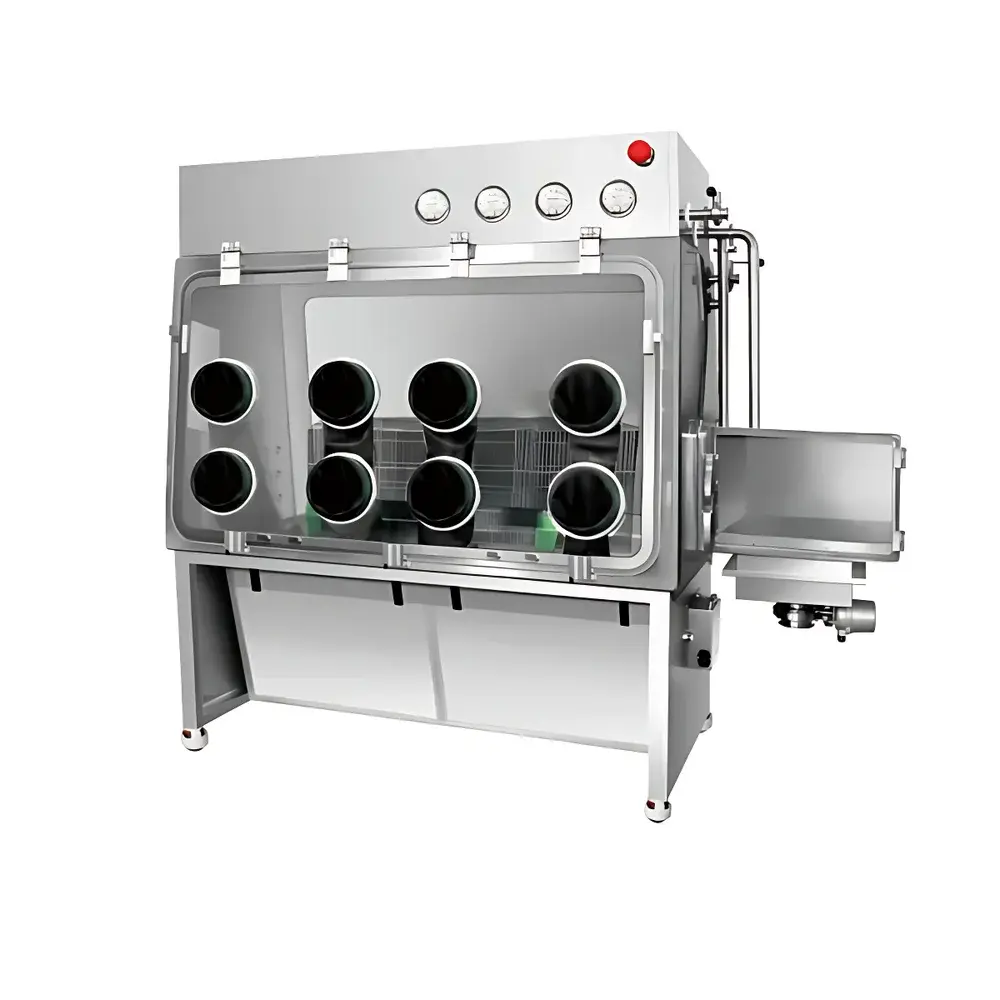
Huiron HRH-Series Biosafety Isolator
| Brand | Huiron |
|---|---|
| Origin | Beijing, China |
| Manufacturer Type | Authorized Distributor |
| Country of Origin | China |
| Model | HRH-Series |
| Pricing | Available Upon Request |
| Construction Material | 316L Stainless Steel |
| Safety Level | ABSL-3 / ABSL-4 Compliant |
| Internal Negative Pressure | ≥120 Pa |
| Glove Port Inward Air Velocity (Glove Removed) | 0.7 m/s |
| HEPA Filtration | H14 (EN 1822) on Supply & Exhaust |
| Door Seal | Pneumatic Gasket with Interlock |
| Control System | PLC-Based with Real-Time Monitoring |
| Pass-Through Chamber | Integrated Self-Cleaning Transfer Port |
| Decontamination Interface | H₂O₂ Vapor Inlet Port |
| Noise Level | <67 dB(A) |
| Compliance | RB/T 199–2015, ISO 14644-1 Class 5 (at work surface), EN 12469, NSF/ANSI 49 Annex D (adapted for isolators) |
Overview
The Huiron HRH-Series Biosafety Isolator is an engineered containment system designed for the safe handling, housing, and experimental manipulation of highly pathogenic infectious agents in animal models under ABSL-3 and ABSL-4 conditions. Built upon the principles of directional airflow containment and physical barrier integrity, it operates as a negative-pressure, sealed enclosure that prevents unidirectional leakage of aerosols or droplets from the work chamber to the external environment. Its core architecture adheres to the fundamental tenets of biosafety engineering: continuous inward airflow at critical access points (e.g., glove ports), redundant filtration of supply and exhaust air through H14-grade HEPA filters (≥99.995% efficiency at 0.1–0.2 µm), and real-time pressure differential monitoring across multiple zones. The isolator is not a generic enclosure but a validated life-support and containment platform—capable of sustaining physiological stability in housed animals while simultaneously ensuring operator and environmental protection during high-consequence virological, bacterial, or toxin-based challenge studies.
Key Features
- Monolithic 316L stainless steel construction with electropolished interior surfaces and fully radiused internal corners to eliminate crevices and support validated cleaning and decontamination protocols.
- Human-centered ergonomic design: 5° inclined front sash window minimizes operator fatigue and visual distortion during prolonged procedures.
- Dynamic glove port safety: Achieves ≥0.7 m/s inward laminar flow velocity at the cuff interface when a glove is removed—verified per RB/T 199–2015 Section 6.4.3—to prevent outward aerosol escape during emergency glove replacement.
- Integrated pneumatic door gasket system with dual-stage interlock logic: Prevents simultaneous opening of inner and outer doors; ensures chamber integrity during material transfer.
- PLC-based control unit with password-protected parameter configuration, event logging, and configurable alarm thresholds for pressure deviation, filter loading, and power interruption.
- H14 HEPA filters on both supply and exhaust lines—certified to EN 1822—with integrated upstream/downstream scanning capability for in-place leak testing (DOP/PAO) and vapor-phase hydrogen peroxide (VHP®) sterilization compatibility.
- Low-noise, EC-controlled centrifugal fans delivering stable airflow profiles with energy consumption optimized for 24/7 operation.
Sample Compatibility & Compliance
The HRH-Series accommodates a broad spectrum of preclinical animal models—including avian species, ferrets, rabbits, non-human primates—and supports custom cage integration via standardized mounting interfaces. All internal dimensions and utility penetrations (gas, power, data, waste) are modular and configurable to match institutional vivarium infrastructure. Regulatory alignment includes full traceability to RB/T 199–2015 (China’s national technical specification for biosafety equipment evaluation), with supporting documentation available for GLP-compliant study submissions. Design elements reflect harmonized interpretation of ISO 14644-1 (cleanroom classification), EN 12469 (microbiological safety cabinets), and NIH/CDC Biosafety in Microbiological and Biomedical Laboratories (BMBL, 6th Ed.) containment requirements. Third-party validation packages—including airflow smoke visualization, pressure decay testing, and microbial challenge studies—are available upon request for audit readiness.
Software & Data Management
The embedded PLC controller records time-stamped operational data—including chamber pressure differentials (±0.5 Pa resolution), fan RPM, filter delta-P, and alarm events—for minimum 30 days onboard storage. Data export is supported via USB 2.0 or optional Ethernet (Modbus TCP/IP) for integration into centralized laboratory information management systems (LIMS). Audit trails comply with ALCOA+ principles: attributable, legible, contemporaneous, original, accurate, complete, consistent, enduring, and available. While the base system does not include FDA 21 CFR Part 11-compliant electronic signatures, a validated software upgrade path is available for GMP-regulated preclinical contract research organizations requiring electronic record integrity.
Applications
- In vivo pathogenesis studies involving SARS-CoV-2, influenza A (H5N1), Nipah virus, Ebola virus, and other WHO Risk Group 4 agents.
- Vaccine efficacy and antiviral therapeutic evaluation under controlled exposure conditions (aerosol, intranasal, intratracheal).
- Longitudinal immunological monitoring of infected animals without cross-contamination risk between cohorts.
- Biosafety validation of novel PPE, decontamination methods, or HVAC interventions in high-containment facilities.
- Training platforms for ABSL-4 operations personnel in glovebox technique, emergency response, and routine maintenance procedures.
FAQ
What biosafety levels is the HRH-Series certified for?
The isolator is engineered and validated for sustained operation in ABSL-3 and ABSL-4 laboratories, meeting structural, airflow, and filtration requirements defined in BMBL 6th Edition and RB/T 199–2015.
Can the isolator be integrated with existing facility HVAC or building management systems?
Yes—exhaust ducting interfaces support connection to dedicated lab exhaust stacks; optional analog/digital I/O modules enable BMS communication for pressure cascade monitoring and alarm relay.
Is third-party certification for HEPA filter integrity included with delivery?
Factory-installed H14 filters undergo DOP/PAO scanning prior to shipment; on-site requalification post-installation is recommended and supported by Huiron’s certified field service engineers.
What decontamination methods are validated for this isolator?
Hydrogen peroxide vapor (H₂O₂) decontamination is fully supported via the dedicated inlet port; formaldehyde fumigation and chlorine dioxide protocols may be adapted subject to validation studies.
Does the system support remote diagnostics or predictive maintenance?
Remote diagnostics via secure VPN connection are available under extended service agreements; predictive maintenance is enabled through trending of fan power draw, filter pressure drop rate, and motor temperature profiles.





