
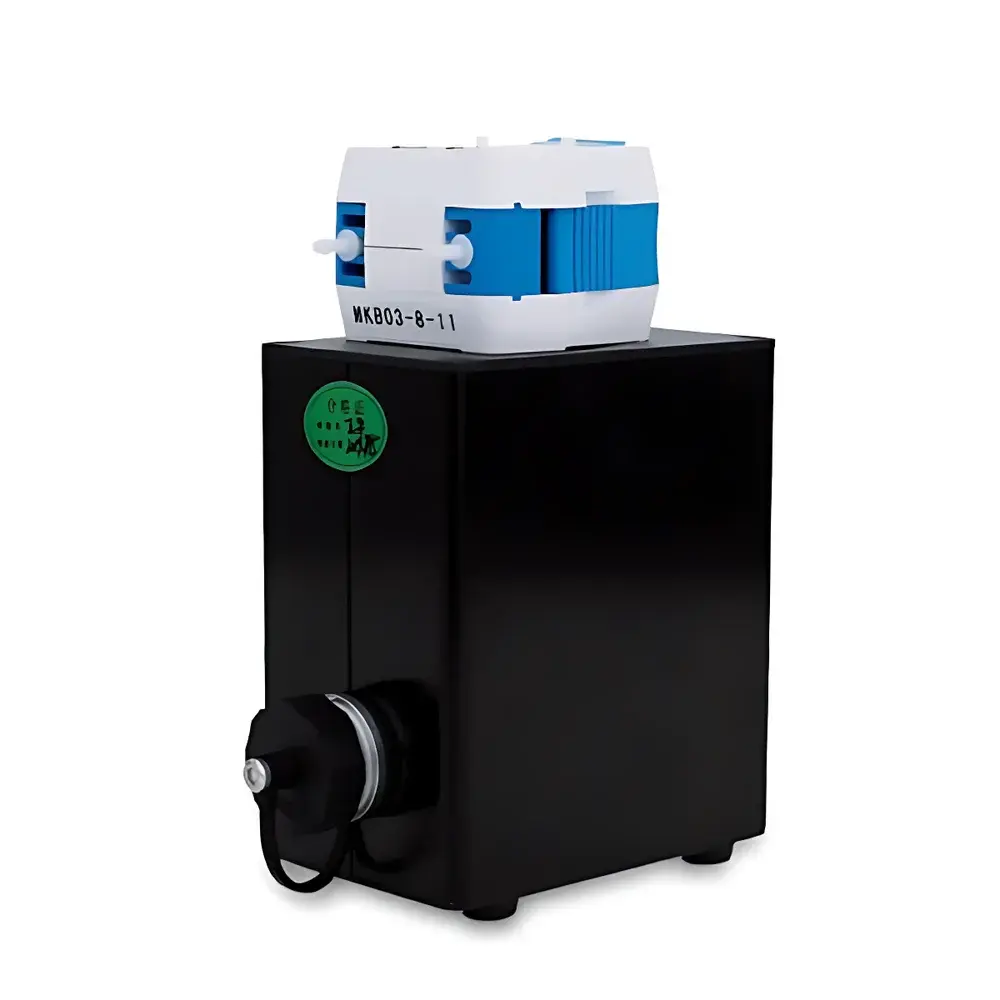
Huironhe HRH-TIP586 Precision Peristaltic Liquid Delivery Instrument
| Brand | Huironhe |
|---|---|
| Model | HRH-TIP586 |
| Type | Peristaltic Liquid Delivery Instrument |
| Flow Range | 0.02–10 mL/min |
| Tubing Dimensions | 2 × 1 mm (ID × OD) |
| Speed Range | 0.1–80 rpm |
| Speed Resolution | 0.1 rpm |
| Delivery Accuracy | <0.5% |
| Power Supply | DC 24 V / 2 A |
| Communication Interface | RS485, Modbus RTU protocol |
| Operating Environment | 0–40 °C, RH <80% |
| Ingress Protection | IP31 |
| Dimensions (L×W×H) | 110 × 60 × 150 mm |
| Weight | 0.85 kg |
Overview
The Huironhe HRH-TIP586 Precision Peristaltic Liquid Delivery Instrument is an engineered solution for controlled, continuous, and highly reproducible liquid dosing in regulated experimental environments—particularly inhalation toxicology exposure systems, preclinical medical research, and chemical reagent delivery applications. Unlike syringe pumps or gravity-fed dispensers, the HRH-TIP586 employs a peristaltic pumping principle: rollers compress flexible tubing in sequence to generate positive displacement flow without fluid contact with moving parts. This design ensures complete fluid isolation, eliminates cross-contamination risk, and supports long-duration operation (>72 h) with minimal maintenance. Its compact footprint (110 × 60 × 150 mm) and low mass (0.85 kg) enable seamless integration into enclosed exposure chambers, aerosol generation platforms, and multi-instrument test racks. The instrument is specifically optimized for compatibility with corrosive, viscous, or pH-extreme aqueous and organic solutions—leveraging chemically resistant silicone or fluoropolymer tubing (2 × 1 mm ID/OD) and a corrosion-resistant housing.
Key Features
- High-precision peristaltic delivery with accuracy better than ±0.5% across the full flow range (0.02–10 mL/min), validated under steady-state and step-change conditions.
- Wide dynamic speed control (0.1–80 rpm) with 0.1 rpm resolution, enabling fine-grained modulation of flow rate for dose-response studies and time-resolved exposure protocols.
- Integrated RS485 digital interface compliant with Modbus RTU protocol, permitting bidirectional communication with central exposure system controllers (e.g., PLCs or LabVIEW-based orchestration software) for synchronized start/stop, speed setpoint updates, and real-time status feedback (e.g., motor stall detection, run-time accumulation).
- DC24V/2A power architecture ensures electromagnetic compatibility (EMC) stability in electromagnetically noisy laboratory environments and enables safe operation within Class II biological safety cabinets or explosion-proof enclosures when paired with appropriate tubing and shielding.
- IP31-rated enclosure provides protection against vertically falling drips and solid objects ≥2.5 mm, supporting reliable deployment in non-sterile but humidity-controlled lab spaces (0–40 °C, RH <80%).
Sample Compatibility & Compliance
The HRH-TIP586 delivers broad fluid compatibility through user-selectable tubing materials—including platinum-cured silicone (for general aqueous buffers and saline), FEP-lined silicone (for organic solvents such as ethanol, acetone, or dichloromethane), and fluorinated ethylene propylene (FEP) tubing (for strong acids/bases, e.g., 1 M HCl or 1 M NaOH). No wetted metal components are exposed to the sample stream, eliminating leaching concerns critical in GLP-compliant inhalation studies. While the instrument itself is not certified to ISO 17025 or FDA 21 CFR Part 11, its deterministic flow behavior, traceable speed calibration, and digital audit trail capability (via Modbus register logging) support alignment with OECD Test Guidelines 412 (Subacute Inhalation Toxicity) and ASTM E2933 (Standard Practice for Generation of Aerosols for Inhalation Toxicology Studies). Documentation packages—including factory calibration reports and electrical safety test summaries—are available upon request to facilitate internal QA/QC validation.
Software & Data Management
The HRH-TIP586 operates as a field device within larger exposure system architectures. It does not include embedded GUI software but interfaces natively with industry-standard SCADA, LabVIEW, Python (via PyModbus), or MATLAB environments. All operational parameters—including current speed, cumulative volume delivered, runtime hours, and error flags (e.g., tubing occlusion, overcurrent)—are mapped to discrete Modbus holding registers (0x0001–0x0010). This enables automated data capture into electronic lab notebooks (ELNs), LIMS, or custom databases with timestamped entries. For laboratories requiring ALCOA+ principles (Attributable, Legible, Contemporaneous, Original, Accurate), the instrument supports external logging of command history and state transitions when integrated with a validated master controller that enforces user authentication and change control.
Applications
- Inhalation toxicology: Continuous delivery of test article solutions (e.g., nanoparticle suspensions, pharmaceutical nebulizer formulations, or volatile organic compound carriers) into nose-only or whole-body exposure chambers for rodent or primate studies.
- Medical device evaluation: Controlled infusion of simulated lung fluids or mucin-based matrices during aerosol deposition testing of inhalers, dry powder inhalers (DPIs), or nebulizer systems.
- Chemical process simulation: Metered introduction of catalyst precursors, initiators, or reactive monomers into gas-phase reaction streams or aerosol synthesis reactors.
- Environmental chamber conditioning: Precise humidification or contaminant spiking (e.g., formaldehyde, ozone co-exposures) via aqueous solution nebulization upstream of exposure zones.
FAQ
Is the HRH-TIP586 suitable for sterile applications?
No—it is not autoclavable or gamma-irradiated certified. Sterility must be achieved via aseptic tubing installation and single-use tubing protocols.
Can it deliver viscous liquids such as glycerol or polymer solutions?
Yes, provided tubing selection accounts for backpressure (e.g., shorter lengths, larger ID options); maximum viscosity supported is ~1,000 mPa·s at 25 °C using standard 2 × 1 mm tubing.
Does it support analog input for speed control?
No—only digital RS485/Modbus RTU interface is provided; analog 0–10 V or 4–20 mA inputs are not implemented.
What maintenance is required?
Tubing replacement every 200–500 hours depending on flow rate and chemical exposure; roller wear inspection recommended annually under continuous operation.
Is firmware upgradable in the field?
Yes—firmware updates are delivered via Modbus register write sequences using vendor-provided configuration utilities; version history and checksum verification are supported.
Related Products







