
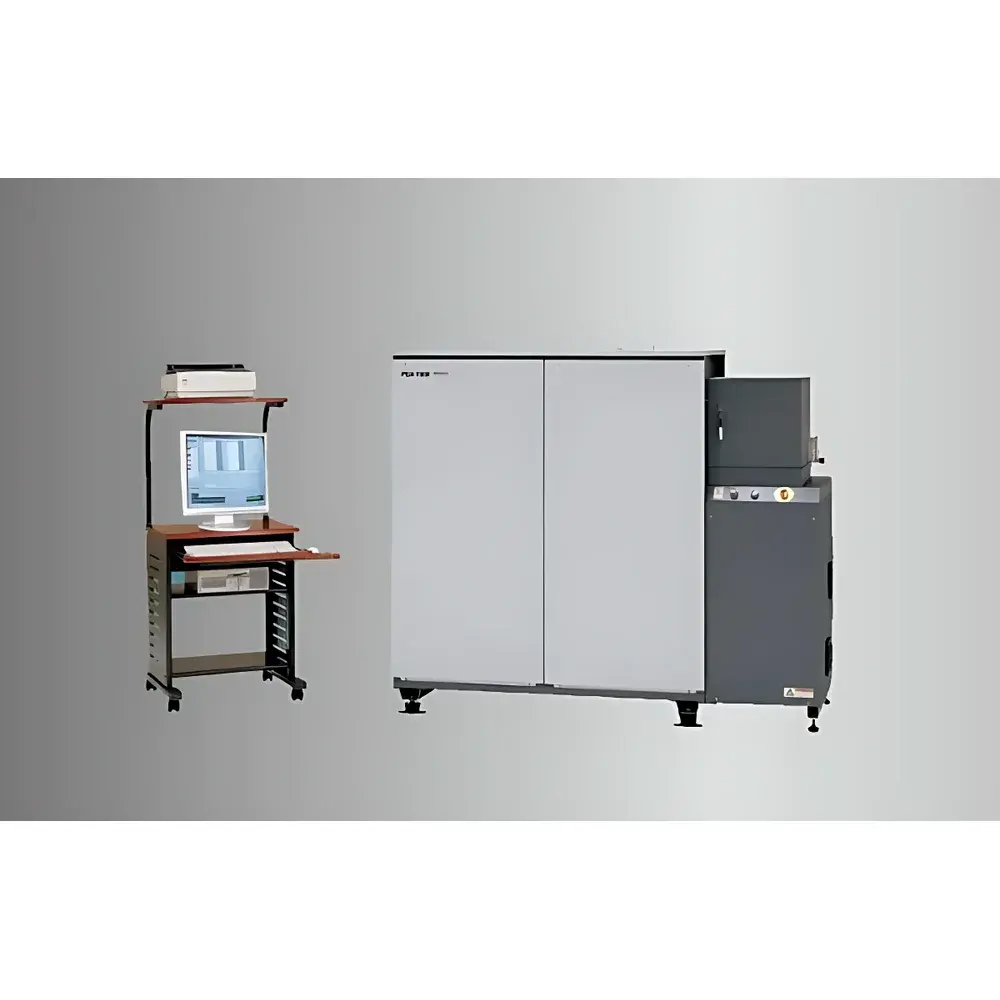
Shimadzu PDA-5500S Direct-Reading Optical Emission Spectrometer (OES)
| Brand | Shimadzu |
|---|---|
| Origin | Japan |
| Instrument Type | Floor-standing |
| Excitation Source | Spark |
| Detector | Photomultiplier Tube (PMT) |
| Focal Length | 600 mm |
| Grating Groove Density | 2400 lines/mm |
| Wavelength Range | 120–800 nm |
| Number of Channels | Up to 64 |
Overview
The Shimadzu PDA-5500S is a high-performance floor-standing direct-reading optical emission spectrometer (OES) engineered for precise, reproducible elemental analysis of solid metallic samples. It operates on the fundamental principle of spark-induced optical emission spectroscopy: a controlled argon-atmosphere spark discharge vaporizes and excites atoms from the sample surface, generating element-specific atomic emission lines across the ultraviolet-to-near-infrared spectrum (120–800 nm). The emitted light is dispersed by a high-resolution concave holographic ion-etched grating (600 mm focal length, 2400 lines/mm), enabling accurate wavelength separation and intensity measurement via an array of photomultiplier tubes (PMTs). Unlike sequential or CCD-based systems, the PDA-5500S employs Shimadzu’s proprietary Pulse Distribution Analysis (PDA) detection method—a statistical evaluation of pulse amplitude and frequency distribution over multiple spark discharges—which significantly enhances signal-to-noise ratio and long-term stability without requiring internal standard normalization for every measurement cycle. This architecture delivers exceptional precision in routine quality control and demanding R&D applications across ferrous and non-ferrous metallurgy.
Key Features
- Robust optical design featuring a 600 mm focal length concave holographic grating with 2400 lines/mm groove density, optimized for high spectral resolution and stray-light suppression.
- Multi-parameter spark source with software-selectable excitation voltages (300 V / 500 V) and six distinct discharge modes; discharge parameters (pulse duration, delay time, integration gate) are fully configurable per analytical program.
- Horizontal argon-flushed spark stand with integrated flow control, ensuring consistent plasma stability and minimizing oxide interference during analysis of reactive alloys.
- PDA detection methodology—real-time statistical processing of spark pulse distributions—enabling superior repeatability (RSD < 0.5% for major elements in certified reference materials) and resistance to matrix-induced drift.
- Modular channel architecture supporting up to 64 independent PMT detectors, allowing simultaneous quantification of major, minor, and trace elements—including C, P, S, N, and B—in a single exposure.
- Factory-calibrated base curves supplemented by user-creatable calibration models, facilitating rapid method development for specialty alloys (e.g., high-Ni superalloys, Mg-Li composites, and low-alloy tool steels).
Sample Compatibility & Compliance
The PDA-5500S is validated for direct analysis of flat, polished solid metal specimens (diameter ≥ 20 mm, thickness ≥ 4 mm) across a broad compositional range: carbon and alloy steels, stainless steels, cast irons, aluminum and magnesium alloys, copper and brass, titanium grades, and nickel-based superalloys. Sample introduction requires no digestion or dilution—analysis is completed in under 30 seconds per sample. The system complies with international standards governing metal analysis, including ASTM E415 (Standard Test Method for Analysis of Carbon and Low-Alloy Steel by Spark Atomic Emission Spectrometry), ISO 11573 (Metallic materials — Spark discharge atomic emission spectrometric analysis), and JIS G 1253 (Methods of test for steel and iron — Spark emission spectrometry). Its hardware architecture and firmware support audit-trail-enabled operation aligned with GLP and GMP requirements; data integrity safeguards include electronic signature capability and user-access-level management within the PDA-Win software environment.
Software & Data Management
The PDA-5500S is operated via Shimadzu’s PDA-Win analysis software, a Windows-based application designed for metrological rigor and regulatory compliance. It provides full control over excitation parameters, spectral acquisition, calibration management, and quantitative reporting. Key capabilities include multi-point calibration with polynomial or spline fitting, interference correction using internal or external reference lines, limit-of-detection (LOD) calculation per element, and automated pass/fail judgment against specification limits. All raw spectra, calibration logs, operator actions, and result histories are timestamped and stored in a secure relational database. Export formats comply with ASTM E1382 (Standard Practice for Digital Storage of Analytical Data) and support LIMS integration via ODBC. Software updates adhere to version-controlled release protocols, and the system supports FDA 21 CFR Part 11 compliance when configured with electronic signatures and audit-trail activation.
Applications
The PDA-5500S serves as a core analytical platform in foundries, rolling mills, metal service centers, and third-party testing laboratories where rapid, reliable compositional verification is critical. Typical use cases include incoming raw material inspection (scrap sorting, alloy grade identification), melt process control (ladle analysis, continuous casting monitoring), finished product certification (mill test reports per EN 10204 Type 3.1), and failure analysis (inclusion mapping support via spectral line ratioing). Its ability to quantify interstitial elements (C, N, O, S, P) at sub-0.001 wt% levels makes it particularly valuable in aerospace-grade titanium and high-strength low-alloy (HSLA) steel production. The instrument also supports research into phase transformation kinetics and segregation behavior through time-resolved spark profiling and depth-profile mode (with optional electrode rotation).
FAQ
What types of samples can be analyzed on the PDA-5500S?
Solid metallic samples with flat, conductive surfaces—such as castings, forgings, rolled plates, and machined coupons—are suitable. Non-conductive or powdered samples require pelletization with conductive binder and are not recommended for routine use.
Does the PDA-5500S require daily recalibration?
No. The PDA detection method and stable optical bench minimize drift; routine verification using certified reference materials (CRMs) every 8–12 hours is sufficient for QC environments meeting ISO/IEC 17025 requirements.
Can the system analyze light elements such as carbon and sulfur in steel?
Yes. With optimized vacuum UV optics and dedicated PMTs, the PDA-5500S achieves detection limits of 3 ppm for C and 5 ppm for S in low-alloy steel matrices.
Is remote diagnostics supported?
Yes. Optional Shimadzu Remote Support Module enables encrypted, permission-based remote access for preventive maintenance and troubleshooting under IT security policies.
What argon purity is required for optimal performance?
Grade 4.8 (99.998% pure) argon with dew point ≤ –60 °C is recommended; impurity levels above 10 ppm O₂ or H₂O will degrade UV sensitivity below 190 nm.
Related Products





