
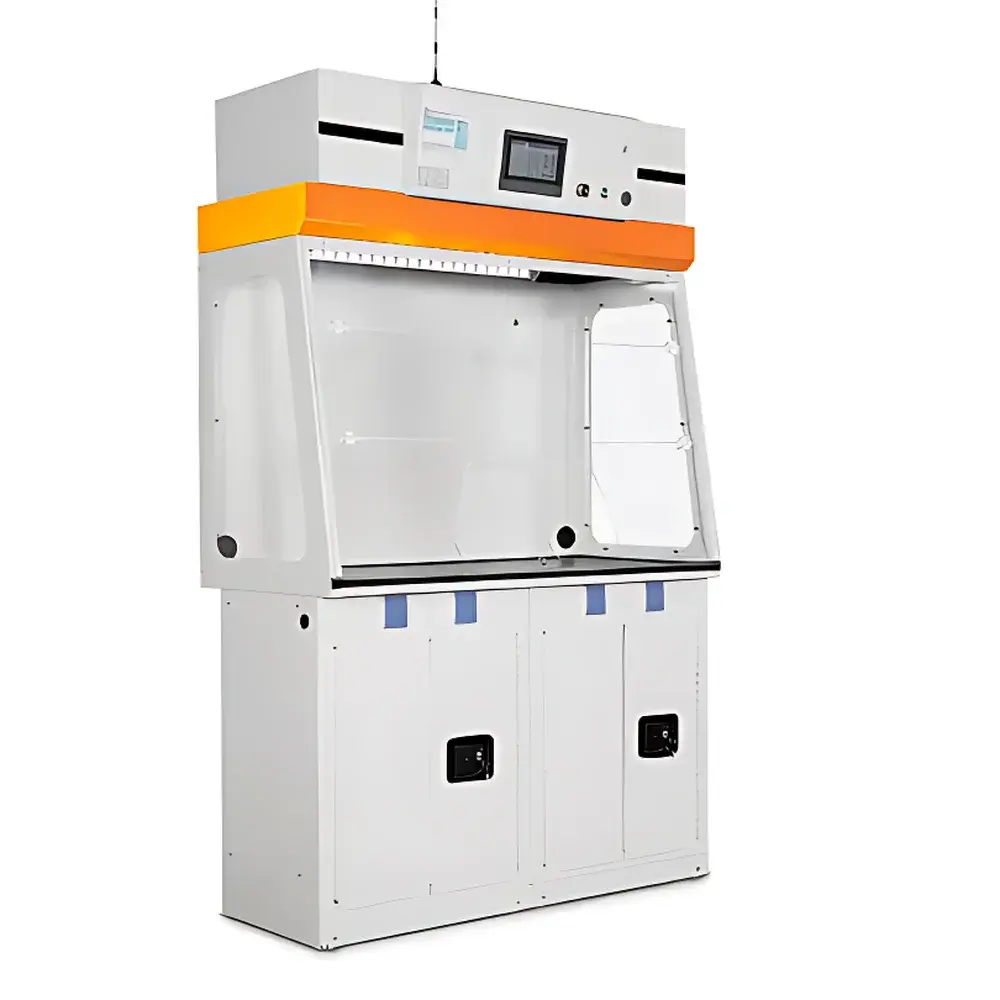
Hujing Purification FX-DS Series Ductless Air-Cleaning Fume Hood
| Brand | Hujing Purification (HJ) |
|---|---|
| Origin | Shanghai, China |
| Manufacturer Type | Direct Manufacturer |
| Country of Origin | China |
| Model | FX-DS |
| Construction | All-Steel Ductless Fume Hood |
| Airflow Capacity | 230 m³/h |
| Average Face Velocity | 0.4–0.6 m/s |
| Power Supply | 110–240 V, 50–60 Hz |
| Max Current | 2 A |
| Sound Level | 40–52 dBA |
| Power Consumption | 42 W |
| Filter Dimensions | 370 × 395 × 50 mm (Main), 370 × 395 × 21 mm (Pre-filter) |
| Display | 7-inch TFT-LCD Touchscreen (1024 × 600) |
| Compliance | NFX 15-211:2009, ASHRAE 110:1995, JG/T 385–2012, ISO 9001 Certified |
| Filtration Efficiency | HEPA H14 ≥99.995% @ 0.3 µm |
| VOC Monitoring | Dual-sensor system (ambient + filter saturation) |
| Fan | UL-listed PSC motor, 24 V DC, spark-free, low-noise |
| Optional Filters | OG (Organic), AG (Inorganic), AM (Ammonia), FO (Formaldehyde), HEPA H14 |
Overview
The Hujing Purification FX-DS Series Ductless Air-Cleaning Fume Hood is an engineered containment solution designed for laboratories where infrastructure constraints, energy efficiency, and chemical safety converge. Unlike conventional ducted hoods that exhaust conditioned air outdoors—resulting in significant HVAC load and installation complexity—the FX-DS operates on a closed-loop recirculation principle. Ambient laboratory air is drawn across the work surface at a controlled face velocity (0.4–0.6 m/s), establishing a stable aerodynamic barrier between the operator and hazardous vapors or particulates. This air then passes sequentially through a multi-stage filtration system: first through pre-filters capturing coarse particulates and aerosols, followed by application-specific sorbent media (e.g., activated carbon for organic vapors, potassium permanganate-impregnated media for inorganic acids), and finally through a certified HEPA H14 filter removing ≥99.995% of particles ≥0.3 µm. Clean, temperature-neutral air is returned directly to the lab environment—eliminating ductwork, minimizing thermal loss, and reducing total cost of ownership over its service life.
Key Features
- Robust all-steel construction with ≥1.0 mm galvanized steel panels, finished with lead-free epoxy resin electrostatic coating for superior corrosion resistance and long-term surface integrity.
- 6 mm optically clear acrylic front and side sashes offering high impact resistance, UV stability, and exceptional chemical compatibility—including exposure to concentrated acids, bases, and solvents.
- Dual VOC monitoring architecture: one sensor continuously measures ambient lab air quality; the second monitors real-time breakthrough concentration at the filter outlet—triggering visual and audible alerts when saturation thresholds are exceeded.
- Intelligent fan control with adjustable speed via touchscreen interface, ensuring consistent face velocity across varying filter loading states and chemical volatility profiles.
- Integrated environmental monitoring system displaying real-time temperature and relative humidity, with user-configurable alarm thresholds aligned with ISO 14644-1 cleanroom stability guidelines.
- UL-recognized 24 V DC PSC blower—spark-free, thermally protected, and acoustically optimized (<52 dBA)—ensuring operational safety in flammable or explosive atmospheres.
- LED task lighting (equivalent to 25 W fluorescent output) delivering uniform illumination without radiant heat emission, preserving thermal stability of sensitive samples and reagents.
- Epoxy resin work surface with through-body composition—resistant to thermal shock up to 180 °C, impervious to hydrochloric acid, nitric acid, sodium hydroxide, and acetone under continuous exposure per ASTM D543.
Sample Compatibility & Compliance
The FX-DS accommodates a broad spectrum of laboratory workflows involving volatile organic compounds (VOCs), low-concentration inorganic acids (e.g., HCl, HF, HNO₃), ammonia, formaldehyde, and fine particulates. Its modular filter configuration supports concurrent or sequential use of OG, AG, AM, FO, and HEPA H14 cartridges—enabling safe handling of mixed-hazard experiments without cross-contamination risk. The unit complies with international performance standards including NFX 15-211:2009 (France), ASHRAE 110:1995 (USA), and JG/T 385–2012 (China), and has undergone third-party verification per ISO 9001:2015 quality management requirements. While not intended for high-volume perchloric acid or radioactive applications, it meets GLP-aligned documentation protocols—including audit-ready event logs, filter lifecycle tracking, and timestamped alarm records—supporting regulatory readiness for ISO/IEC 17025-accredited facilities.
Software & Data Management
The FX-DS integrates a 7-inch industrial-grade HMI (1024 × 600 resolution) running a Linux-based embedded OS, validated by China Software Testing Center (CSTC) with formal test report certification. Core software capabilities include:
- Chemical inventory management: local database supporting ≥100 entries with searchable fields (CAS number, name, quantity, unit, exposure limit); editable directly on-device and synchronized bi-directionally with cloud backend.
- Remote telemetry via embedded 4G LTE module (CCC-certified), enabling secure access through authenticated WeChat Mini Program—displaying historical VOC trends, temperature/humidity curves, alarm chronology, and real-time device status.
- Remote actuation of critical functions: fan start/stop, lighting toggle, alarm silencing, and emergency shutdown—all logged with user ID and timestamp for accountability.
- RESTful API interface compliant with OpenAPI 3.0 specification, facilitating integration with LIMS, ELN, or building management systems (BMS) for centralized lab asset oversight.
Applications
The FX-DS is deployed in academic research labs, pharmaceutical QC suites, analytical chemistry departments, and teaching institutions where space, budget, or architectural limitations preclude traditional ducted installations. Typical use cases include:
- Preparative chromatography solvent handling (acetonitrile, methanol, chloroform)
- Microscale synthesis under inert atmosphere with volatile reagents
- Standardization of reference materials requiring trace-level contamination control
- Electrochemical cell assembly involving lithium salt electrolytes
- Environmental sample preparation (e.g., EPA Method 525.3 extractions)
- Cell culture support operations requiring localized VOC abatement without laminar flow disruption
Its compact footprint (FX-DS800: 800 × 620 × 1245 mm; FX-DS1000: 1000 × 620 × 1245 mm) and optional castor-mount base allow deployment on standard lab benches or mobile carts—ideal for temporary setups, field labs, or multi-user shared spaces.
FAQ
Does the FX-DS require external ductwork or roof penetration?
No. It is a fully self-contained, recirculating system with no external exhaust connection required.
How often must filters be replaced?
Filter service intervals depend on usage intensity and chemical profile; typical replacement ranges from 6–12 months for organic vapor cartridges and 18–24 months for HEPA H14 under moderate use. The dual-VOC sensor provides objective, real-time saturation data to guide maintenance scheduling.
Can the unit be validated for GxP environments?
Yes. Audit trails, electronic signatures (via WeChat login), and configurable alarm thresholds support alignment with FDA 21 CFR Part 11 and EU Annex 11 requirements when deployed within documented SOP frameworks.
Is the epoxy resin work surface resistant to hot plates or soldering irons?
It withstands brief contact up to 180 °C but is not rated for sustained direct flame or molten metal exposure; supplemental ceramic mats are recommended for high-heat instrumentation.
What happens during power failure?
The system enters fail-safe mode: fan stops immediately, sash interlock engages (if equipped), and non-volatile alarm memory retains last 100 events for post-event diagnostics.



