
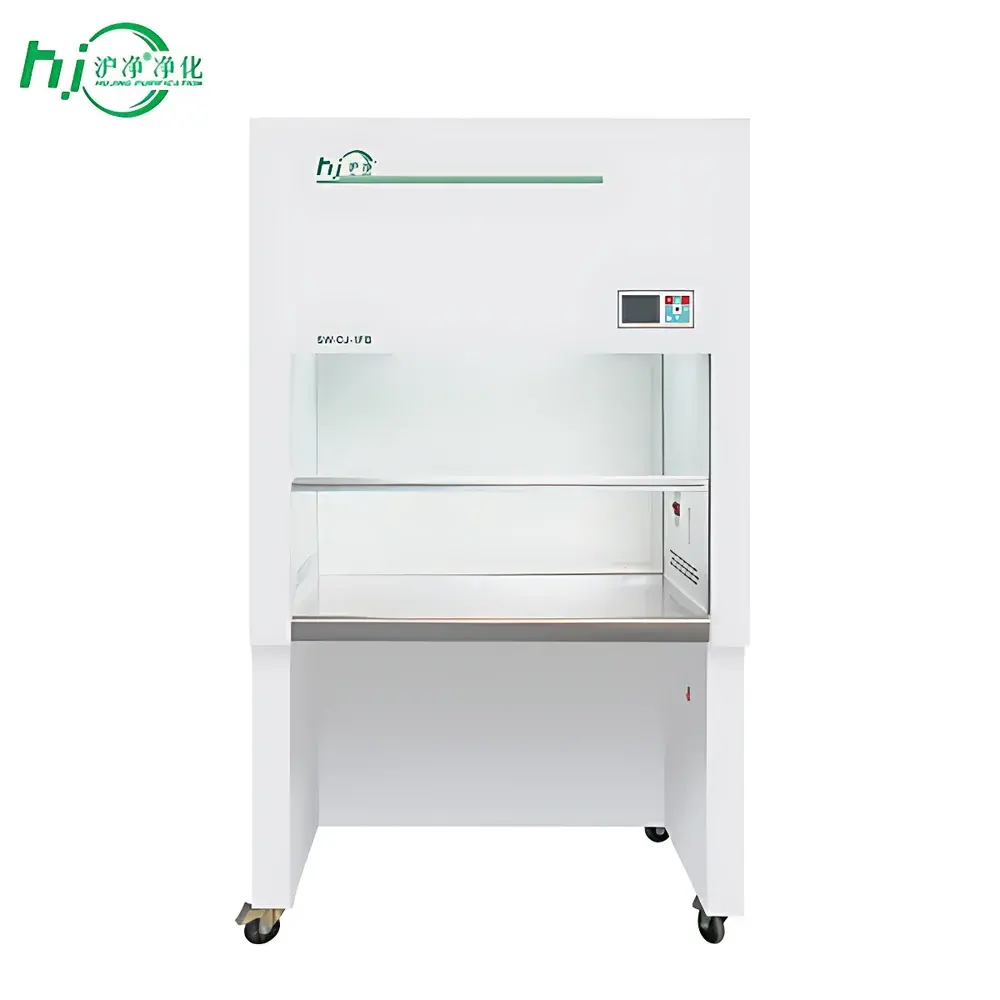
Hujing Purification SW-CJ1FB Stainless Steel Single-Person Horizontal/Vertical Dual-Mode Laminar Flow Clean Bench
| Brand | Hujing Purification (HJ) |
|---|---|
| Origin | Shanghai, China |
| Manufacturer Type | Direct Manufacturer |
| Regional Category | Domestic (China) |
| Model | SW-CJ1FB |
| Price | USD 920 (approx.) |
| Cleanliness Class | ISO Class 5 (equivalent to Fed. Std. 209E Class 100 @ ≥0.5 µm) |
| Noise Level | ≤62 dB(A) |
| User Capacity | Single-user, single-front configuration |
| Average Air Velocity | 0.25–0.45 m/s (3-speed adjustable) |
| Microbial Recovery | ≤0.5 CFU/plate·hour (Φ90 mm settle plate) |
| Vibration | ≤5 µm half-amplitude (X/Y/Z axes) |
| Illumination | ≥300 lux |
| Power Supply | AC 220 V, 50 Hz |
| Max. Power Consumption | 500 W |
| Net Weight | 90 kg |
| Work Area Dimensions | 870 × 520 × 620 mm (W×D×H) |
| Overall Dimensions | 1030 × 740 × 1800 mm (W×D×H) |
| HEPA Filter Config. | 855 × 450 × 50 mm (1 pc) + 820 × 565 × 50 mm (1 pc) |
| Pre-filter | Integrated coarse particulate filter |
| Lighting | 20 W fluorescent lamp (1 pc) |
| UV Sterilization Lamp | 20 W (1 pc) |
| Control Interface | Digital LCD panel with interlocked safety logic |
Overview
The Hujing Purification SW-CJ1FB is a dual-mode laminar flow clean bench engineered for ISO Class 5 (Fed. Std. 209E Class 100) environments, delivering unidirectional airflow either horizontally (toward the operator) or vertically (downward over the work surface), configurable via internal ducting and fan orientation. It operates on the principle of high-efficiency particulate air (HEPA) filtration—specifically H14 grade per EN 1822-1—to remove ≥99.995% of airborne particles ≥0.3 µm, ensuring sterility-critical tasks such as aseptic sampling, media preparation, microbiological plating, and pharmaceutical component handling meet stringent environmental control requirements. Designed for single-operator use in R&D labs, QC facilities, and GMP-compliant production support zones, the unit integrates mechanical stability, ergonomic accessibility, and regulatory-aligned safety architecture—including mandatory electrical interlocks between UV germicidal irradiation and sash movement.
Key Features
- Configurable airflow mode: Switchable between horizontal laminar flow (operator-facing) and vertical laminar flow (downward) without tooling—optimized for diverse procedural workflows including open-vessel handling and sterile barrier applications.
- Counterbalanced sash system: Full-height tempered glass front window with frictionless counterweight mechanism enables stepless positioning at any height, enhancing operator comfort and workflow continuity during extended procedures.
- Corrosion-resistant construction: Entire enclosure formed from pre-painted steel panels; work surface fabricated from brushed 304 stainless steel (ASTM A240), compliant with ISO 14644-1 surface cleanliness and USP material compatibility guidelines.
- Dual-stage filtration: Integrated pre-filter (G4 class per EN 779) extends service life of primary HEPA filters (855 × 450 × 50 mm and 820 × 565 × 50 mm); both filters certified per IEST-RP-CC001.3 for integrity and efficiency.
- Safety-interlocked control: LCD interface enforces hardware-level interlock—UV lamp deactivates automatically when sash is raised above safe threshold; lighting remains active only when sash is fully closed or within operational range.
- Three-speed fan control: Adjustable air velocity (0.25–0.45 m/s) via digital interface supports protocol-specific airflow tuning—e.g., low speed for sensitive cell culture, high speed for rapid particle clearance post-contamination event.
Sample Compatibility & Compliance
The SW-CJ1FB accommodates standard laboratory vessels up to 200 mm tall within its 620 mm-deep work area, supporting Petri dishes, test tubes, flasks, pipette racks, and small-scale bioreactors. Its design conforms to key international safety and performance benchmarks: IEC 61010-1 (electrical safety), IEC 60335-1 (household/industrial appliance safety), and EN 61326-1 (EMC compliance). While not classified as medical device under FDA 21 CFR Part 820, it meets foundational requirements for equipment used in GLP and GMP environments—particularly regarding documentation traceability, maintenance log retention, and validation-ready operational parameters (e.g., velocity mapping, filter integrity testing ports). All lighting and UV components comply with IEC 62471 photobiological safety classification (Risk Group 1 for visible light; Risk Group 2 for UV-C emission).
Software & Data Management
This clean bench operates via embedded microcontroller-based logic with no external software dependency. The digital LCD interface logs runtime hours for HEPA and UV lamps, stores last-used airflow speed setting, and displays real-time status indicators (fan operation, UV activation, sash position). Though not networked or cloud-connected, its control architecture supports IQ/OQ documentation per ASTM E2500 and EU Annex 15: all critical parameters—including air velocity calibration points, illumination uniformity measurements, and microbial challenge test results—are recordable using standardized templates aligned with FDA 21 CFR Part 11 audit-trail principles (manual entry with timestamped operator sign-off). Optional calibration certificates (ISO/IEC 17025-accredited) are available upon request for velocity, noise, and illumination verification.
Applications
- Aseptic processing of microbial cultures, mammalian cell lines, and plant tissue explants in academic and industrial bioscience laboratories.
- Preparation and dispensing of sterile pharmaceutical excipients, APIs, and compounded sterile preparations (CSPs) under USP and guidance.
- Environmental monitoring sample handling—including membrane filtration, settle plate exposure, and air sampler media loading—in ISO 14644-certified cleanrooms.
- Electronics assembly and microfabrication where electrostatic discharge (ESD)-safe airflow and particulate-free workspaces are required (complementary to grounded stainless steel surface).
- Quality control testing of medical devices, packaging materials, and raw ingredients in regulated manufacturing settings adhering to ISO 13485 and ICH Q5A.
FAQ
Is the SW-CJ1FB certified to ISO 14644-1 Class 5?
Yes—the unit achieves and maintains ≤3,520 particles/m³ ≥0.5 µm under steady-state operation, verified per ISO 14644-3 protocols using calibrated laser particle counters.
Can the HEPA filters be replaced in-house without specialized tools?
Yes—front-access filter compartments allow full replacement of both HEPA units using only a Phillips screwdriver; filter gasket integrity is validated via smoke visualization per IEST-RP-CC034.2.
Does the unit support integration into a facility’s BMS or monitoring network?
No native Ethernet or Modbus interface is provided; however, analog 4–20 mA outputs for airflow velocity and digital dry-contact alarms (for sash breach or UV fault) can be added via optional retrofit kit.
What is the recommended recalibration interval for velocity and illumination?
Per ISO 14644-3, annual verification is advised; velocity mapping should cover nine-point grid across work surface, while illumination uniformity must satisfy ≥70% minimum/maximum ratio per IESNA RP-27.
Is UV lamp intensity monitored or logged?
No real-time UV radiometry is built-in, but the control system records cumulative UV-on time; users are advised to perform quarterly radiometric validation using NIST-traceable UV-C meters per ISO/IEC 17025.



