
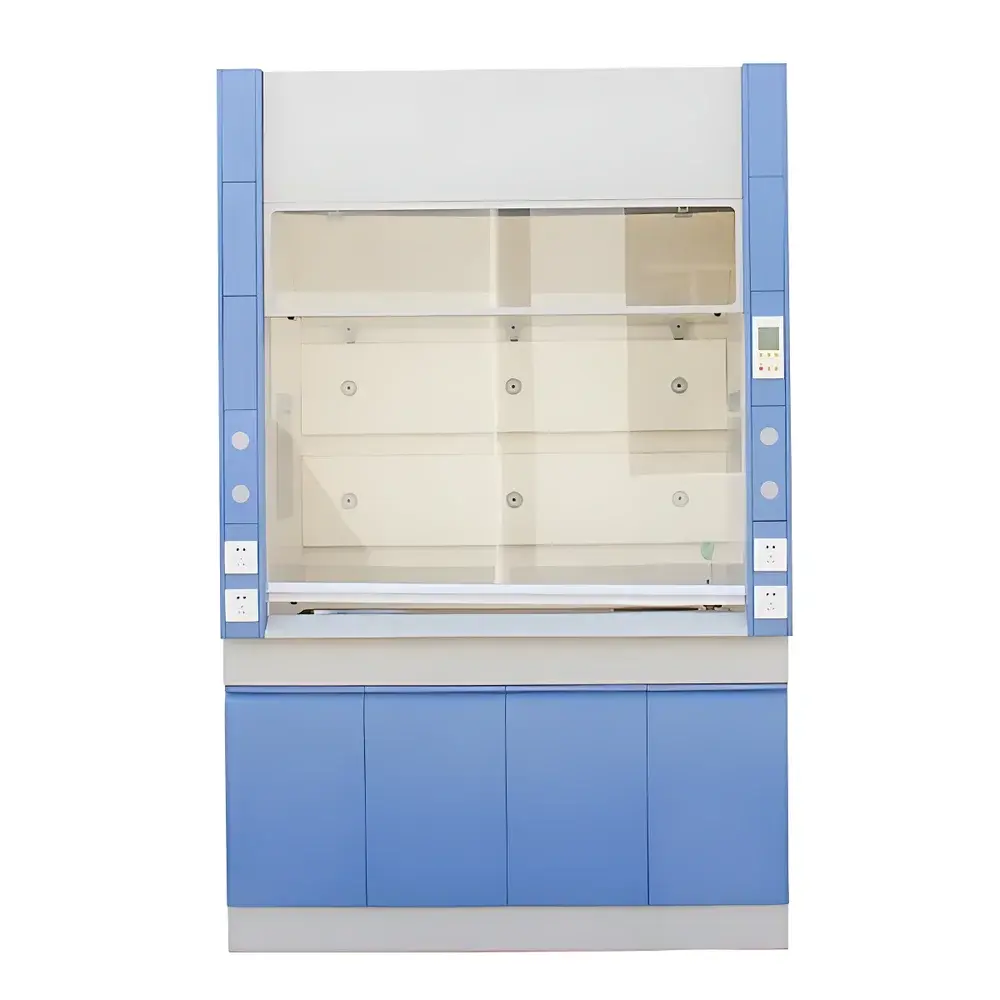
Hujing Purification ZJ-TFG-15 Full-Steel Single-Face Constant-Volume Fume Hood
| Brand | Hujing Purification (HJ) |
|---|---|
| Origin | Shanghai, China |
| Manufacturer Type | Direct Manufacturer |
| Country of Origin | China |
| Model | ZJ-TFG-15 |
| Price | USD 1,320 (FOB Shanghai) |
| Cabinet Material | 1.0 mm Cold-Rolled Steel (Epoxy-Powder Coated) |
| Configuration | Single-Face, Front-Access Workstation |
| Exhaust Mode | 100% Ducted (Constant-Volume) |
| Face Velocity | 0.5 m/s |
| Power Supply | 220 V AC, 50 Hz |
| Max. Power Consumption | 0.3 kW |
| Net Weight | 165 kg |
| Work Area Dimensions (W×D×H) | 1288 × 655 × 1200 mm |
| Overall Dimensions (W×D×H) | 1500 × 850 × 2350 mm |
| Lighting | 12 W LED Lamp (Integrated, Shadow-Free Illumination) |
| Work Surface | 12.7 mm Solid Phenolic Chem-Resistant Laminate |
| Interior Liner | 5 mm Grey Antilaminate (Chemical-Resistant High-Pressure Laminate, HPL) |
| Structural Compliance | ASTM E1547-22 (Standard Guide for Laboratory Fume Hood Performance), ISO 10975:2022 (Laboratory Ventilation – Fume Hood Testing), EN 14175-3:2021 (Fume Hoods – Part 3: Type Testing) |
Overview
The Hujing Purification ZJ-TFG-15 is a CE-compliant, full-steel, single-face constant-volume fume hood engineered for routine chemical handling, synthesis, and analytical preparation in academic, industrial, and quality control laboratories. It operates on the principle of directional airflow management: ambient air is drawn across the work surface at a controlled face velocity of 0.5 m/s, entraining hazardous vapors, aerosols, and particulates before exhausting them through a dedicated ducted system. Its structural architecture follows ASHRAE 110–2016 test protocols for containment performance and integrates passive safety design elements—including a vertically sliding sash made of tempered safety glass, rear service cavity access, and recessed utility integration—to minimize operator exposure while maintaining ergonomic workflow integrity. Designed for installation in fixed-duct laboratory ventilation networks, it does not incorporate variable-air-volume (VAV) actuators or airflow sensors, making it suitable for environments where stable exhaust demand and predictable static pressure drop are prioritized over dynamic energy modulation.
Key Features
- Structural frame fabricated from 1.0 mm cold-rolled steel, precision-cut and welded using CNC-controlled bending and MIG welding; post-fabrication acid pickling, phosphating, and electrostatic epoxy-powder coating (cured at 180°C) ensure corrosion resistance and Class A surface finish per ISO 20471.
- Interior liner constructed from 5 mm grey high-pressure laminate (HPL), certified to EN 438-2 for resistance to concentrated acids (e.g., HNO₃, H₂SO₄), organic solvents (acetone, ethanol, chloroform), and alkalis—validated via ASTM D543 immersion testing.
- Work surface composed of 12.7 mm solid phenolic chem-resistant laminate meeting ANSI/NSF 51 food equipment standards for non-toxicity and dimensional stability under thermal cycling (−20°C to +120°C).
- Integrated utility manifold with concealed routing for 220 V AC power (GFCI-protected dual outlets), low-pressure water supply (brass quick-connect valve with ceramic disc cartridge), and optional gas line ports (BS 341 No. 6 standard); all penetrations sealed with fire-rated intumescent collars.
- Front sash mechanism features counterbalanced vertical lift with dual-position stops (fully open and 500 mm working height), laminated safety glass compliant with EN 12600 Class 2B2 impact rating.
- Rear service panel provides tool-free access to internal wiring, plumbing junctions, and fan mounting points—designed to support GLP audit requirements for maintenance traceability.
Sample Compatibility & Compliance
The ZJ-TFG-15 accommodates standard bench-scale apparatus including round-bottom flasks (up to 5 L), separatory funnels, reflux condensers, and digital pH meters. Its 1288 mm wide work area supports dual-user side-by-side operation under defined sash height constraints. The unit conforms to mandatory regional safety frameworks: it meets the airflow containment criteria outlined in EN 14175-3:2021 (tracer gas SF₆ challenge test), satisfies structural load requirements per ISO 10975:2022 Annex B (static load ≥ 150 kg distributed over 300 × 300 mm zone), and carries documentation supporting IEC 61000-6-3 EMC emission compliance. While not certified to UL 1805 or NFPA 45, its ducted configuration and material selection align with OSHA 1910.1450 and ANSI Z9.5 laboratory ventilation guidelines for low-to-moderate toxicity applications.
Software & Data Management
This fume hood is a standalone mechanical device with no embedded microcontroller, firmware, or digital interface. All operational parameters—including face velocity, power draw, and lighting output—are fixed and verified during factory commissioning. Documentation includes a signed Certificate of Conformance (CoC), third-party airflow verification report (per ASHRAE 110 tracer gas test), and material safety data sheets (MSDS) for all coated substrates and laminates. For laboratories operating under FDA 21 CFR Part 11 or ISO/IEC 17025, the hood’s passive design simplifies qualification: IQ/OQ protocols require only physical inspection, anemometer-based face velocity mapping, and visual verification of utility isolation—no software validation or electronic audit trail is necessary.
Applications
Typical use cases include general chemistry teaching labs (titration, distillation, reagent dispensing), QC sample preparation for HPLC/GC analysis, pharmaceutical intermediate synthesis (non-potent compounds), environmental water testing (digestion, extraction), and polymer formulation trials. It is not rated for perchloric acid, radioactive isotopes, or nanomaterial handling—applications requiring specialized filtration, wash-down capability, or explosion-proof enclosures require alternative hood types (e.g., perchloric acid hoods per ASTM E1547 Section 7.3.2 or ductless recirculating units with activated carbon + HEPA).
FAQ
What certifications does the ZJ-TFG-15 hold for international export?
It carries ISO 9001:2015 manufacturing certification, EN 14175-3 test reports issued by CNAS-accredited labs, and RoHS 2011/65/EU declaration of conformity for restricted substances.
Can this hood be retrofitted with a variable-air-volume (VAV) controller?
No—the cabinet lacks integrated airflow sensors, actuated dampers, or communication interfaces; conversion would require complete redesign of the exhaust collar and structural reinforcement.
Is the LED lighting compatible with emergency backup power systems?
Yes, the 12 W LED driver accepts 220 V AC input with 15% voltage tolerance and operates within 45–65 Hz frequency range, enabling integration with standard lab UPS circuits.
What maintenance intervals are recommended for long-term performance?
Sash track lubrication every 6 months, annual inspection of gasket integrity at sash perimeter and utility seals, and biannual verification of face velocity using NIST-traceable anemometry.
Does the unit include ductwork or mounting hardware?
No—duct connections, seismic anchoring kits, and wall-mount brackets are supplied separately per site-specific HVAC engineering specifications.



