
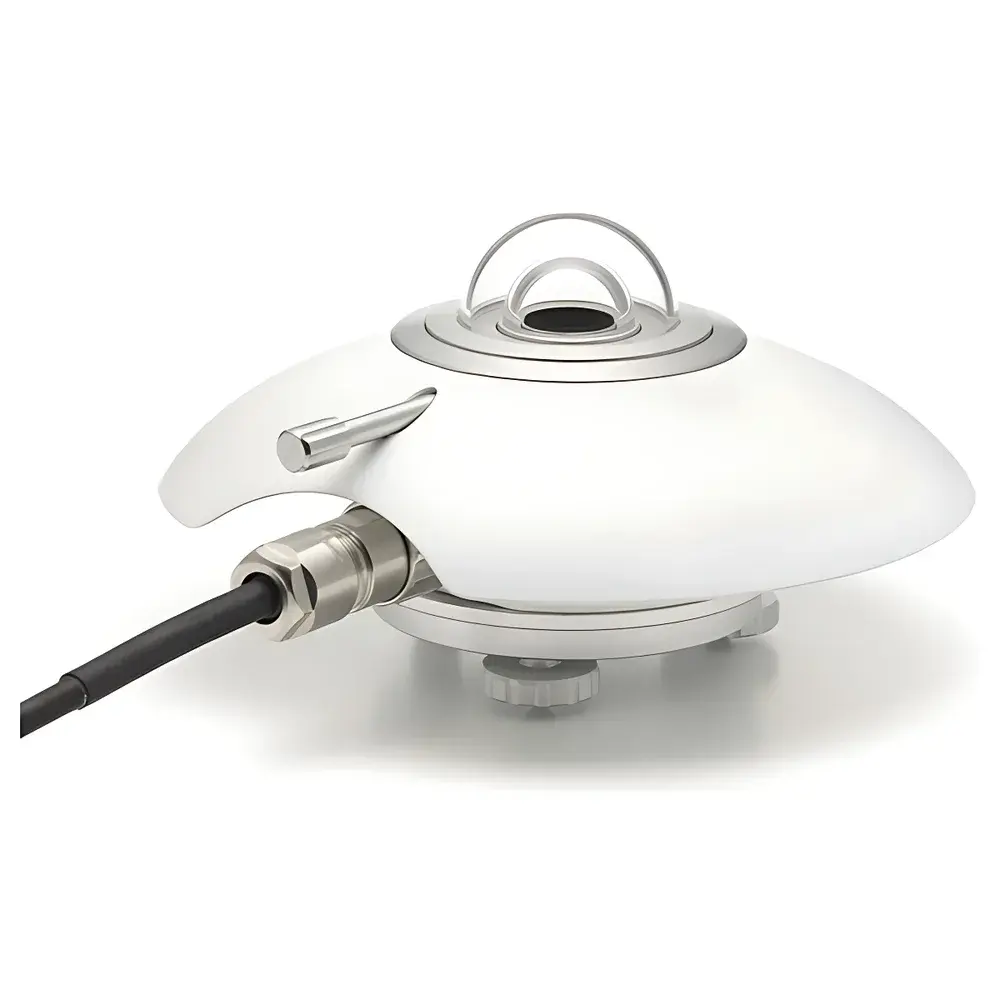
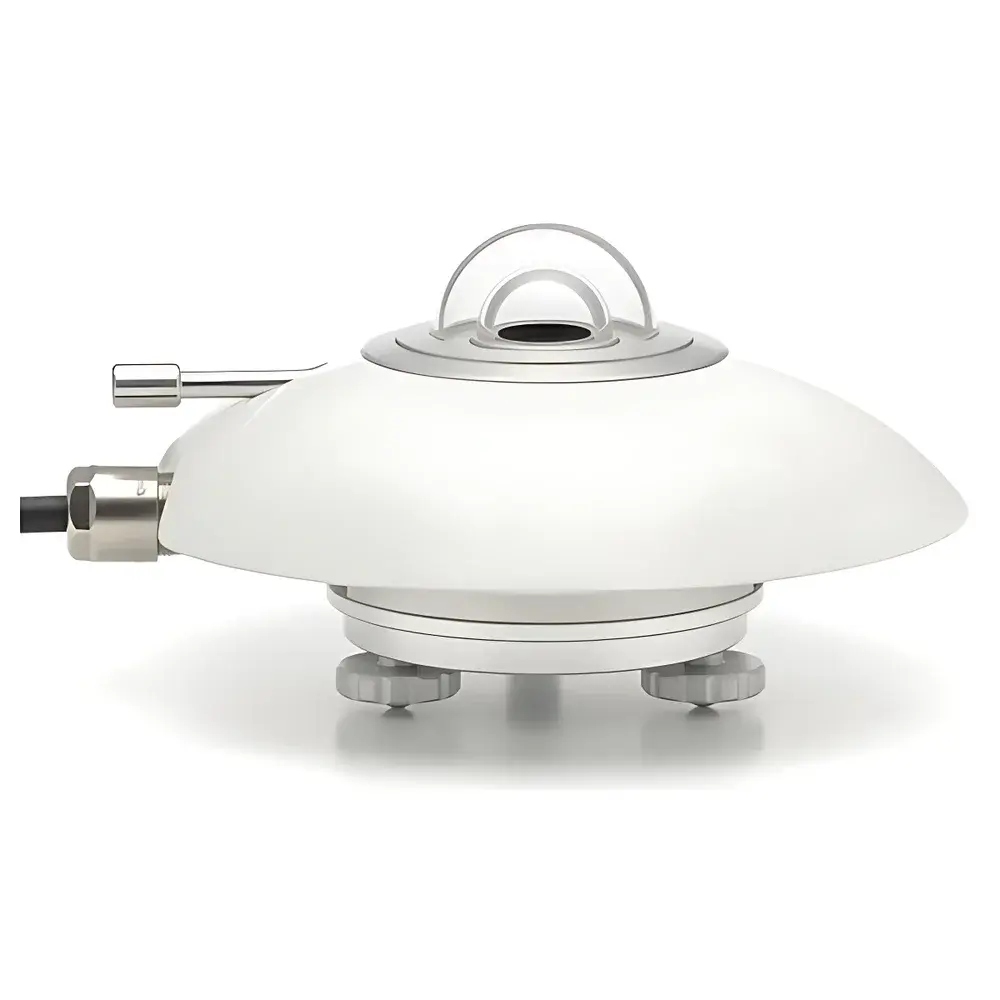
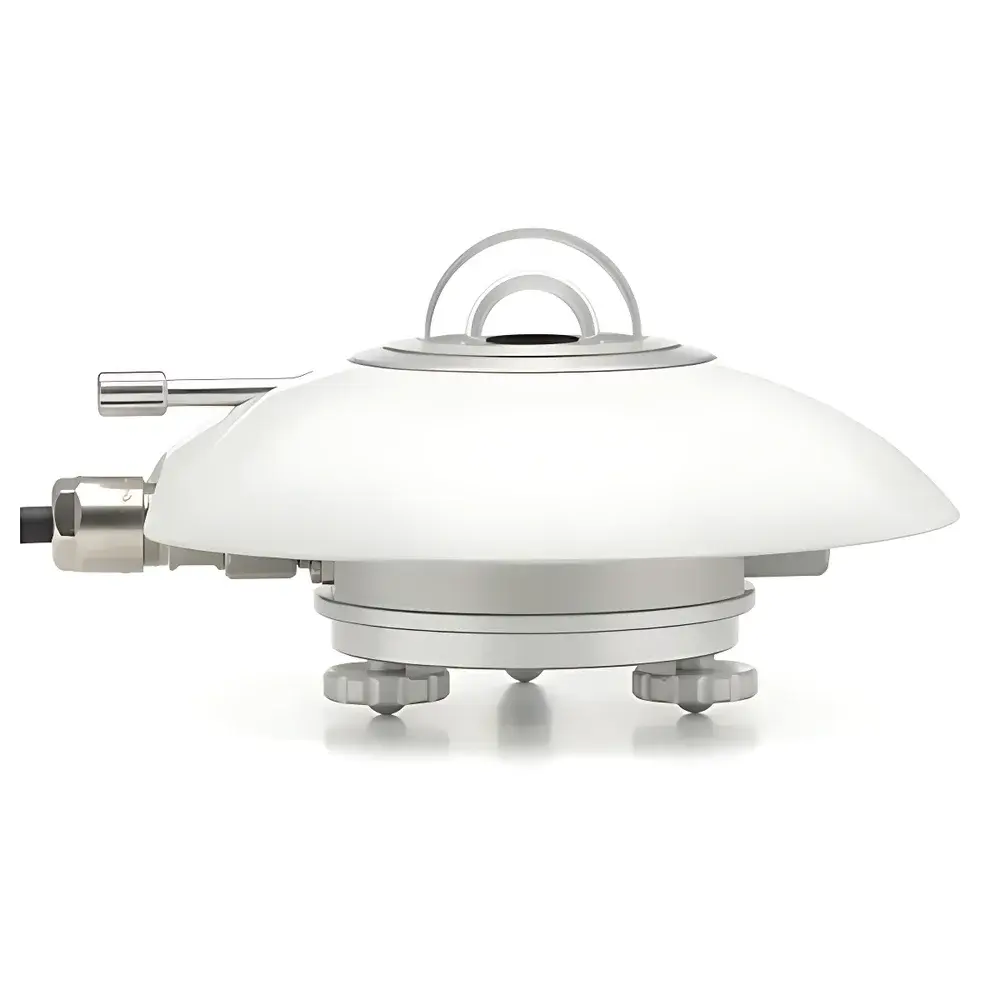
Hukseflux SR20-D2 Secondary Standard Pyranometer
| Brand | Hukseflux |
|---|---|
| Origin | Netherlands |
| Model | SR20-D2 |
| ISO 9060 Classification | Secondary Standard |
| Calibration Uncertainty | < 1.2 % (k = 2) |
| Zero Offset a | < 5 W/m² (unventilated), 2.5 W/m² (ventilated) |
| Traceability | World Radiometric Reference (WRR) |
| Measurement Range | 0–4000 W/m² |
| Spectral Range | 285–3000 nm |
| Field of View | 180° (hemispherical) |
| Operating Temperature | −40 to +80 °C |
| Temperature Response | < ±0.4 % (−30 to +50 °C, corrected in data processing) |
| Digital Output | RS-485 Modbus RTU |
| Analog Output | 4–20 mA (0–1600 W/m² range) |
| Supply Voltage | 5–30 VDC |
| Power Consumption | < 75 mW @ 12 VDC (digital), < 40 mW @ 12 VDC (analog, with 100 Ω shunt) |
| Cable Length | 5 m (standard) |
| Compliance | ISO 9060:2018, IEC 61724-1:2021 (PV monitoring), WMO Guide to Instruments and Methods of Observation |
Overview
The Hukseflux SR20-D2 is a secondary standard pyranometer engineered for high-accuracy hemispherical solar irradiance measurement in demanding environmental and industrial applications. Designed and manufactured in the Netherlands, it complies fully with ISO 9060:2018 classification requirements for secondary standard instruments—representing the highest tier of performance among commercially available thermopile-based pyranometers below primary standard class. Its core sensing principle relies on a precision thermopile detector mounted beneath a dual-dome quartz optical system, enabling spectral response from 285 nm to 3000 nm and near-perfect cosine correction across its 180° field of view. Unlike lower-tier instruments, the SR20-D2 undergoes individual characterization for both temperature response and directional (cosine) error, with traceable calibration reports provided for each unit against the World Radiometric Reference (WRR). This ensures metrological integrity for long-term monitoring campaigns where inter-instrument comparability and data continuity are critical—particularly in photovoltaic (PV) performance ratio analysis, climate network benchmarking, and scientific atmospheric research.
Key Features
- Secondary standard classification per ISO 9060:2018, verified by individual temperature and directional response test reports
- Low zero offset: < 5 W/m² (unventilated), reduced to < 2.5 W/m² when used with optional VU01 ventilator
- Calibration uncertainty < 1.2 % (k = 2), traceable to WRR via accredited laboratories
- Dual-output architecture: simultaneous RS-485 Modbus RTU digital output and 4–20 mA analog output (0–1600 W/m² range)
- Onboard temperature compensation using a second-order polynomial algorithm, correcting for thermal drift across −30 to +50 °C
- Robust thermal design enabling stable operation from −40 to +80 °C without heater—ideal for polar, alpine, and desert deployments
- User-accessible non-volatile memory registers storing calibration sensitivity, recalibration history, and instrument temperature
- Low power consumption (< 75 mW at 12 VDC), compatible with solar-powered remote stations and battery-operated telemetry systems
Sample Compatibility & Compliance
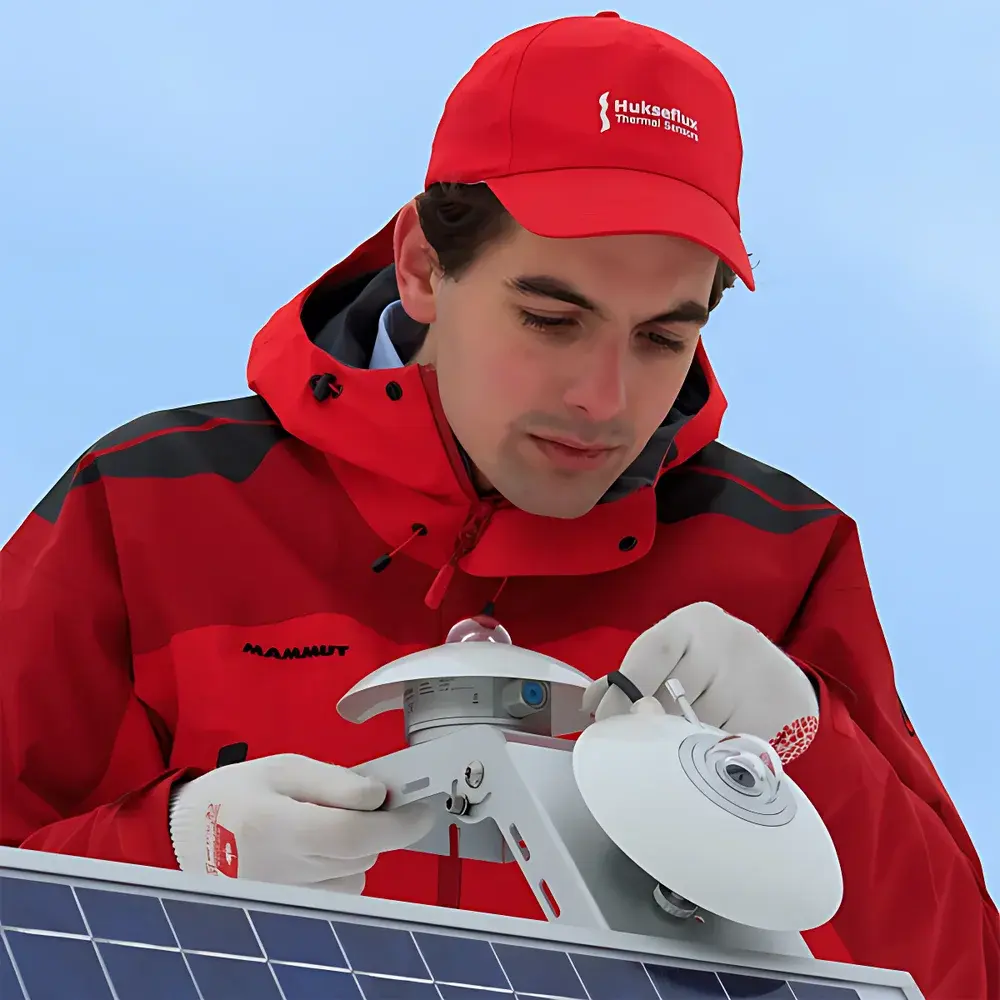
The SR20-D2 is optimized for outdoor, unshaded mounting on horizontal or tilted planes, conforming to WMO and BSRN installation guidelines. It meets IEC 61724-1:2021 requirements for PV system monitoring and supports GLP-compliant data acquisition workflows. Its WRR-traceable calibration satisfies audit requirements under ISO/IEC 17025 and aligns with uncertainty evaluation frameworks described in the Joint Committee for Guides in Metrology (JCGM) 100:2008 (GUM). Directional response testing ensures compliance with cosine error limits defined in ISO 9060:2018 Annex C. Optional VU01 ventilation minimizes dew/frost accumulation and suppresses thermal zero offsets—critical for high-humidity or sub-zero environments. No internal heater is included; thermal stability is achieved through passive design and algorithmic correction, eliminating heater-induced measurement artifacts.
Software & Data Management
The SR20-D2 integrates seamlessly into SCADA, PLC, and cloud-based monitoring platforms via Modbus RTU over RS-485. All operational parameters—including real-time irradiance (W/m²), detector temperature (°C), sensitivity factor, and calibration date—are accessible as discrete holding registers. Users may perform remote recalibration verification or initiate self-diagnostic routines using standard Modbus function codes. Hukseflux provides an Excel-based uncertainty calculator aligned with GUM methodology, allowing users to quantify combined standard uncertainty for site-specific conditions (e.g., tilt angle, soiling, thermal environment). Firmware updates and configuration changes are supported via serial interface without hardware modification. Data logs comply with FDA 21 CFR Part 11 requirements when deployed within validated systems that implement electronic signatures and audit trails.
Applications
- Photovoltaic plant performance monitoring and performance ratio (PR) calculation per IEC 61724-1
- Reference station deployment in national radiation monitoring networks (e.g., BSRN, GAW)
- Benchmarking and intercomparison studies requiring secondary-standard-grade reference instrumentation
- Long-term climatological observation in extreme environments—Arctic, Antarctic, Saharan, and high-altitude sites
- Calibration transfer and field validation of lower-class pyranometers and reference cells
- Research-grade solar resource assessment for CSP and PV feasibility studies
FAQ
What is the recommended recalibration interval?
The manufacturer recommends recalibration every 2 years. Each unit stores full calibration history in user-accessible registers, enabling traceability and local recalibration by accredited service providers.
Can the SR20-D2 be used without ventilation?
Yes—it operates reliably without ventilation, though zero offset increases slightly (< 5 W/m²). For applications requiring lowest possible thermal offset—especially in humid or freezing conditions—the VU01 ventilator is strongly advised.
Is the 4–20 mA output linear across the full 0–4000 W/m² range?
No—the analog output is scaled to 0–1600 W/m² to maximize resolution in the typical operational range of most solar installations; the digital output retains full 0–4000 W/m² capability.
Does the instrument support Modbus TCP?
No—only RS-485 physical layer with Modbus RTU protocol is implemented. Integration with Ethernet-based systems requires an RS-485-to-TCP gateway.
How is temperature compensation applied?
A second-order polynomial correction is executed onboard using real-time thermistor readings; coefficients are stored per unit and applied automatically to raw thermopile voltage before irradiance conversion.







