
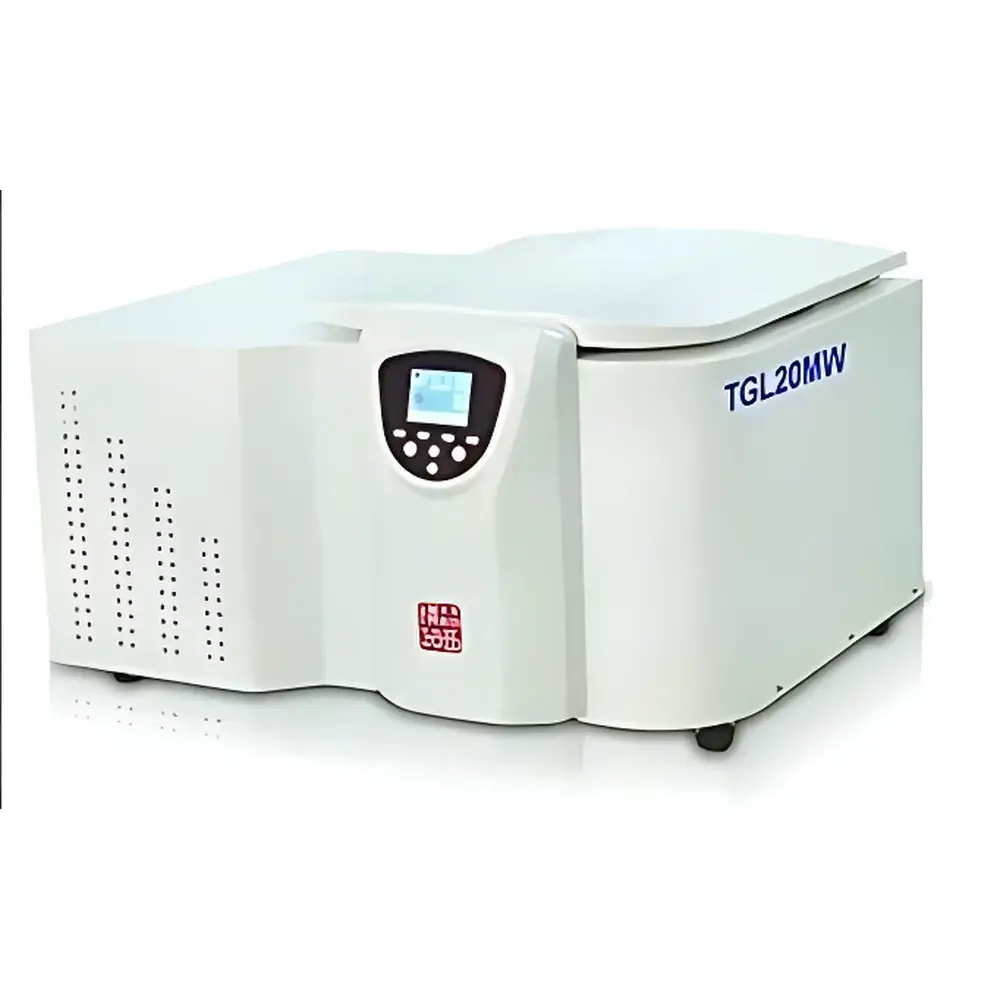
Hunan-made TDL8M Low-Speed Refrigerated Centrifuge
| Origin | Hunan, China |
|---|---|
| Manufacturer Type | Authorized Distributor |
| Product Origin | Domestic (China) |
| Model | TDL8M |
| Max Speed | 8000 rpm |
| Max RCF | 5940 ×g |
| Max Capacity | 4 × 300 mL |
| Temperature Range | −20 °C to +40 °C |
| Temp. Accuracy | ±1 °C |
| Acceleration/Deceleration | 10 selectable rates |
| Noise Level | ≤65 dB(A) |
| Dimensions (W×D×H) | 630 × 760 × 400 mm |
| Weight | 110 kg |
| Power | 1.8 kW |
| Timer Range | 0–99 h 59 min |
| Drive System | AC brushless frequency-converter motor |
| Rotor Lock | Electromechanical silent door lock |
| Display | TFT color touchscreen with dual touch/keypad operation |
Overview
The Hunan-made TDL8M Low-Speed Refrigerated Centrifuge is a robust, microprocessor-controlled laboratory centrifuge engineered for high-reliability separation of temperature-sensitive biological and clinical samples. Designed around the principles of sedimentation kinetics under controlled low-speed rotational fields, it operates within the critical 0–8000 rpm range—optimized for pelleting cells, organelles, macromolecular complexes, and large-volume clinical specimens without inducing shear-induced denaturation or thermal degradation. Its integrated refrigeration system—featuring a fluorine-free compressor—maintains precise chamber temperatures from −20 °C to +40 °C, enabling consistent sample integrity across extended runs. The unit complies with IEC 61010-1 safety standards for laboratory electrical equipment and incorporates structural safeguards including triple-layer steel rotor containment, stainless-steel centrifuge chamber, and dynamic imbalance detection with automatic shutdown.
Key Features
- TFT full-color touchscreen interface with intuitive dual-mode control (touch + physical keypad), supporting real-time parameter monitoring and rapid protocol recall.
- Brushless AC frequency-converter motor delivering high torque at low speeds, coupled with proprietary composite vibration-damping architecture for stable operation even at maximum load.
- Standby pre-cooling function: initiates refrigeration while the rotor remains stationary, reducing time-to-target temperature by up to 40% compared to conventional start-up sequences.
- 20 programmable run protocols with independent acceleration/deceleration profiles (10-step grading); supports RCF-based startup for method reproducibility across instruments.
- Electromechanical silent door lock ensures secure lid engagement and seamless integration into GLP-compliant workflows requiring audit-ready mechanical interlocks.
- Full-steel frame construction with electropolished 304 stainless-steel rotor chamber resists corrosion from repeated decontamination cycles using ethanol, sodium hypochlorite, or hydrogen peroxide vapor.
Sample Compatibility & Compliance
The TDL8M accommodates a broad spectrum of sample formats—including whole blood, plasma, serum, tissue homogenates, bacterial cultures, plant extracts, and food suspensions—via interchangeable horizontal and angular rotors. Certified compatibility includes 4 × 300 mL buckets, 4 × 100 mL tubes, 32 × 15 mL conical tubes, 48–76 × vacuum blood collection tubes (5/2 mL), and 2 × 96-well microplate carriers. All rotor configurations are validated for use under ISO 22870:2016 (point-of-care testing) and align with CLSI EP05-A3 guidelines for centrifuge performance verification. The system meets essential requirements for ISO 13485-certified medical device manufacturing environments and supports traceable calibration per ISO/IEC 17025 when paired with accredited third-party service providers.
Software & Data Management
While the TDL8M operates as a standalone instrument with embedded firmware, its operational logs—including run ID, timestamp, rotor ID, speed, RCF, temperature, duration, and fault codes—are stored internally for ≥10,000 cycles with non-volatile memory retention. Optional RS-232/USB data export enables integration with LIMS platforms or custom QC dashboards. Audit trail functionality satisfies basic FDA 21 CFR Part 11 readiness when deployed in conjunction with institutional electronic signature policies and networked user authentication systems. Firmware updates are delivered via encrypted USB key to preserve data integrity and regulatory continuity.
Applications
This centrifuge serves core workflows in clinical diagnostics (e.g., serum/plasma separation prior to immunoassay or clinical chemistry analysis), biopharmaceutical process development (clarification of mammalian cell culture harvests), academic life sciences (isolation of nuclei, mitochondria, or ribosomes), agricultural research (extraction of starch granules or seed oil emulsions), and food safety testing (pathogen concentration from liquid matrices). Its 300 mL capacity per bucket supports batch processing of pooled donor samples in blood bank settings, while its −20 °C capability enables cryoprecipitate recovery and cold-active enzyme stabilization during preparative runs.
FAQ
What is the minimum operating temperature and how quickly does the chamber reach −20 °C?
The refrigeration system achieves −20 °C within 22 minutes from ambient (25 °C) under no-load conditions; pre-cooling while stationary reduces thermal lag significantly.
Is rotor balancing required manually before each run?
No—integrated dynamic imbalance sensors automatically detect mass asymmetry exceeding ±5 g and halt acceleration prior to unsafe operation.
Can this centrifuge be used for regulatory submissions under GLP or GMP?
Yes—when operated with documented maintenance records, calibrated temperature/speed verification, and user access controls, it fulfills foundational instrumentation requirements for GLP audits and early-phase GMP process validation.
Are rotor certifications provided with each unit?
Each rotor carries a serialized test certificate confirming burst speed validation at 1.5× maximum rated speed per ISO 15841:2021, included in the shipping documentation package.
Does the system support remote monitoring or IoT connectivity?
Not natively—but analog voltage outputs (0–10 V) for speed and temperature are available via optional I/O module for integration into building management or centralized lab automation systems.



