
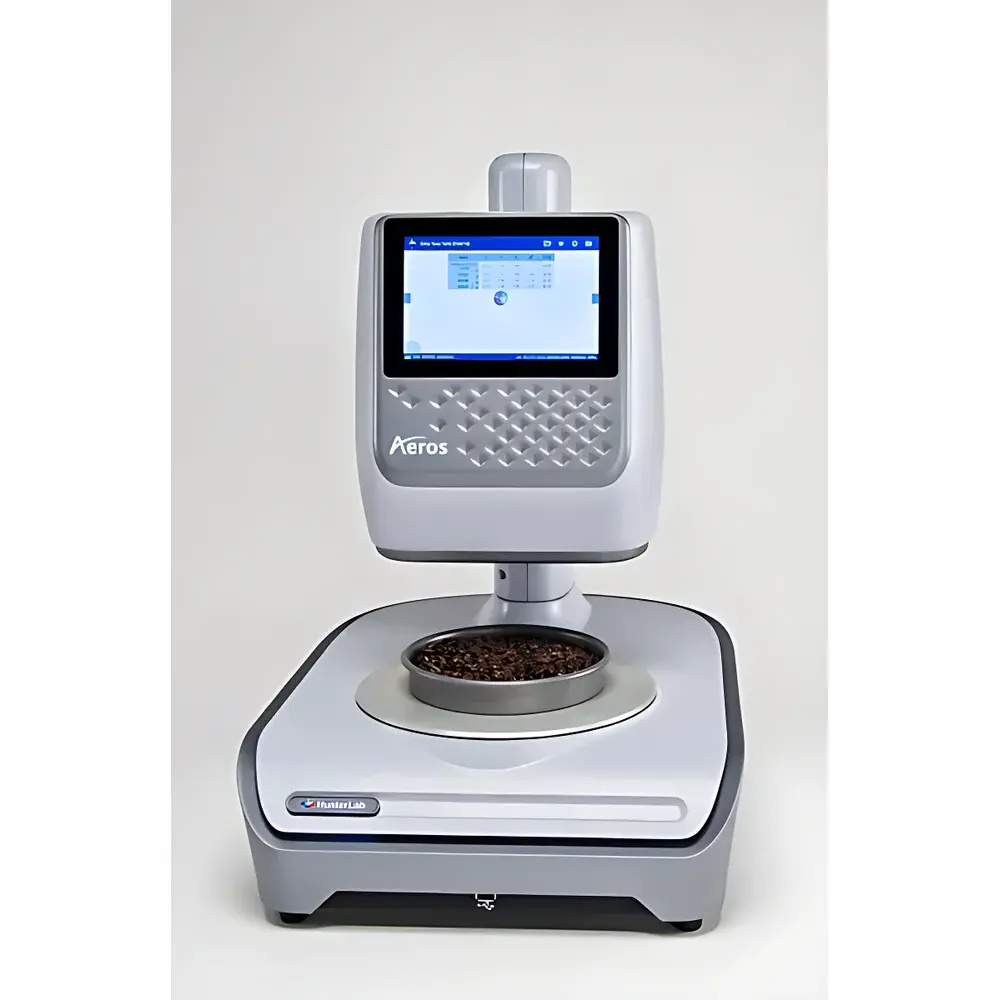
HunterLab Aeros Non-Contact Spectrophotometer
| Brand | HunterLab |
|---|---|
| Origin | USA |
| Model | Aeros |
| Instrument Type | Benchtop |
| Light Source | Full-Spectrum LED Array |
| Spectral Range | 400 nm – 700 nm |
| Repeatability | ∆E* < 0.025 CIE L*a*b* (max, 30 measurements on white tile) |
| Measurement Area | 177.25 cm² (φ15 cm) |
| Sample Height Range | 65 mm – 140 mm |
| Rotation Speed | 12 rpm |
| Measurement Time per Revolution | 5 s |
| Spectral Resolution | < 3 nm |
| Effective Bandwidth | 10 nm |
| Photometric Range | 0–150 % |
| Inter-Instrument Agreement | ∆E* < 0.30 CIE L*a*b* (avg, CCSII tile) |
| Data Storage Capacity | 500,000 measurements |
| Display | 7″ HD Touchscreen (1280 × 800) |
| Power Supply | 100–240 VAC, 47–63 Hz / 24 VDC (90 W) |
| Dimensions (L×W×H) | 38 × 51 × 56 cm |
| Weight | 23 kg |
Overview
The HunterLab Aeros Non-Contact Spectrophotometer is a benchtop, dual-beam spectrophotometric color measurement system engineered for high-precision, operator-independent analysis of heterogeneous, textured, and irregularly shaped samples. Unlike contact-based integrating sphere or 45°/0° geometry instruments, the Aeros employs a non-contact optical architecture with synchronized sample rotation and dynamic probe height adjustment—enabling consistent illumination and detection geometry across variable surface topographies. Its core optical engine integrates a 256-element diode array detector coupled with a high-resolution concave holographic grating, delivering spectral data at 10 nm reporting intervals across the full visible spectrum (400–700 nm). The full-spectrum LED light source provides stable, NIST-traceable irradiance without UV-induced degradation or thermal drift, ensuring long-term photometric integrity over its rated 5-year operational lifetime.
Key Features
- Auto-height positioning: Real-time vertical probe adjustment (0.1 mm resolution) compensates for sample height variations from 65 mm to 140 mm—eliminating manual leveling and reducing operator-induced measurement bias.
- Rotating sample stage: Motorized turntable rotates at 12 rpm, acquiring 35 spectral scans per revolution (7 Hz sampling rate) to compute spatially averaged color values—critical for particulate, granular, or structurally non-uniform materials.
- Large-area measurement aperture: φ15 cm (177.25 cm²) field-of-view enables representative sampling of bulk materials such as coffee beans, plastic pellets, color masterbatches, and textured food products where small-spot devices yield statistically insufficient data.
- Full-spectrum LED illumination: Stable, cool-running, and spectrally uniform light source compliant with CIE illuminants A, C, D50, D55, D65, D75, F02, F07, F11, TL84, ULT30, and ULT35—switchable via software with 2° and 10° standard observer settings.
- High-fidelity touchscreen interface: 7″ capacitive HD display (1280 × 800) supports intuitive gesture-based navigation, real-time spectral visualization, and one-touch measurement execution—designed for glove-compatible operation in QC laboratories.
- Robust connectivity suite: Dual USB ports (for barcode scanners, printers, or HID peripherals), Gigabit Ethernet (RJ45), and native support for LIMS/SPC integration via HTTP POST, FTP, or direct database push—fully compatible with FDA 21 CFR Part 11 audit trail requirements when deployed with HunterLab’s optional compliance software package.
Sample Compatibility & Compliance
The Aeros accommodates physically challenging samples that cannot be flattened, pressed, or homogenized—including roasted coffee beans, extruded polymer granules, ground spices, ceramic powders, and molded elastomers with surface relief. Its non-contact design avoids contamination, compression artifacts, or gloss-related specular errors associated with contact probes. All spectral data comply with ISO 11664 (CIE colorimetry standards), ASTM E308 (computing color coordinates from spectral data), and ISO/DIS 13655 (spectral measurement geometry definitions). Instrument inter-comparability is validated against the CCSII color standard set, meeting the ≤0.30 ∆E* (CIE L*a*b*) instrument agreement threshold specified in ASTM D2244 and ISO 13655 Annex B. Optional IQ/OQ documentation packages support GLP and GMP-regulated environments.
Software & Data Management
Aeros operates on HunterLab’s proprietary EasyMatch QC software platform, supporting multi-language UI (English default), customizable pass/fail tolerancing, and automated report generation in PDF, CSV, or XML formats. Data views include EZ View (real-time delta-E trend), spectral overlay comparison, Lab distribution scatter plots, and time-series tracking. Up to 500,000 measurements are stored onboard with timestamp, operator ID, instrument serial number, and environmental metadata (ambient temperature/humidity if external sensors are connected). Secure remote access is enabled via HTTPS-enabled web server mode; all network transactions support TLS 1.2 encryption. Audit trails record user actions, parameter changes, calibration events, and data exports—fully traceable for regulatory review under 21 CFR Part 11 when configured with electronic signatures and role-based access control.
Applications
The Aeros serves as a primary color verification tool in industries requiring statistical confidence across variable substrates: food & beverage (coffee, chocolate, dairy powders), plastics & polymers (recycled flake, injection-molded parts), pharmaceuticals (coated tablets, excipient batches), paints & coatings (metallic flakes, textured finishes), and textiles (yarn bundles, nonwoven mats). Its ability to quantify whiteness (E313, D1925, 457 nm), yellowness index, baking contrast units (BCU), HCCI, and SCCA—alongside full CIE L*a*b*, LCh, Yxy, and XYZ outputs—supports both internal quality gates and customer-facing specification compliance (e.g., Pantone Matching System® correlation, RAL tolerance bands). The system is routinely deployed in incoming raw material inspection, in-process blend verification, and final product release testing.
FAQ
Does the Aeros require annual recalibration?
No—HunterLab calibrates each unit at the factory using NIST-traceable standards. However, daily verification with the included certified white tile is recommended per ISO 9001 and ASTM E2539. Optional annual performance qualification (PQ) services are available.
Can the Aeros measure metallic or pearlescent samples?
It does not support multi-angle gonio-spectrophotometry; therefore, it reports only diffuse+specular-excluded (SCE) reflectance. For effect pigments, use in conjunction with a dedicated gonio-instrument is advised.
Is the rotating stage compatible with custom fixtures?
Yes—the φ30.4 cm stage accepts third-party retention rings and clamping plates (M4 threaded inserts provided); dimensional drawings and mounting templates are supplied upon request.
What spectral data export formats are supported?
ASCII (.txt), CSV (.csv), XML (.xml), and binary .spc files—all including wavelength, reflectance %, and metadata headers compliant with ASTM E2539 and ISO 15752.
How is data security maintained during network transmission?
All Ethernet communications use TLS 1.2 encryption; local storage employs AES-256 file-level encryption when enabled via administrative password. Audit logs capture all data export events with user context and timestamp.




