
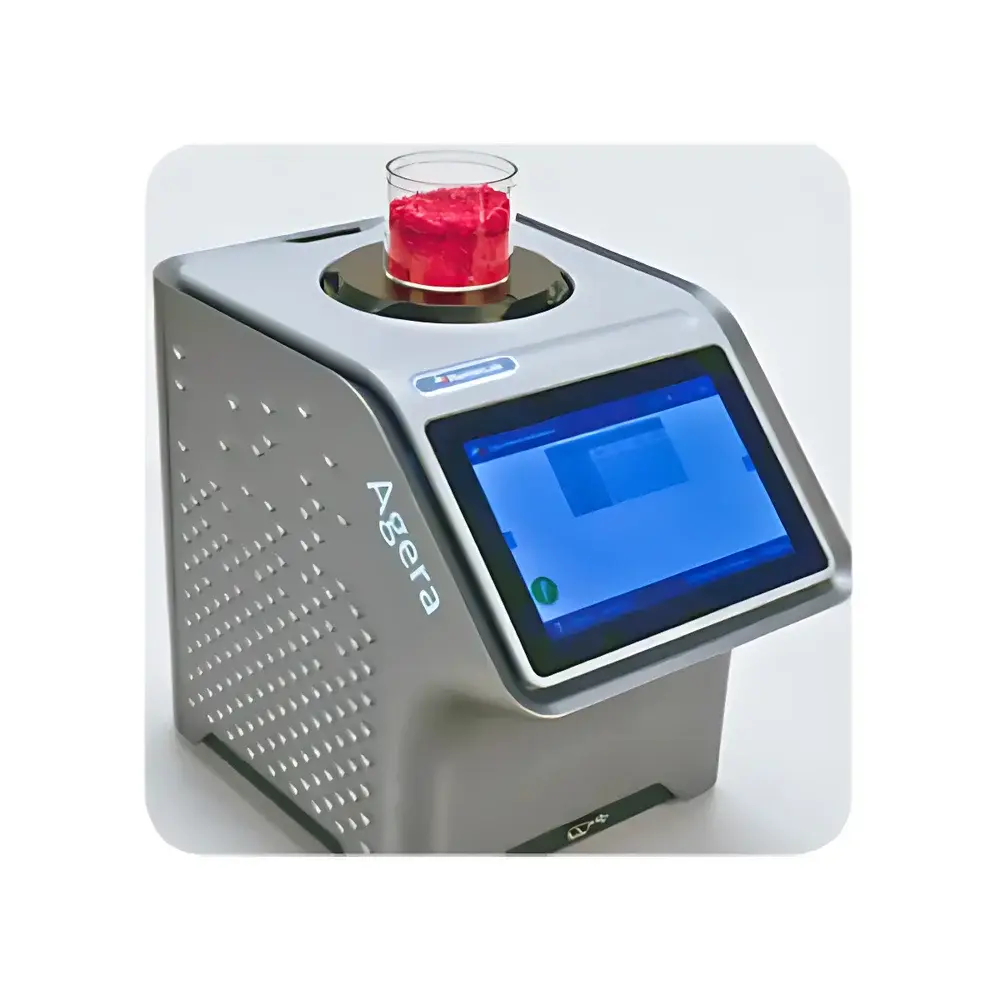
HunterLab Agera AGR Benchtop Spectrophotometer
| Brand | HunterLab |
|---|---|
| Origin | USA |
| Model | AGR |
| Product Type | Benchtop Spectrophotometer |
| Instrument Category | Color Measurement Instrument |
| Optical Geometry | 0°/45° annular illumination (15-point fiber optic averaging) |
| Light Source | Full-spectrum LED (360–700 nm) with UV control |
| Spectral Range | 360–700 nm |
| Repeatability | ΔE₀₀ < 0.03 CIELAB (max) |
| Gloss Measurement | 60° geometry, compliant with ASTM D523, ISO 2813, ASTM D2457 |
| Image Capture | Integrated 5 MP camera at 45° |
| Display | 7″ 1280×800 industrial capacitive touchscreen |
| Software | Embedded EasyMatch Essentials QC software with optional 21 CFR Part 11 electronic signature |
| Calibration Standards | NIST-traceable white tile, green tile with certified values, black glass gloss standard (ASTM/ISO traceable) |
| Aperture Options | XL (51 mm), L (25.4 mm), M (16.9 mm), custom 30 mm |
| Power Supply | 100–240 VAC |
Overview
The HunterLab Agera AGR is a high-precision benchtop spectrophotometer engineered for comprehensive color, gloss, and surface appearance evaluation in quality-critical manufacturing environments. Built upon HunterLab’s foundational expertise in CIELAB color space development and ASTM-compliant yellow index (YI) metrology, the Agera implements a rigorously validated 0°/45° annular optical geometry—designed to replicate human visual perception under standardized viewing conditions. Unlike diffuse 8°/d or d/8 instruments, the Agera’s 15-fiber-optic ring receiver captures reflected light from 360° around the measurement area, enabling robust compensation for surface texture, particle orientation, micro-roughness, and structural heterogeneity commonly encountered in granular, flaked, or molded polymer samples. Its sealed optical path integrates a 256-element diode array detector and a high-resolution concave holographic grating, delivering stable spectral data across the full 360–700 nm range. The instrument employs full-spectrum LED illumination calibrated to CIE Illuminant D65 spectral power distribution—including precise UV component control—to ensure accurate quantification of fluorescent whitening agents (FWAs), optical brighteners, and UV-reactive pigments per ASTM E308 and ASTM E2539.
Key Features
- 0°/45° annular optical geometry with 15-point fiber optic averaging for texture-invariant color measurement—validated against ASTM D6290 (45–52 mm aperture compliance)
- Simultaneous color and 60° gloss measurement in a single operation, with gloss calibration traceable to NIST and certified per ASTM D523 and ISO 2813
- Integrated 5-megapixel imaging system at 45° incidence, providing real-time sample positioning verification and archived RGB image capture with histogram-based analysis
- UV-controllable full-spectrum LED source (360–700 nm) with factory-calibrated UV output and user-definable UV reference standards for fluorescence quantification
- 7-inch industrial capacitive touchscreen interface running embedded EasyMatch Essentials QC software—no external PC required for routine operation
- Triple-aperture configuration (XL: 51 mm, L: 25.4 mm, M: 16.9 mm) optimized for particulates, pellets, films, and irregular solids; XL aperture delivers superior signal-to-noise ratio for low-contrast samples
- Fanless, filterless thermal design ensures silent operation, minimal maintenance, and long-term photometric stability in production-floor environments
- Double-beam optical architecture with automatic dual-reference correction (white + black) for enhanced baseline stability and drift resistance over time
Sample Compatibility & Compliance
The Agera accommodates diverse physical forms—powders, granules, flakes, injection-molded parts, extruded sheets, and opaque plastics—without requiring specialized holders in most cases. Its upward- and forward-facing aperture layout enables rapid loading of bulk materials and irregular geometries. The instrument meets or exceeds requirements of ASTM D1925 (Yellowness Index), ASTM E313 (Whiteness/Yellowness), ASTM D6290 (plastic pellet measurement), HG/T 3862–2006 (Chinese industrial standard for plastic yellowness), and ISO 11664–4 (CIE colorimetry). All calibration tiles are supplied with NIST-traceable certification documents—not manufacturer-generated values—ensuring metrological integrity for GLP/GMP audits. Optional accessories include particle detection upgrade kits, robotic sample handling interfaces, and transparent sample measurement modules compliant with ASTM D1003.
Software & Data Management
Embedded EasyMatch Essentials provides full spectral data acquisition, color difference (ΔE₀₀, ΔEₐb, ΔE₉₄), YI (D1925/E313), whiteness, opacity, and custom index calculation. Workflow templates support multi-stage QC protocols, pass/fail tolerancing, and statistical process control (SPC) charting. Data export is supported via USB drive, Ethernet, Wi-Fi, Bluetooth, and SMTP email—each transmission logged with timestamp, operator ID, and instrument serial number. Optional EZMQC Windows-based software extends functionality with advanced reporting, database integration (ODBC), and FDA 21 CFR Part 11-compliant electronic signatures, including audit trail, role-based access control, and biometric or token-based authentication. HunterLab Remote Service allows secure, encrypted technician access for diagnostics, firmware updates, and remote training—fully auditable and compliant with ITAR and ISO/IEC 27001 information security guidelines.
Applications
The Agera serves as a primary metrology platform in polymer compounding (PTA, PP, PE, PET, ABS, POM), pigment manufacturing (titanium dioxide, carbon black), pharmaceutical excipient release testing, food-grade packaging validation, and specialty chemical R&D. Its ability to decouple color variation from surface effects makes it indispensable for troubleshooting batch-to-batch inconsistencies arising from crystallinity shifts, additive migration, or thermal degradation. In regulatory contexts, its traceable calibration, documented uncertainty budgets, and Part 11-ready software enable direct use in FDA-submitted stability studies, EU Annex 11-compliant processes, and ISO 9001-certified quality systems. The integrated imaging module further supports defect correlation—linking discoloration events to localized contamination, oxidation zones, or mold-line artifacts.
FAQ
Does the Agera comply with FDA 21 CFR Part 11 for electronic records and signatures?
Yes—when configured with optional EZMQC e-signature software, the system provides full Part 11 functionality including audit trails, electronic signatures with identity verification, and secure record retention.
What standards does the 60° gloss measurement adhere to?
Gloss measurement conforms to ASTM D523, ISO 2813, and ASTM D2457, with calibration standards certified by an ISO/IEC 17025-accredited laboratory.
Can the Agera measure fluorescent or optically brightened samples?
Yes—the UV-controllable LED source and spectral acquisition down to 360 nm enable quantitative fluorescence correction per ASTM E308 and E2539 methodologies.
Is NIST-traceable calibration provided with the instrument?
All standard calibration tiles (white, green, black glass) ship with NIST-traceable certificates of calibration, including spectral reflectance data and uncertainty statements.
How is sample heterogeneity addressed during measurement?
The 0°/45° annular geometry with 15-point spatial averaging inherently mitigates bias from particle orientation, surface roughness, and local reflectance variance—eliminating need for manual rotation or multiple readings.



